







Question: Question 3 : ( 2 5 points ) Consider a signalling game between a government in control of monetary and fiscal policy, and the public
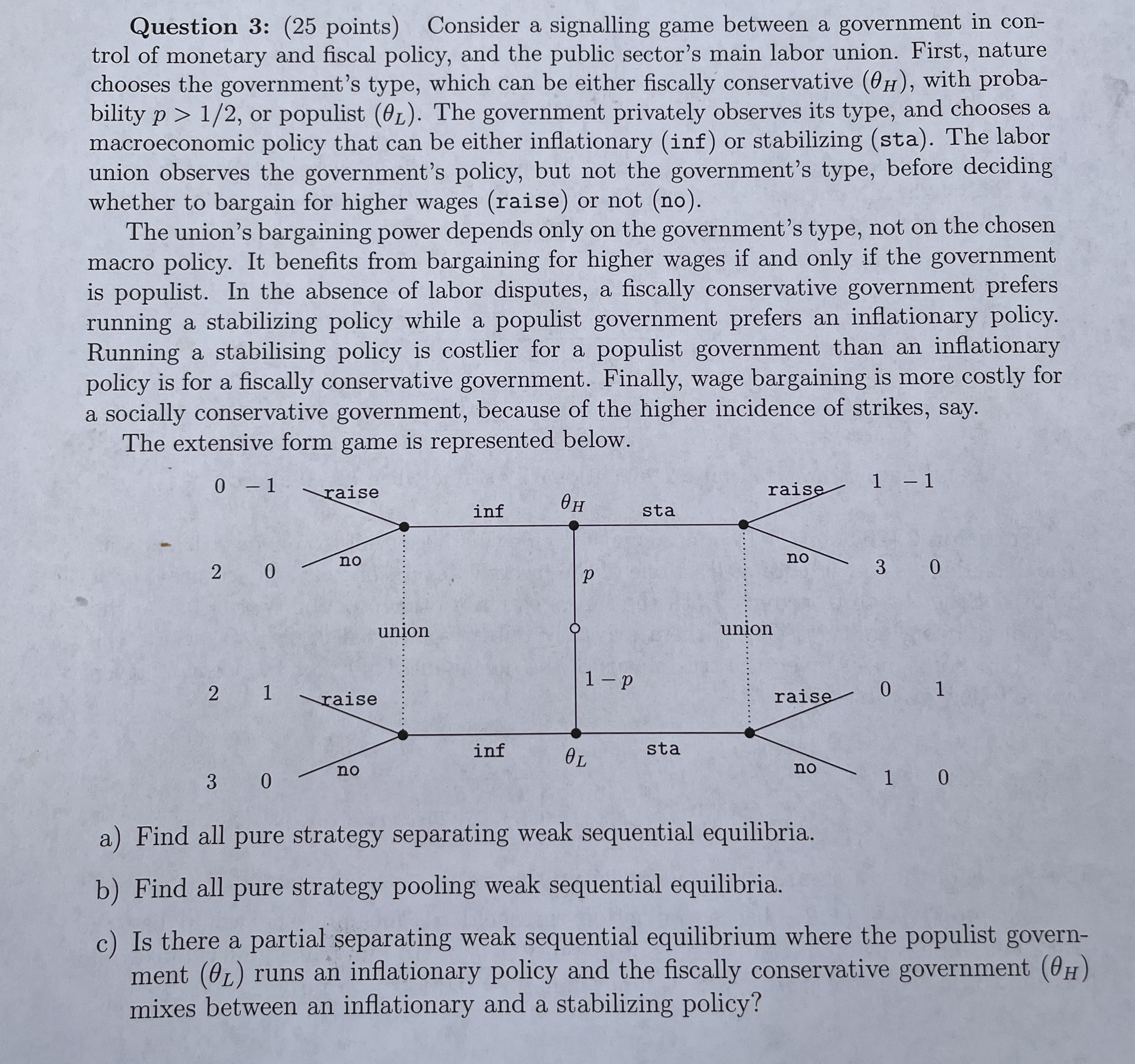
Question : points Consider a signalling game between a government in control of monetary and fiscal policy, and the public sectors main labor union. First, nature chooses the government's type, which can be either fiscally conservative with probability or populist The government privately observes its type, and chooses a macroeconomic policy that can be either inflationary inf or stabilizing sta The labor union observes the government's policy, but not the government's type, before deciding whether to bargain for higher wages raise or not no
The union's bargaining power depends only on the government's type, not on the chosen macro policy. It benefits from bargaining for higher wages if and only if the government is populist. In the absence of labor disputes, a fiscally conservative government prefers running a stabilizing policy while a populist government prefers an inflationary policy. Running a stabilising policy is costlier for a populist government than an inflationary policy is for a fiscally conservative government. Finally, wage bargaining is more costly for a socially conservative government, because of the higher incidence of strikes, say.
The extensive form game is represented in the image.
a Find all pure strategy separating weak sequential equilibria.
b Find all pure strategy pooling weak sequential equilibria.
c Is there a partial separating weak sequential equilibrium where the populist government runs an inflationary policy and the fiscally conservative government mixes between an inflationary and a stabilizing policy?
Step by Step Solution
There are 3 Steps involved in it
1 Expert Approved Answer
Step: 1 Unlock

Question Has Been Solved by an Expert!
Get step-by-step solutions from verified subject matter experts
Step: 2 Unlock
Step: 3 Unlock
 Study Help