







Question: Question 3 - 23 marks a) A simple model that describes both pseudoplastic and dilatant behavior is the power-law model (Eq. 1.3N from the lecture
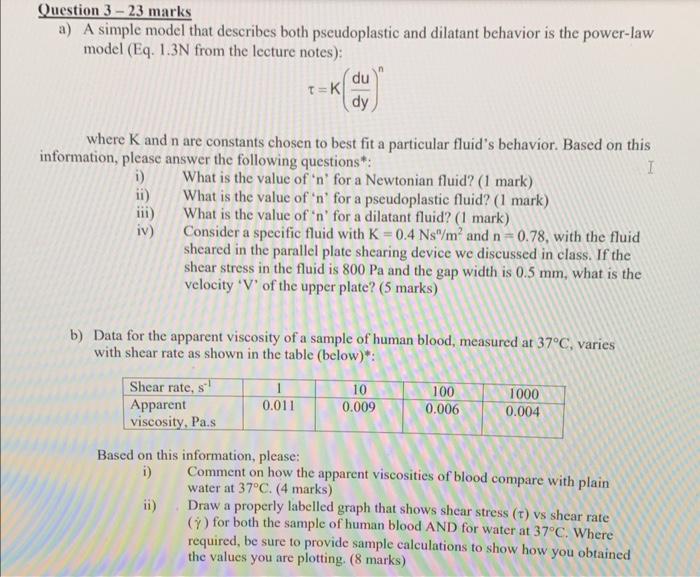

Question 3 - 23 marks a) A simple model that describes both pseudoplastic and dilatant behavior is the power-law model (Eq. 1.3N from the lecture notes): =K(dydu)n where K and n are constants chosen to best fit a particular fluid's behavior. Based on this information, please answer the following questions*: i) What is the value of ' n ' for a Newtonian fluid? (1 mark) ii) What is the value of ' n ' for a pseudoplastic fluid? ( 1 mark) iii) What is the value of ' n ' for a dilatant fluid? ( 1 mark) iv) Consider a specific fluid with K=0.4Nsn/m2 and n=0.78, with the fluid sheared in the parallel plate shearing device we discussed in class. If the shear stress in the fluid is 800Pa and the gap width is 0.5mm, what is the velocity ' V ' of the upper plate? (5 marks) b) Data for the apparent viscosity of a sample of human blood, measured at 37C, varies with shear rate as shown in the table (below)*: Based on this information, please: i) Comment on how the apparent viscosities of blood compare with plain water at 37C. (4 marks) ii) Draw a properly labelled graph that shows shear stress () vs shear rate ( ^ ) for both the sample of human blood AND for water at 37C. Where required, be sure to provide sample calculations to show how you obtained the values you are plotting. ( 8 marks) ii) Based on the rheological models we discussed in class (Newtonian, pseudoplastic, dilatant, Bingham), which model do you think best describes the behaviour of this human blood sample? Use 1-2 sentences to justify/explain your answer. ( 3 marks) Question 3 - 23 marks a) A simple model that describes both pseudoplastic and dilatant behavior is the power-law model (Eq. 1.3N from the lecture notes): =K(dydu)n where K and n are constants chosen to best fit a particular fluid's behavior. Based on this information, please answer the following questions*: i) What is the value of ' n ' for a Newtonian fluid? (1 mark) ii) What is the value of ' n ' for a pseudoplastic fluid? ( 1 mark) iii) What is the value of ' n ' for a dilatant fluid? ( 1 mark) iv) Consider a specific fluid with K=0.4Nsn/m2 and n=0.78, with the fluid sheared in the parallel plate shearing device we discussed in class. If the shear stress in the fluid is 800Pa and the gap width is 0.5mm, what is the velocity ' V ' of the upper plate? (5 marks) b) Data for the apparent viscosity of a sample of human blood, measured at 37C, varies with shear rate as shown in the table (below)*: Based on this information, please: i) Comment on how the apparent viscosities of blood compare with plain water at 37C. (4 marks) ii) Draw a properly labelled graph that shows shear stress () vs shear rate ( ^ ) for both the sample of human blood AND for water at 37C. Where required, be sure to provide sample calculations to show how you obtained the values you are plotting. ( 8 marks) ii) Based on the rheological models we discussed in class (Newtonian, pseudoplastic, dilatant, Bingham), which model do you think best describes the behaviour of this human blood sample? Use 1-2 sentences to justify/explain your answer. ( 3 marks)
Step by Step Solution
There are 3 Steps involved in it

Get step-by-step solutions from verified subject matter experts
 Study Help