







Question: QUESTION 3 : ( 3 0 pts ) Conformation in an Ionic Liquid About the polymer: PEO is hydrophilic, biocompatible and easy to crosslink to
QUESTION : pts Conformation in an Ionic Liquid
About the polymer: PEO is hydrophilic, biocompatible and easy to crosslink to form gels with
tunable mechanical properties suitable for many biomedical applications such as drug release.
In addition, PEO is one of the most widely studied polymers for ion conducting membranes in
lithiumion batteries due its ability to form complexes with a variety of salts. The glass
transition temperature of PEO is ~~ Due to the lack of bulky groups on the chain
backbone, PEO crystallizes below ~~ to adopt a semicrystalline phase coexisting
mixture of amorphous and crystalline phases The molecular structure of PEO is
given below:
PEO in ionic liquid: In their work published in Macromolecules, pp
Kharel and Lodge investigate the conformation of PEO in an ionic liquid as the chain
conformation is directly related to the polymer's conducting properties. Please read the
background information below.
'Ionic liquids exhibit negligible vapor pressure, high thermal and chemical stability, and high
ionic conductivity, which make them attractive for use in a variety of applications including
fuel cells and electrochemical devices. One essential property that ionic liquids lack is
mechanical integrity, which can instead be provided by the addition of suitable polymer
architectures. However, optimization of these composite materials requires a thorough
understanding of the behavior of polymers in ILs.
Among numerous combinations of polymers and ILs, the use of polyethylene oxidePEO is
particularly attractive from both fundamental and technological perspectives. For example,
polymer gel electrolytes based on PEO and ILs are being investigated as replacements for
current battery technologies that otherwise employ flammable and volatile organic solvents."
From Kharel and Lodge, Macromolecules, pp
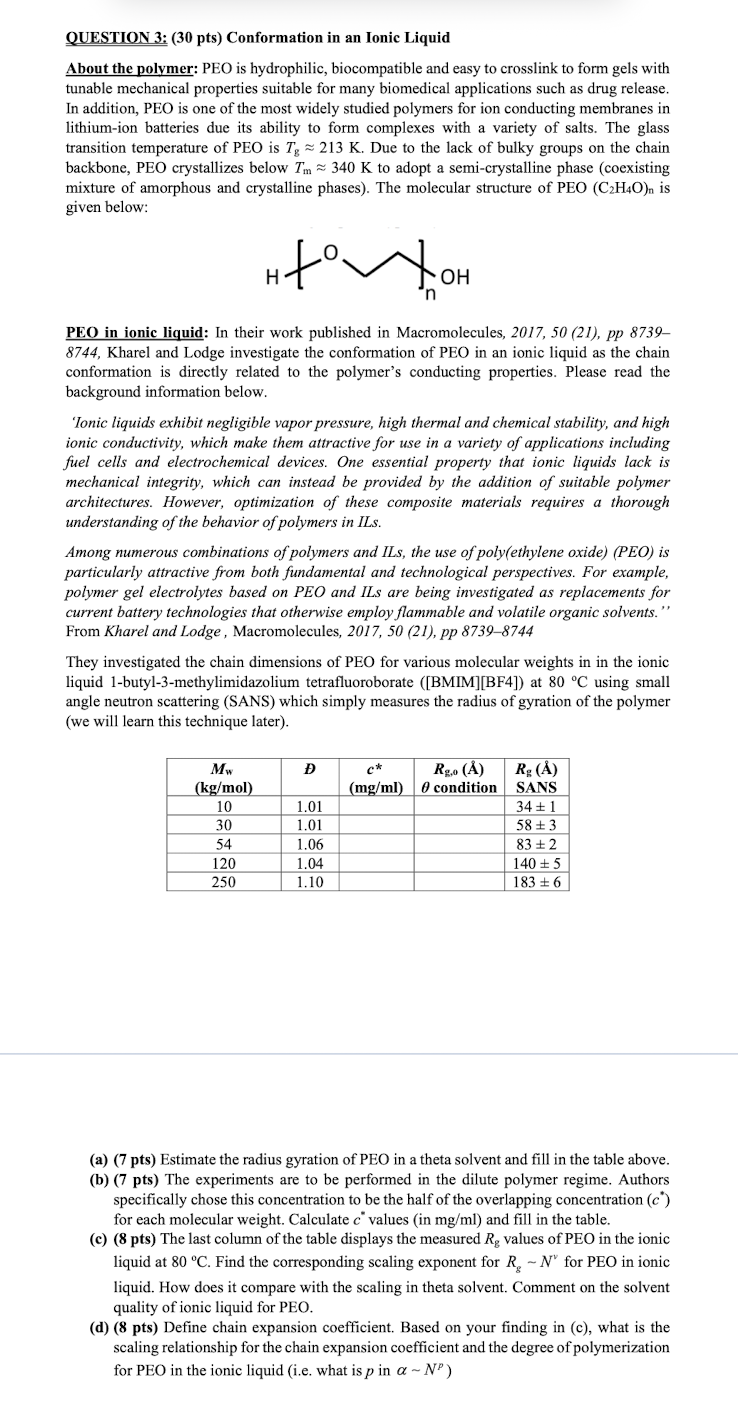
They investigated the chain dimensions of PEO for various molecular weights in in the ionic
liquid butylmethylimidazolium tetrafluoroborate BMIMBF at using small
angle neutron scattering SANS which simply measures the radius of gyration of the polymer
we will learn this technique later
a pts Estimate the radius gyration of PEO in a theta solvent and fill in the table above.
b pts The experiments are to be performed in the dilute polymer regime. Authors
specifically chose this concentration to be the half of the overlapping concentration
for each molecular weight. Calculate values in and fill in the table.
c pts The last column of the table displays the measured values of PEO in the ionic
liquid at Find the corresponding scaling exponent for for PEO in ionic
liquid. How does it compare with the scaling in theta solvent. Comment on the solvent
quality of ionic liquid for PEO.
d pts Define chain expansion coefficient. Based on your finding in c what is the
scaling relationship for the chain expansion coefficient and the degree of polymerization
for PEO in the ionic liquid ie what is in
Step by Step Solution
There are 3 Steps involved in it
1 Expert Approved Answer
Step: 1 Unlock

Question Has Been Solved by an Expert!
Get step-by-step solutions from verified subject matter experts
Step: 2 Unlock
Step: 3 Unlock
 Study Help