







Question: Question 3 (30 Marks) Read the following case and evaluate the case from a capital structure decision making perspective and also from an earnings diatribution
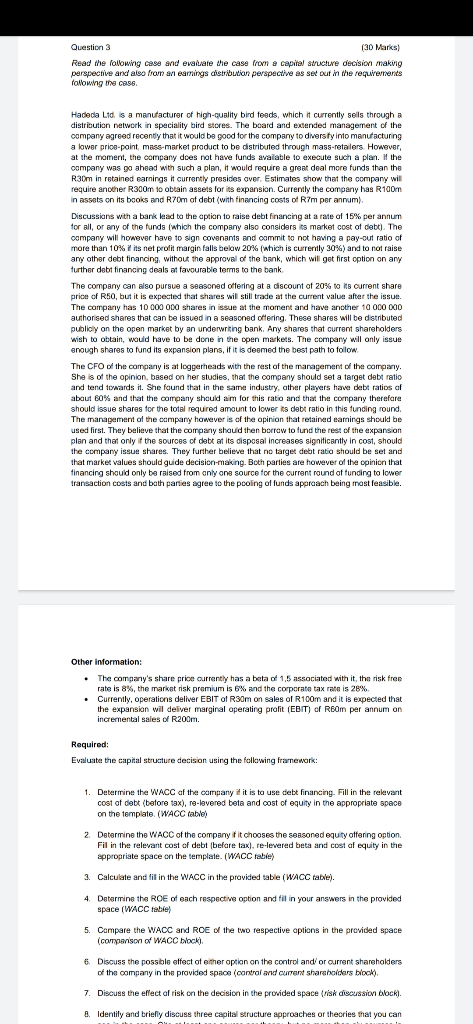
Question 3 (30 Marks) Read the following case and evaluate the case from a capital structure decision making perspective and also from an earnings diatribution perspective as set out in the requirements following the case. Hadeda Lid is a manufacturer of high-quality bind feeds, which it currently sells through a distribution network in speciality bird stores. The board and extended management of the company agreed recendy that it would be good for the company to diversity into manufacturng a lower price point mass-market product to be distributed through mass-retailers. However, at the moment, the company does not have funds available to execute such a plan the company was go ahead with such a plan, it would require a great deal more funds than the R30m in retained earnings it currently presides over. Estimates show that the company wil require another R300m to obtain assets for its expansion. Currently the company has R100m in assets on its books and R70m of debt with financing costs of R7m per annum Discussions with a bank lead to the option to raise debt financing at a rate of 15% per annum for all, or any of the funds (which the company also considers its market cost of otel. The company will however have to sign covenants and commit to not having a pay-out ratio of more than 10% is net profit margin falls below 20% which is currently 30%) and to not raise any other debt financing without the approval of the bank, which will get first option on any further debt financing deals at favourable terms to the bank The company can also pursue a seasoned offering at a discount of 20% tot current share price of R50, but it is expected that shares will still trade and the current value after the issue The company has 10 000 000 shares in issue at the moment and have another 10 000 000 authorised shares that can be issued in a seasoned offering. These shares will be distributed publicly on the open market by an underwriting bank. Any shares that current shareholders wish to obtain would have to be done in the open markets. The company will only issue enough shares to fund its expansion plans, if it is deemed the best path to follow The CFO of the company is at loggerheads with the rest of the management of the company She is of the opinion based on her studies, that the company should set a target debt ratio and tend towards it. She found that in the same industry, other players have debt ratios of about 60% and that the company should aim for this ratio and that the company therefore should issue shares for the total required amount to lower ta debt ratio in this funding found The management of the company however is of the opinion that retained earnings should be used first. They believe that the company should then borrow to fund the rest of the expansion plan and that only the sources of debt at its disposal increases significantly in cost should the company issue shares. They further believe that no target debt ratio should be set and that market values should guide decision-making. Both parties are however of the opinion that financing should only be raised from only one source for the ourrent round of funding to lower transaction costs and both parties agree to the pooing ollunds approach being most feasible. Other information: The company's share price currently has a beta of 1.5 associated with it, the risk free rate is 8%, the market risk premium is 6% and the corporate tax rate is 28% Currently, operations deliver EBIT of Romon sales of R100m and it is expected that the expansion will deliver marginal operating profit (EBIT) of R60m per annum on incremental sales of R200m. Required: Evaluate the capital structure decision using the following framework 1. Determine the WACC of the company it is to use debt financing. Fill in the relevant cost of det (betone tax), re-lovered beta and cost of equity in the appropriate space on the template. (WACC table 2 Determine the WACC of the company tit chooses the seasoned equity offering option Fill in the relevant cost of debt before tax), re-levered beta and cost of equity in the appropriate space on the template. (WACC table 3. Calculate and fill in the WACC in the provided table (WACC table). 4. Determine the ROE of each respective option and fill in your answers in the provided space (WACC table 5. Compare the WACC and ROE of the two respective options in the provided space (comparison of WACC block 6. Discuss the possble effect of other option on the control and/or current shareholders of the company in the provided space (central and current shareholders black) 7. Discuss the effect of risk on the decision in the provided space is discussioni block) 8. Identily and briefly discuss three capital structure approaches or theories that you can Question 3 (30 Marks) Read the following case and evaluate the case from a capital structure decision making perspective and also from an earnings diatribution perspective as set out in the requirements following the case. Hadeda Lid is a manufacturer of high-quality bind feeds, which it currently sells through a distribution network in speciality bird stores. The board and extended management of the company agreed recendy that it would be good for the company to diversity into manufacturng a lower price point mass-market product to be distributed through mass-retailers. However, at the moment, the company does not have funds available to execute such a plan the company was go ahead with such a plan, it would require a great deal more funds than the R30m in retained earnings it currently presides over. Estimates show that the company wil require another R300m to obtain assets for its expansion. Currently the company has R100m in assets on its books and R70m of debt with financing costs of R7m per annum Discussions with a bank lead to the option to raise debt financing at a rate of 15% per annum for all, or any of the funds (which the company also considers its market cost of otel. The company will however have to sign covenants and commit to not having a pay-out ratio of more than 10% is net profit margin falls below 20% which is currently 30%) and to not raise any other debt financing without the approval of the bank, which will get first option on any further debt financing deals at favourable terms to the bank The company can also pursue a seasoned offering at a discount of 20% tot current share price of R50, but it is expected that shares will still trade and the current value after the issue The company has 10 000 000 shares in issue at the moment and have another 10 000 000 authorised shares that can be issued in a seasoned offering. These shares will be distributed publicly on the open market by an underwriting bank. Any shares that current shareholders wish to obtain would have to be done in the open markets. The company will only issue enough shares to fund its expansion plans, if it is deemed the best path to follow The CFO of the company is at loggerheads with the rest of the management of the company She is of the opinion based on her studies, that the company should set a target debt ratio and tend towards it. She found that in the same industry, other players have debt ratios of about 60% and that the company should aim for this ratio and that the company therefore should issue shares for the total required amount to lower ta debt ratio in this funding found The management of the company however is of the opinion that retained earnings should be used first. They believe that the company should then borrow to fund the rest of the expansion plan and that only the sources of debt at its disposal increases significantly in cost should the company issue shares. They further believe that no target debt ratio should be set and that market values should guide decision-making. Both parties are however of the opinion that financing should only be raised from only one source for the ourrent round of funding to lower transaction costs and both parties agree to the pooing ollunds approach being most feasible. Other information: The company's share price currently has a beta of 1.5 associated with it, the risk free rate is 8%, the market risk premium is 6% and the corporate tax rate is 28% Currently, operations deliver EBIT of Romon sales of R100m and it is expected that the expansion will deliver marginal operating profit (EBIT) of R60m per annum on incremental sales of R200m. Required: Evaluate the capital structure decision using the following framework 1. Determine the WACC of the company it is to use debt financing. Fill in the relevant cost of det (betone tax), re-lovered beta and cost of equity in the appropriate space on the template. (WACC table 2 Determine the WACC of the company tit chooses the seasoned equity offering option Fill in the relevant cost of debt before tax), re-levered beta and cost of equity in the appropriate space on the template. (WACC table 3. Calculate and fill in the WACC in the provided table (WACC table). 4. Determine the ROE of each respective option and fill in your answers in the provided space (WACC table 5. Compare the WACC and ROE of the two respective options in the provided space (comparison of WACC block 6. Discuss the possble effect of other option on the control and/or current shareholders of the company in the provided space (central and current shareholders black) 7. Discuss the effect of risk on the decision in the provided space is discussioni block) 8. Identily and briefly discuss three capital structure approaches or theories that you can
Step by Step Solution
There are 3 Steps involved in it

Get step-by-step solutions from verified subject matter experts
 Study Help