







Question: Question 3 [4 + 4 + 2 + 5 = 15 marks] Word gets out that you are doing such a great job in your
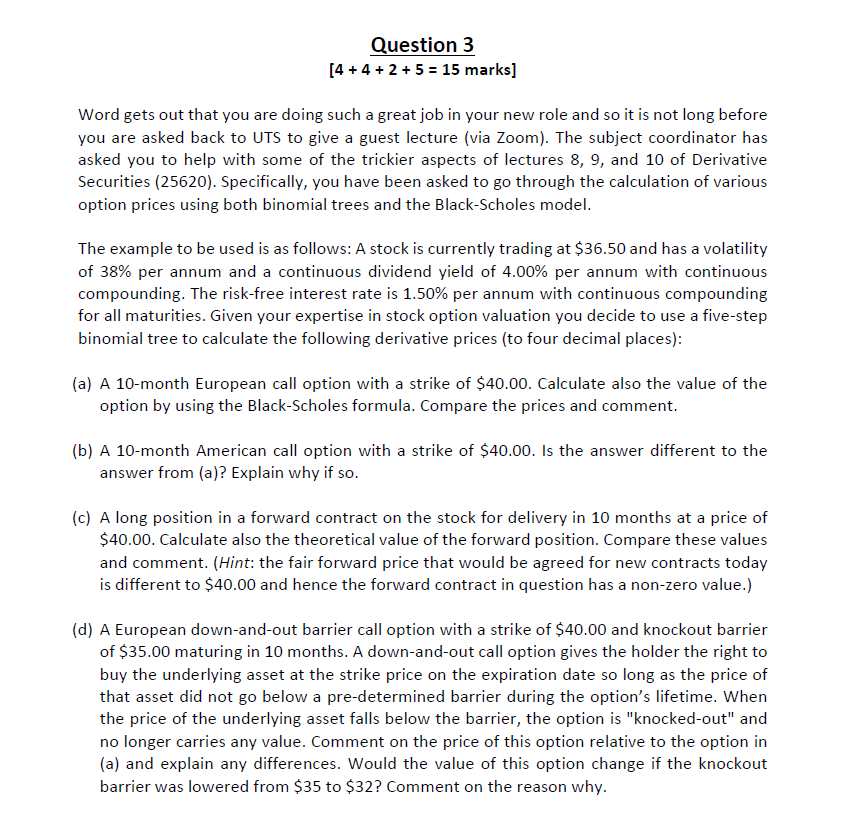
Question 3 [4 + 4 + 2 + 5 = 15 marks] Word gets out that you are doing such a great job in your new role and so it is not long before you are asked back to UTS to give a guest lecture (via Zoom). The subject coordinator has asked you to help with some of the trickier aspects of lectures 8, 9, and 10 of Derivative Securities (25620). Specifically, you have been asked to go through the calculation of various option prices using both binomial trees and the Black-Scholes model. The example to be used is as follows: A stock is currently trading at $36.50 and has a volatility of 38% per annum and a continuous dividend yield of 4.00% per annum with continuous compounding. The risk-free interest rate is 1.50% per annum with continuous compounding for all maturities. Given your expertise in stock option valuation you decide to use a five-step binomial tree to calculate the following derivative prices (to four decimal places): (a) A 10-month European call option with a strike of $40.00. Calculate also the value of the option by using the Black-Scholes formula. Compare the prices and comment. (b) A 10-month American call option with a strike of $40.00. Is the answer different to the answer from (a)? Explain why if so. (c) A long position in a forward contract on the stock for delivery in 10 months at a price of $40.00. Calculate also the theoretical value of the forward position. Compare these values and comment. (Hint: the fair forward price that would be agreed for new contracts today is different to $40.00 and hence the forward contract in question has a non-zero value.) (d) A European down-and-out barrier call option with a strike of $40.00 and knockout barrier of $35.00 maturing in 10 months. A down-and-out call option gives the holder the right to buy the underlying asset at the strike price on the expiration date so long as the price of that asset did not go below a pre-determined barrier during the option's lifetime. When the price of the underlying asset falls below the barrier, the option is "knocked-out" and no longer carries any value. Comment on the price of this option relative to the option in (a) and explain any differences. Would the value of this option change if the knockout barrier was lowered from $35 to $32? Comment on the reason why. Question 3 [4 + 4 + 2 + 5 = 15 marks] Word gets out that you are doing such a great job in your new role and so it is not long before you are asked back to UTS to give a guest lecture (via Zoom). The subject coordinator has asked you to help with some of the trickier aspects of lectures 8, 9, and 10 of Derivative Securities (25620). Specifically, you have been asked to go through the calculation of various option prices using both binomial trees and the Black-Scholes model. The example to be used is as follows: A stock is currently trading at $36.50 and has a volatility of 38% per annum and a continuous dividend yield of 4.00% per annum with continuous compounding. The risk-free interest rate is 1.50% per annum with continuous compounding for all maturities. Given your expertise in stock option valuation you decide to use a five-step binomial tree to calculate the following derivative prices (to four decimal places): (a) A 10-month European call option with a strike of $40.00. Calculate also the value of the option by using the Black-Scholes formula. Compare the prices and comment. (b) A 10-month American call option with a strike of $40.00. Is the answer different to the answer from (a)? Explain why if so. (c) A long position in a forward contract on the stock for delivery in 10 months at a price of $40.00. Calculate also the theoretical value of the forward position. Compare these values and comment. (Hint: the fair forward price that would be agreed for new contracts today is different to $40.00 and hence the forward contract in question has a non-zero value.) (d) A European down-and-out barrier call option with a strike of $40.00 and knockout barrier of $35.00 maturing in 10 months. A down-and-out call option gives the holder the right to buy the underlying asset at the strike price on the expiration date so long as the price of that asset did not go below a pre-determined barrier during the option's lifetime. When the price of the underlying asset falls below the barrier, the option is "knocked-out" and no longer carries any value. Comment on the price of this option relative to the option in (a) and explain any differences. Would the value of this option change if the knockout barrier was lowered from $35 to $32? Comment on the reason why
Step by Step Solution
There are 3 Steps involved in it

Get step-by-step solutions from verified subject matter experts
 Study Help