







Question: Question 3 (4 points) Part (a) (2 point) Consider the mixture of multivariate Normals (X1,X2) given by: U 0 2 l.5 U = 1 N
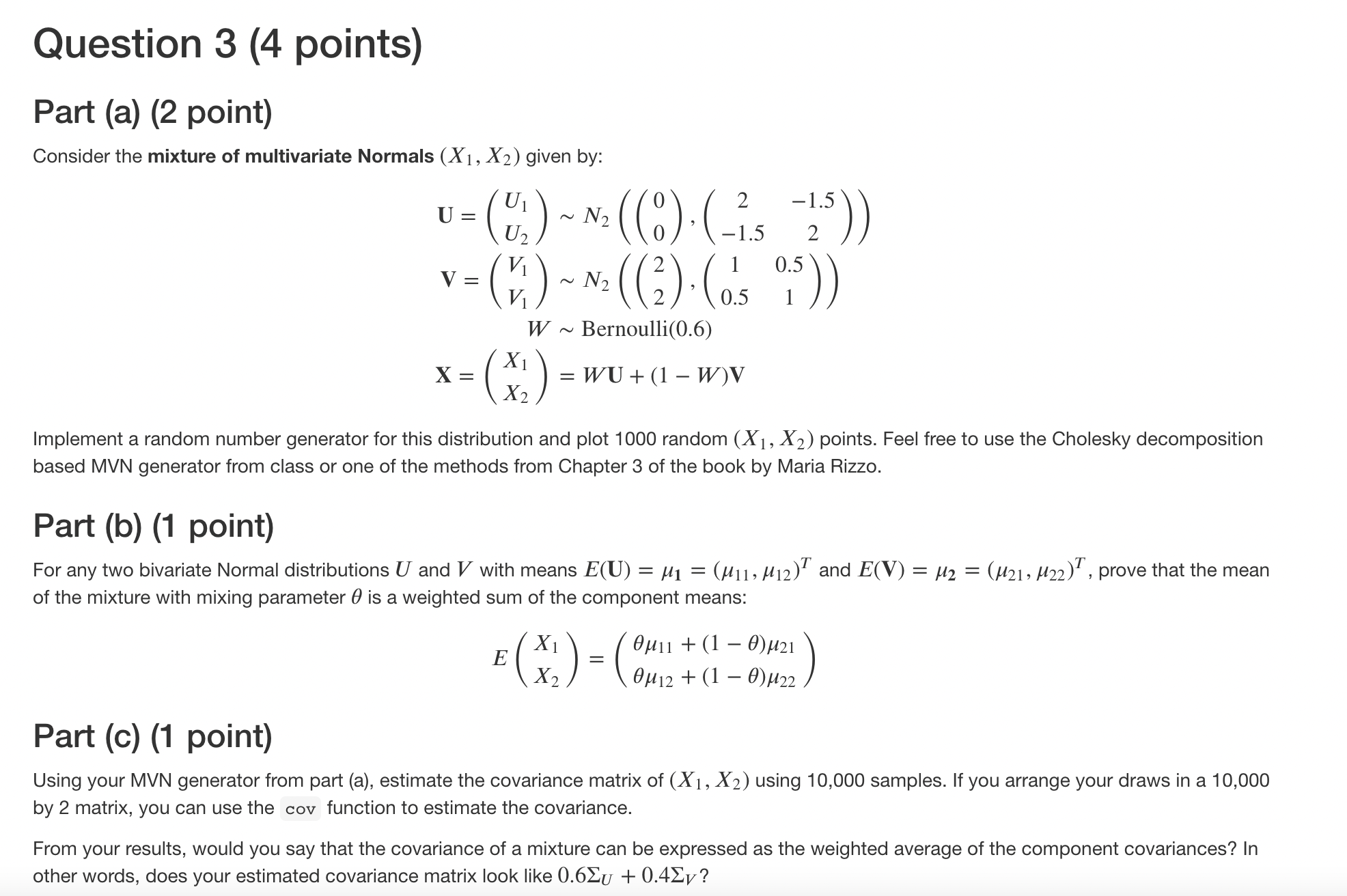
Question 3 (4 points) Part (a) (2 point) Consider the mixture of multivariate Normals (X1,X2) given by: U 0 2 l.5 U = 1 N N; 7 _ ) U2 0 1.5 2 V = V1 ) N N; 2 ' 1 0.5 V1 2 0.5 l W ~ Bernoulli(0.6) X=(X1)=WU+(1W)V X2 Implement a random number generator for this distribution and plot 1000 random (X1, X2) points. Feel free to use the Cholesky decomposition based MVN generator from class or one of the methods from Chapter 3 of the book by Maria Rizzo. Part (b) (1 pomt) For any two bivariate Normal distributions U and V with means E(U) = M1 = (#11,M12)T and E(V) = 142 = (1421, 1122)T, prove that the mean of the mixture with mixing parameter 19 is a weighted sum of the component means: E(X1) = (91411 +(1-9)M21 ) X2 W112 + (1 9)M22 Part (c) (1 point) Using your MVN generator from part (3), estimate the covariance matrix of (X1, X2) using 10,000 samples. If you arrange your draws in a 10,000 by 2 matrix, you can use the cov function to estimate the covariance. From your results, would you say that the covariance of a mixture can be expressed as the weighted average of the component covariances? In other words, does your estimated covariance matrix look like 0.621; + 0.4EV
Step by Step Solution
There are 3 Steps involved in it

Get step-by-step solutions from verified subject matter experts
 Study Help