Question: Question 3 (60 marks) (Sovereign Default Model) Let it be a risk free rate on the T-Bills. Let D, be the amount of debt. When
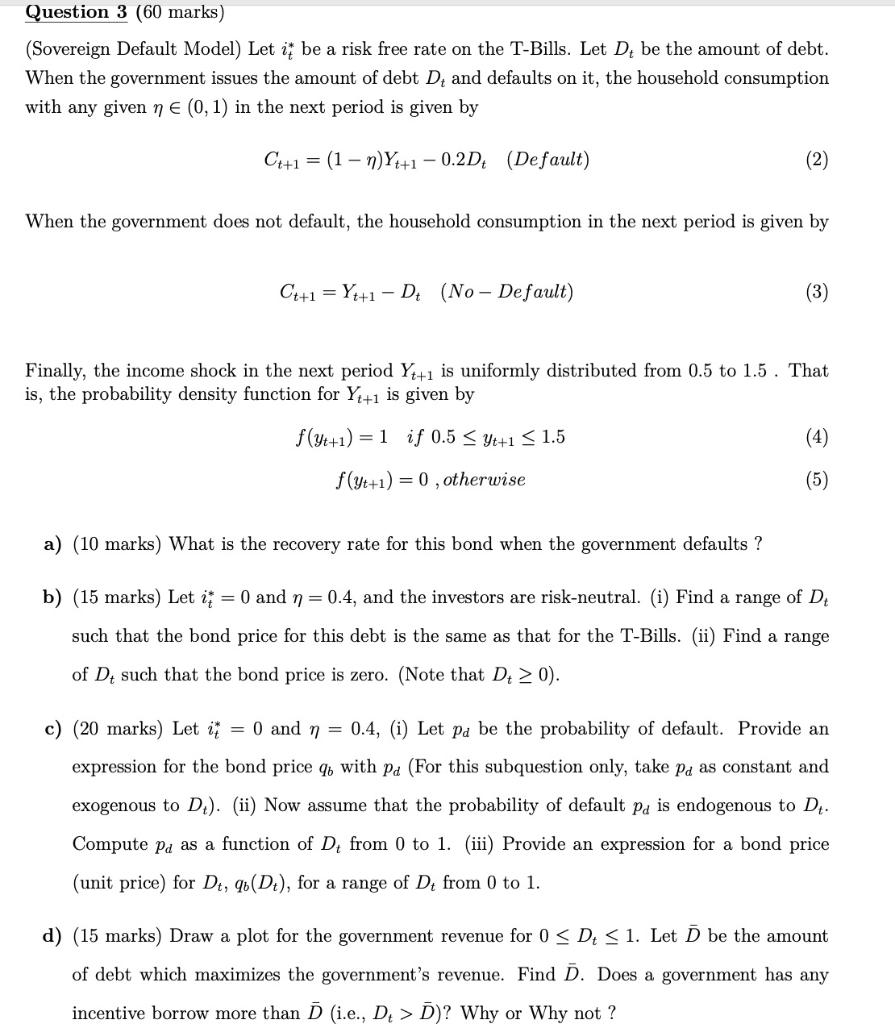
Question 3 (60 marks) (Sovereign Default Model) Let it be a risk free rate on the T-Bills. Let D, be the amount of debt. When the government issues the amount of debt De and defaults on it, the household consumption with any given n E (0,1) in the next period is given by C++1 = (1 - n)Y4+1 -0.2D+ (Default) (2) When the government does not default, the household consumption in the next period is given by Ct+1=Y++1 - D+ (No - Default) (3) Finally, the income shock in the next period Y4+1 is uniformly distributed from 0.5 to 1.5. That is, the probability density function for Yi+1 is given by f(yt+1) = 1 if 0.5 0). c) (20 marks) Let i = 0 and n = 0.4, (i) Let be the probability of default. Provide an expression for the bond price 96 with pd (For this subquestion only, take pa as constant and exogenous to D). (ii) Now assume that the probability of default pd is endogenous to De. Compute pa as a function of D, from 0 to 1. (iii) Provide an expression for a bond price (unit price) for Dt, qu(D+), for a range of De from 0 to 1. d) (15 marks) Draw a plot for the government revenue for 0 D)? Why or Why not? Question 3 (60 marks) (Sovereign Default Model) Let it be a risk free rate on the T-Bills. Let D, be the amount of debt. When the government issues the amount of debt De and defaults on it, the household consumption with any given n E (0,1) in the next period is given by C++1 = (1 - n)Y4+1 -0.2D+ (Default) (2) When the government does not default, the household consumption in the next period is given by Ct+1=Y++1 - D+ (No - Default) (3) Finally, the income shock in the next period Y4+1 is uniformly distributed from 0.5 to 1.5. That is, the probability density function for Yi+1 is given by f(yt+1) = 1 if 0.5 0). c) (20 marks) Let i = 0 and n = 0.4, (i) Let be the probability of default. Provide an expression for the bond price 96 with pd (For this subquestion only, take pa as constant and exogenous to D). (ii) Now assume that the probability of default pd is endogenous to De. Compute pa as a function of D, from 0 to 1. (iii) Provide an expression for a bond price (unit price) for Dt, qu(D+), for a range of De from 0 to 1. d) (15 marks) Draw a plot for the government revenue for 0 D)? Why or Why not









 Study Help