







Question: Question 3 A) (10 points) Consider the following strategy. Strategy A: Play C in the first period. Then, - Choose C after any history in
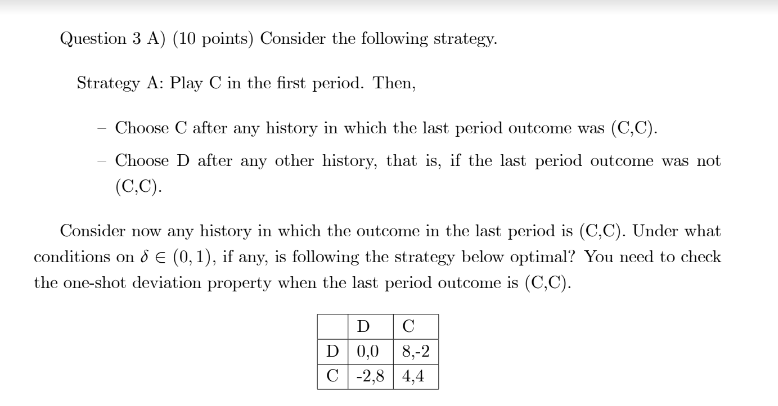
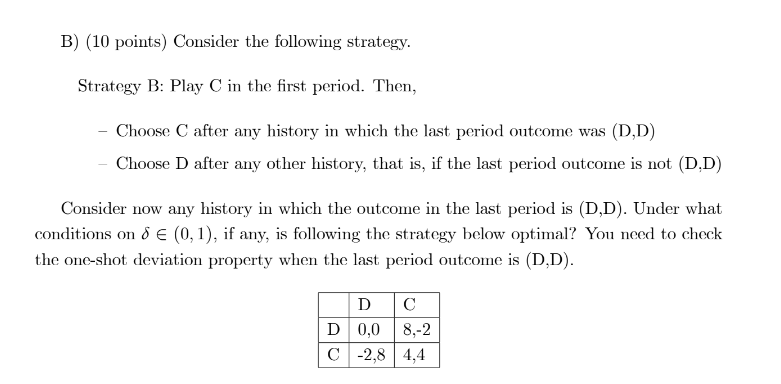
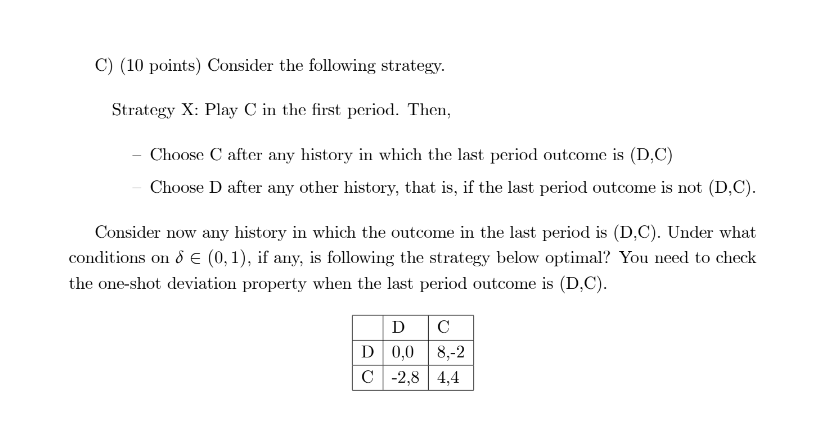
Question 3 A) (10 points) Consider the following strategy. Strategy A: Play C in the first period. Then, - Choose C after any history in which the last period outcome was (C,C). - Choose D after any other history, that is, if the last period outcome was not (C.C). Consider now any history in which the outcome in the last period is (C,C). Under what conditions on & E (0, 1), if any, is following the strategy below optimal? You need to check the one-shot deviation property when the last period outcome is (C,C). D C D 0,0 8,-2 C -2,8 4,4B) (10 points) Consider the following strategy. Strategy B: Play C in the first period. Then, - Choose C after any history in which the last period outcome was (D,D) - Choose D after any other history, that is, if the last period outcome is not (D.D) Consider now any history in which the outcome in the last period is (D,D). Under what conditions on 6 6 (0, 1), if any, is following the strategy below optimal? You need to check the one-shot deviation property when the last period outcome is (D.D). D C D 0,0 8.-2 C -2,8 4,4C) (10 points) Consider the following strategy. Strategy X: Play C in the first period. Then, - Choose C after any history in which the last period outcome is (D,C) Choose D after any other history, that is, if the last period outcome is not (D,C). Consider now any history in which the outcome in the last period is (D.C). Under what conditions on & E (0, 1), if any, is following the strategy below optimal? You need to check the one-shot deviation property when the last period outcome is (D.C). D C D 0,0 8.-2 C -2,8 4,4
Step by Step Solution
There are 3 Steps involved in it

Get step-by-step solutions from verified subject matter experts
 Study Help