







Question: ## Question 3 A basketball player is trying out a new technique to make a three-point shot. The player will continue to practice until he's
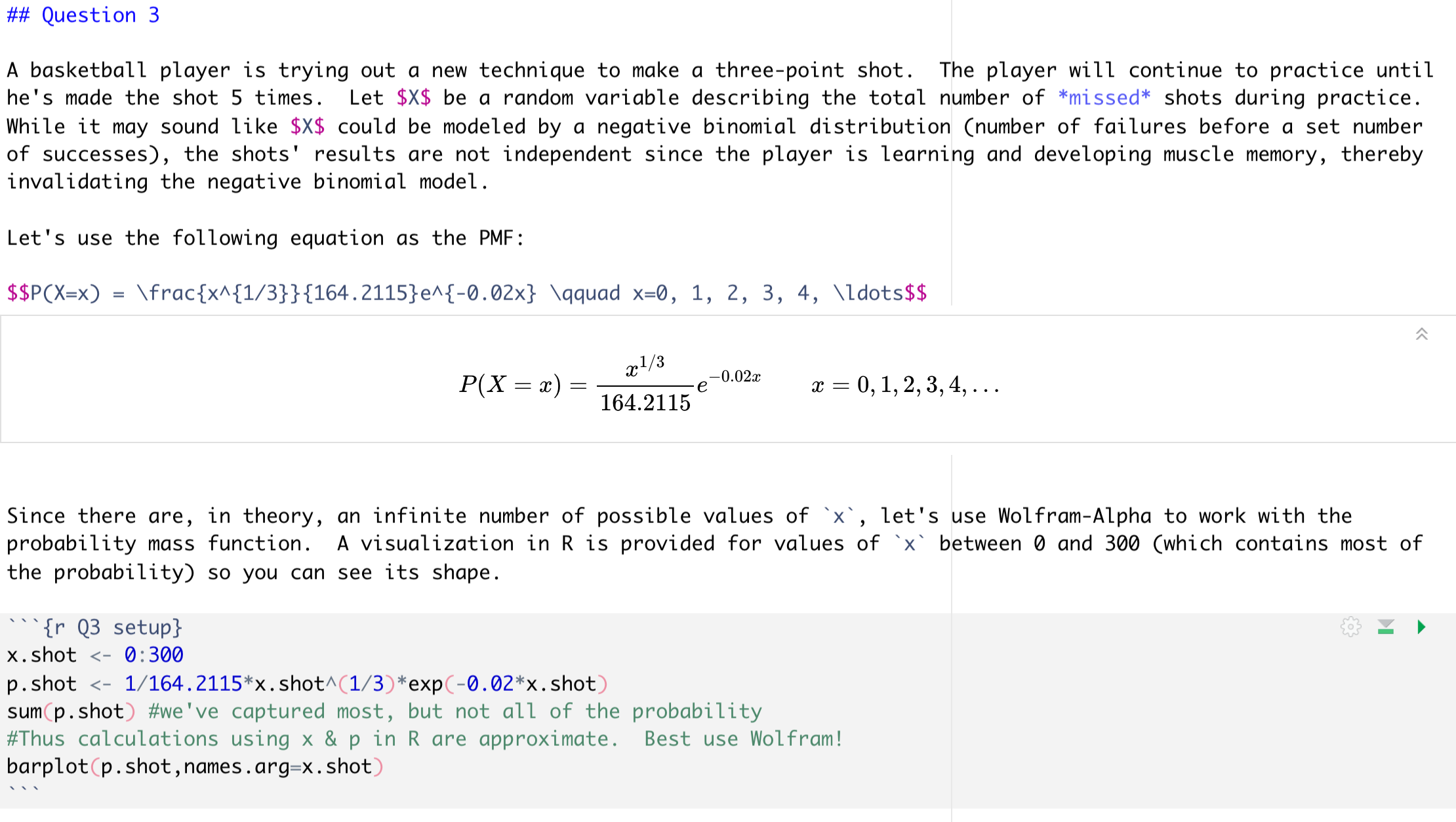
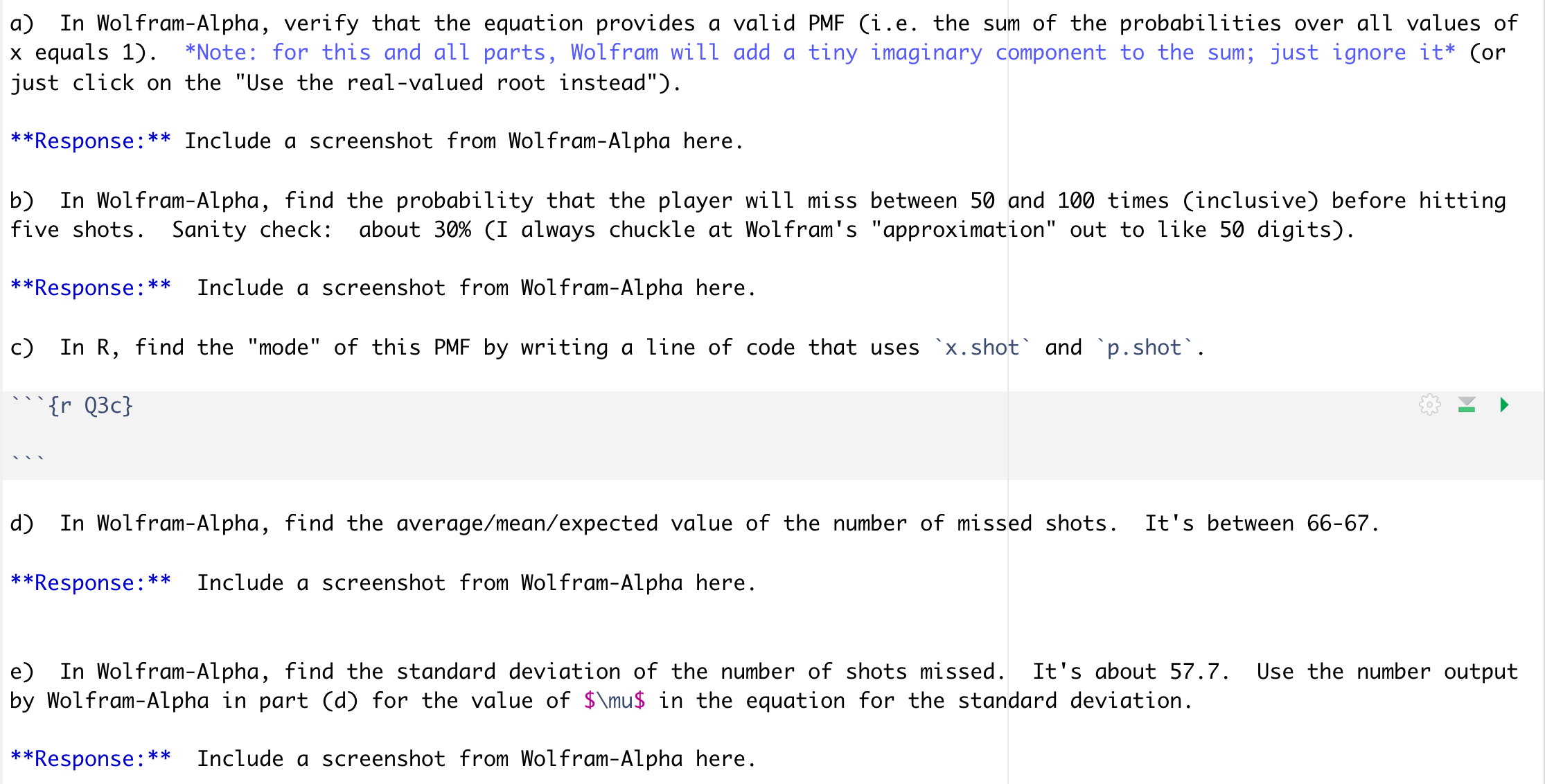
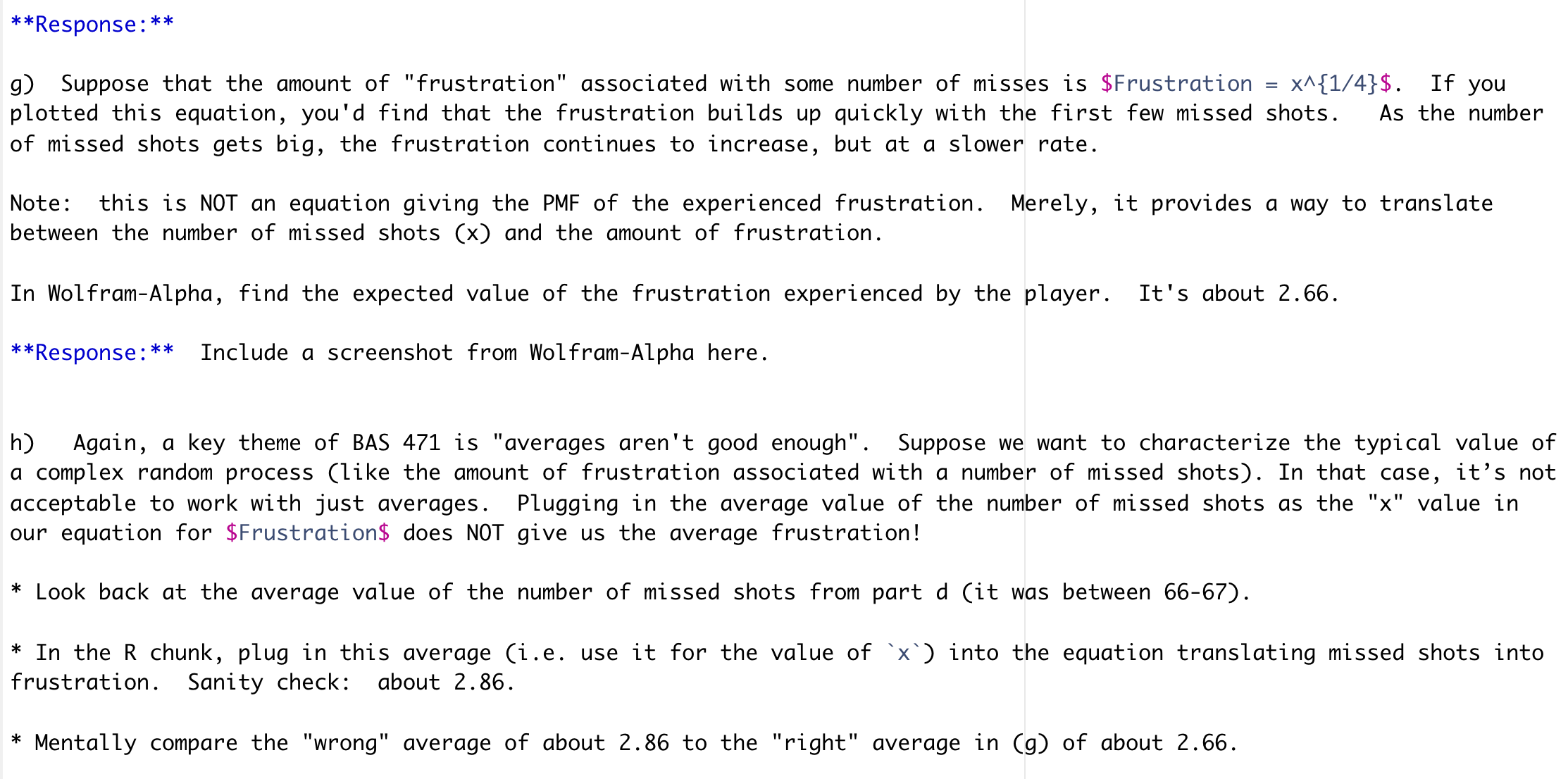

## Question 3 A basketball player is trying out a new technique to make a three-point shot. The player will continue to practice until he's made the shot 5 times. Let $X$ be a random variable describing the total number of *missed* shots during practice. While it may sound like $X$ could be modeled by a negative binomial distribution (number of failures before a set number of successes), the shots' results are not independent since the player is learning and developing muscle memory, thereby invalidating the negative binomial model. Let's use the Following equation as the PMF: $$PCX=X) = \\frac{xA{l/3}}{164.2115}eA{0.02x} \\qquad x=0, l, 2, 3, 4, \\ldots$$ x1/3 PX: : ( 7\") 164.2115 {0-021 m : 0,1,2,3,4,... Since there are, in theory, an infinite number of possible values of 'x', let's use Wolfram-Alpha to work with the probability mass function. A visualization in R is provided for values of 'x' between 0 and 300 (which contains most of the probability) so you can see its shape. \"'{r Q3 setup} _ b x.shot
Step by Step Solution
There are 3 Steps involved in it

Get step-by-step solutions from verified subject matter experts
 Study Help