







Question: QUESTION 3 (a) Consider the code C={010,101} as the input to an extended binary symmetric channel with bit-error probability 0.1. Write out the rows of
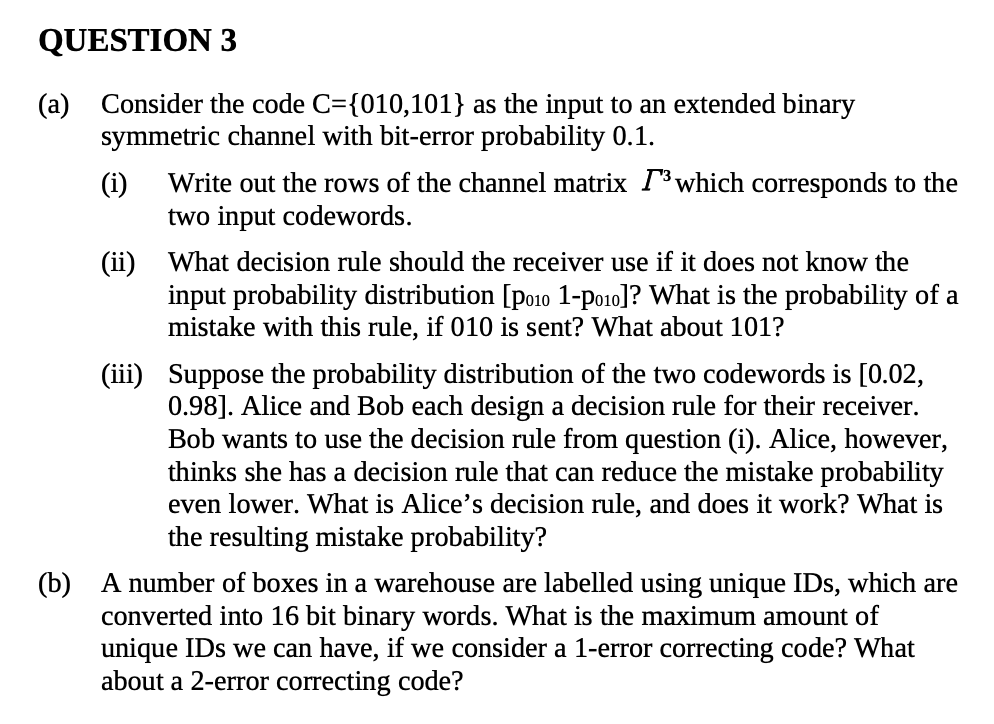
QUESTION 3 (a) Consider the code C={010,101} as the input to an extended binary symmetric channel with bit-error probability 0.1. Write out the rows of the channel matrix 1" which corresponds to the two input codewords. (ii) What decision rule should the receiver use if it does not know the input probability distribution (poio 1-poio]? What is the probability of a mistake with this rule, if 010 is sent? What about 101? (iii) Suppose the probability distribution of the two codewords is [0.02, 0.98]. Alice and Bob each design a decision rule for their receiver. Bob wants to use the decision rule from question (i). Alice, however, thinks she has a decision rule that can reduce the mistake probability even lower. What is Alice's decision rule, and does it work? What is the resulting mistake probability? (b) A number of boxes in a warehouse are labelled using unique IDs, which are converted into 16 bit binary words. What is the maximum amount of unique IDs we can have, if we consider a 1-error correcting code? What about a 2-error correcting code? QUESTION 3 (a) Consider the code C={010,101} as the input to an extended binary symmetric channel with bit-error probability 0.1. Write out the rows of the channel matrix 1" which corresponds to the two input codewords. (ii) What decision rule should the receiver use if it does not know the input probability distribution (poio 1-poio]? What is the probability of a mistake with this rule, if 010 is sent? What about 101? (iii) Suppose the probability distribution of the two codewords is [0.02, 0.98]. Alice and Bob each design a decision rule for their receiver. Bob wants to use the decision rule from question (i). Alice, however, thinks she has a decision rule that can reduce the mistake probability even lower. What is Alice's decision rule, and does it work? What is the resulting mistake probability? (b) A number of boxes in a warehouse are labelled using unique IDs, which are converted into 16 bit binary words. What is the maximum amount of unique IDs we can have, if we consider a 1-error correcting code? What about a 2-error correcting code
Step by Step Solution
There are 3 Steps involved in it

Get step-by-step solutions from verified subject matter experts
 Study Help