







Question: Question 3: A. Falcon Plastics Inc. has a capital structure consisting of 20% debt and 80% equity. Falcon's debt currently has a 7% yield to
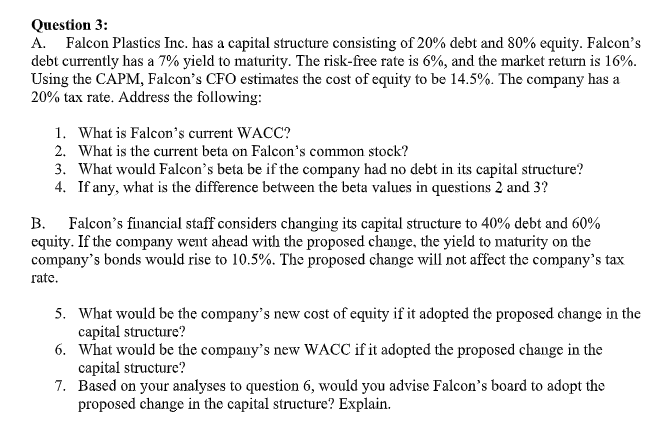
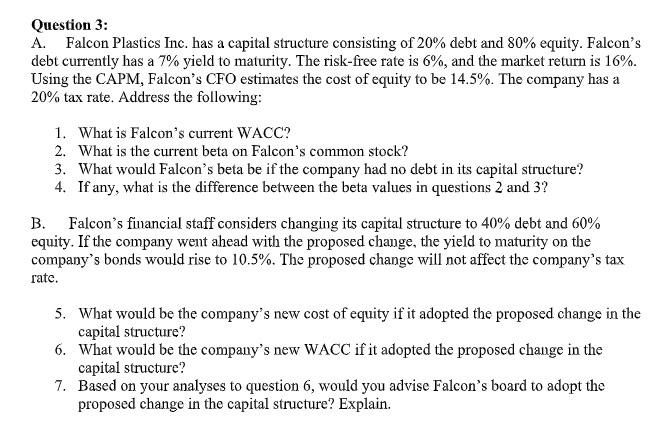
Question 3: A. Falcon Plastics Inc. has a capital structure consisting of 20% debt and 80% equity. Falcon's debt currently has a 7% yield to maturity. The risk-free rate is 6%, and the market return is 16%. Using the CAPM, Falcon's CFO estimates the cost of equity to be 14.5%. The company has a 20% tax rate. Address the following: 1. What is Falcon's current WACC? 2. What is the current beta on Falcon's common stock? 3. What would Falcon's beta be if the company had no debt in its capital structure? 4. If any, what is the difference between the beta values in questions 2 and 3? B. Falcon's financial staff considers changing its capital structure to 40% debt and 60% equity. If the company went ahead with the proposed change, the yield to maturity on the company's bonds would rise to 10.5%. The proposed change will not affect the company's tax rate. 5. What would be the company's new cost of equity if it adopted the proposed change in the capital structure? 6. What would be the company's new WACC if it adopted the proposed change in the capital structure? 7. Based on your analyses to question 6, would you advise Falcon's board to adopt the proposed change in the capital structure? Explain. Question 3: A. Falcon Plastics Inc. has a capital structure consisting of 20% debt and 80% equity. Falcon's debt currently has a 7% yield to maturity. The risk-free rate is 6%, and the market return is 16%. Using the CAPM, Falcon's CFO estimates the cost of equity to be 14.5%. The company has a 20% tax rate. Address the following: 1. What is Falcon's current WACC? 2. What is the current beta on Falcon's common stock? 3. What would Falcon's beta be if the company had no debt in its capital structure? 4. If any, what is the difference between the beta values in questions 2 and 3? B. Falcon's financial staff considers changing its capital structure to 40% debt and 60% equity. If the company went ahead with the proposed change, the yield to maturity on the company's bonds would rise to 10.5%. The proposed change will not affect the company's tax rate. 5. What would be the company's new cost of equity if it adopted the proposed change in the capital structure? 6. What would be the company's new WACC if it adopted the proposed change in the capital structure? 7. Based on your analyses to question 6, would you advise Falcon's board to adopt the proposed change in the capital structure? Explain
Step by Step Solution
There are 3 Steps involved in it

Get step-by-step solutions from verified subject matter experts
 Study Help