



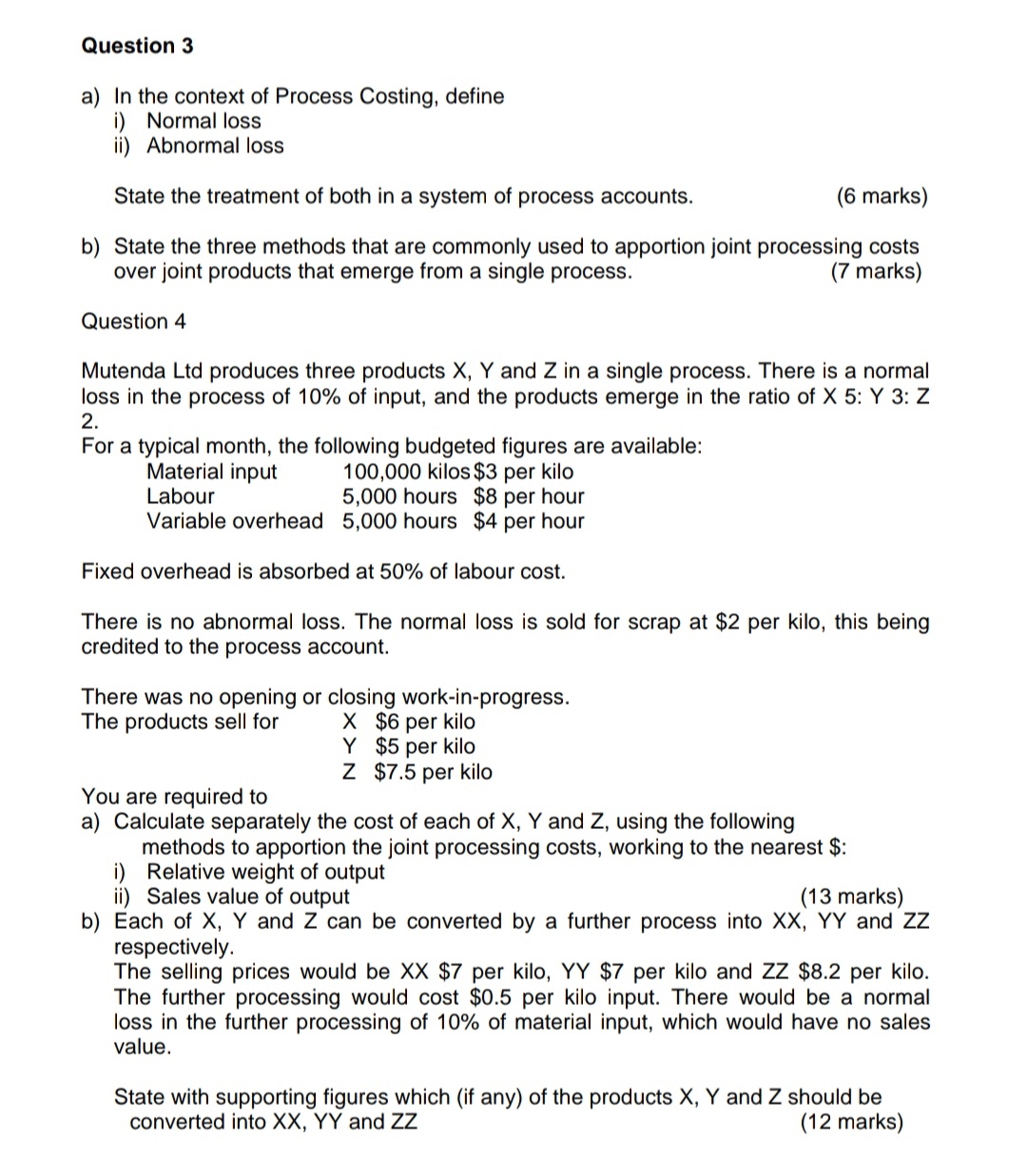
Question: Question 3 a ) In the context of Process Costing, define i ) Normal loss ii ) Abnormal loss State the treatment of both in
Question
a In the context of Process Costing, define
i Normal loss
ii Abnormal loss
State the treatment of both in a system of process accounts.
marks
b State the three methods that are commonly used to apportion joint processing costs over joint products that emerge from a single process.
marks
Question
Mutenda Ltd produces three products and Z in a single process. There is a normal loss in the process of of input, and the products emerge in the ratio of : :
For a typical month, the following budgeted figures are available:
Material input kilos $ per kilo
Labour hours $ per hour
Variable overhead hours $ per hour
Fixed overhead is absorbed at of labour cost.
There is no abnormal loss. The normal loss is sold for scrap at $ per kilo, this being credited to the process account.
There was no opening or closing workinprogress.
The products sell for per kilo
Y $ per kilo
Z $ per kilo
You are required to
a Calculate separately the cost of each of and using the following methods to apportion the joint processing costs, working to the nearest $ :
i Relative weight of output
ii Sales value of output
marks
b Each of and can be converted by a further process into and respectively.
The selling prices would be $ per kilo, YY $ per kilo and $ per kilo. The further processing would cost $ per kilo input. There would be a normal loss in the further processing of of material input, which would have no sales value.
State with supporting figures which if any of the products and Z should be converted into and
marks
Step by Step Solution
There are 3 Steps involved in it
1 Expert Approved Answer
Step: 1 Unlock

Question Has Been Solved by an Expert!
Get step-by-step solutions from verified subject matter experts
Step: 2 Unlock
Step: 3 Unlock