







Question: Question 3: Assuming that the cost variance is constant, how much more money will it take to complete the project? a. $2,500,000 b. $2,750,000 c.
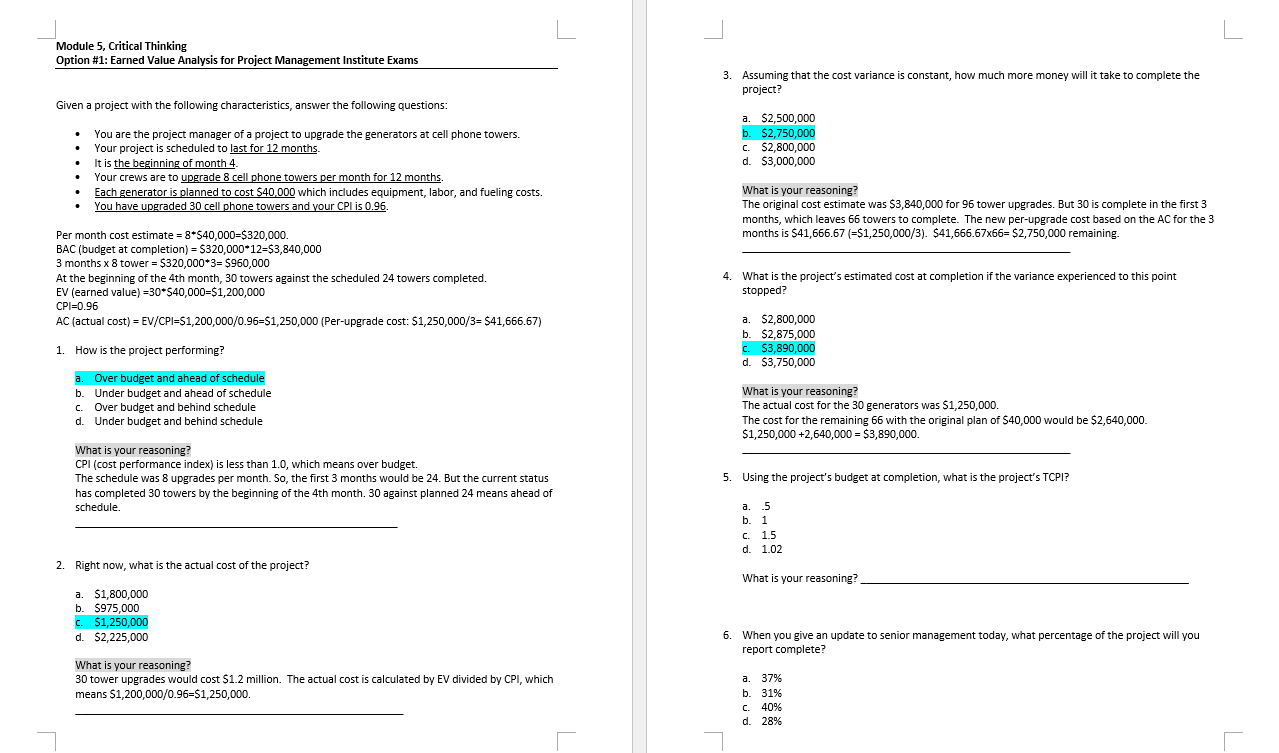
Question 3: Assuming that the cost variance is constant, how much more money will it take to complete the project?
a. $2,500,000
b. $2,750,000
c. $2,800,000
d. $3,000,000
I thought that I got the "b" as the correct answer.
What is your reasoning?
The original cost estimate was $3,840,000 for 96 tower upgrades. But 30 were completed in the first 3 months, which leaves 66 towers to complete.The new per-upgrade cost based on the AC for the 3 months is $41,666.67 (=$1,250,000/3). $41,666.67x66= $2,750,000 remaining.
Module 5, Critical Thinking Option #1: Earned Value Analysis for Project Management Institute Exams 3. Assuming that the cost variance is constant, how much more money will it take to complete the project? Given a project with the following characteristics, answer the following questions: a. $2,500,000 You are the project manager of a project to upgrade the generators at cell phone towers. b. $2,750,000 Your project is scheduled to last for 12 months. $2,800,000 It is the beginning of month 4. d $3,000,000 Your crews are to upgrade 8 cell phone towers per month for 12 months. Each generator is planned to cost $40,000 which includes equipment, labor, and fueling costs. What is your reasoning? You have upgraded 30 cell phone towers and your CPI is 0.96 The original cost estimate was $3,840,000 for 96 tower upgrades. But 30 is complete in the first 3 months, which leaves 66 towers to complete. The new per-upgrade cost based on the AC for the 3 Per month cost estimate = 8*$40,000=$320,000. months is $41,666.67 (=$1,250,000/3). $41,666.67x66= $2,750,000 remaining. BAC (budget at completion) = $320,000*12=$3,840,000 3 months x 8 tower = $320,000*3= $960,000 At the beginning of the 4th month, 30 towers against the scheduled 24 towers completed. 4. What is the project's estimated cost at completion if the variance experienced to this point EV (earned value) =30*$40,000=$1,200,000 stopped? CPI=0.96 AC (actual cost) = EV/CPI=$1,200,000/0.96=$1,250,000 (Per-upgrade cost: $1,250,000/3= $41,666.67) . $2,800,000 b. $2,875,000 1. How is the project performing? c. $3,890,000 d. $3,750,000 a. Over budget and ahead of schedule o. Under budget and ahead of schedule What is your reasoning? c. Over budget and behind schedule The actual cost for the 30 generators was $1,250,000. d. Under budget and behind schedule The cost for the remaining 66 with the original plan of $40,000 would be $2,640,000. $1,250,000 +2,640,000 = $3,890,000. What is your reasoning? CPI (cost performance index) is less than 1.0, which means over budget. The schedule was 8 upgrades per month. So, the first 3 months would be 24. But the current status 5. Using the project's budget at completion, what is the project's TCPI? has completed 30 towers by the beginning of the 4th month. 30 against planned 24 means ahead of schedule. a. b 1 C. 1.5 d. 1.02 2. Right now, what is the actual cost of the project? What is your reasoning? a. $1,800,000 b. $975,000 C. $1,250,000 d. $2,225,000 6. When you give an update to senior management today, what percentage of the project will you report complete? What is your reasoning? 30 tower upgrades would cost $1.2 million. The actual cost is calculated by EV divided by CPI, which a. 37% means $1,200,000/0.96=$1,250,000. b. 31% C. 40% d. 28%d. rosemariebilogS Answered 11 hours ago Explanation: - BAG 2 $3840000 EV = $1200000 AB = 951250000 '0 nd the amount of money,r needed to complete the project, we need to find the variance. Variance = EV - AC Variance = 951200000 - $1250000 Variance = -$50000 '0 nd the total amount of money.r needed to complete the project, we need to find the total variance. 'otal Variance = Variance x (BAG EV} Total Variance = -9550000 x {953840000 - 951200000) Total Variance = 9515000000 'otal Cost = AC + Total Variance Total Cost = $1250000 + 9515000000 "he cost variance is the difference between the EV and the AC. "he total variance is the cost variance multiplied by the difference between the BAC and the EV
Step by Step Solution
There are 3 Steps involved in it

Get step-by-step solutions from verified subject matter experts
 Study Help