







Question: Question # 3 : ( Audio Filtering ) In this problem, we will apply filters to audio signals to observe how these filters change the
Question #: Audio Filtering
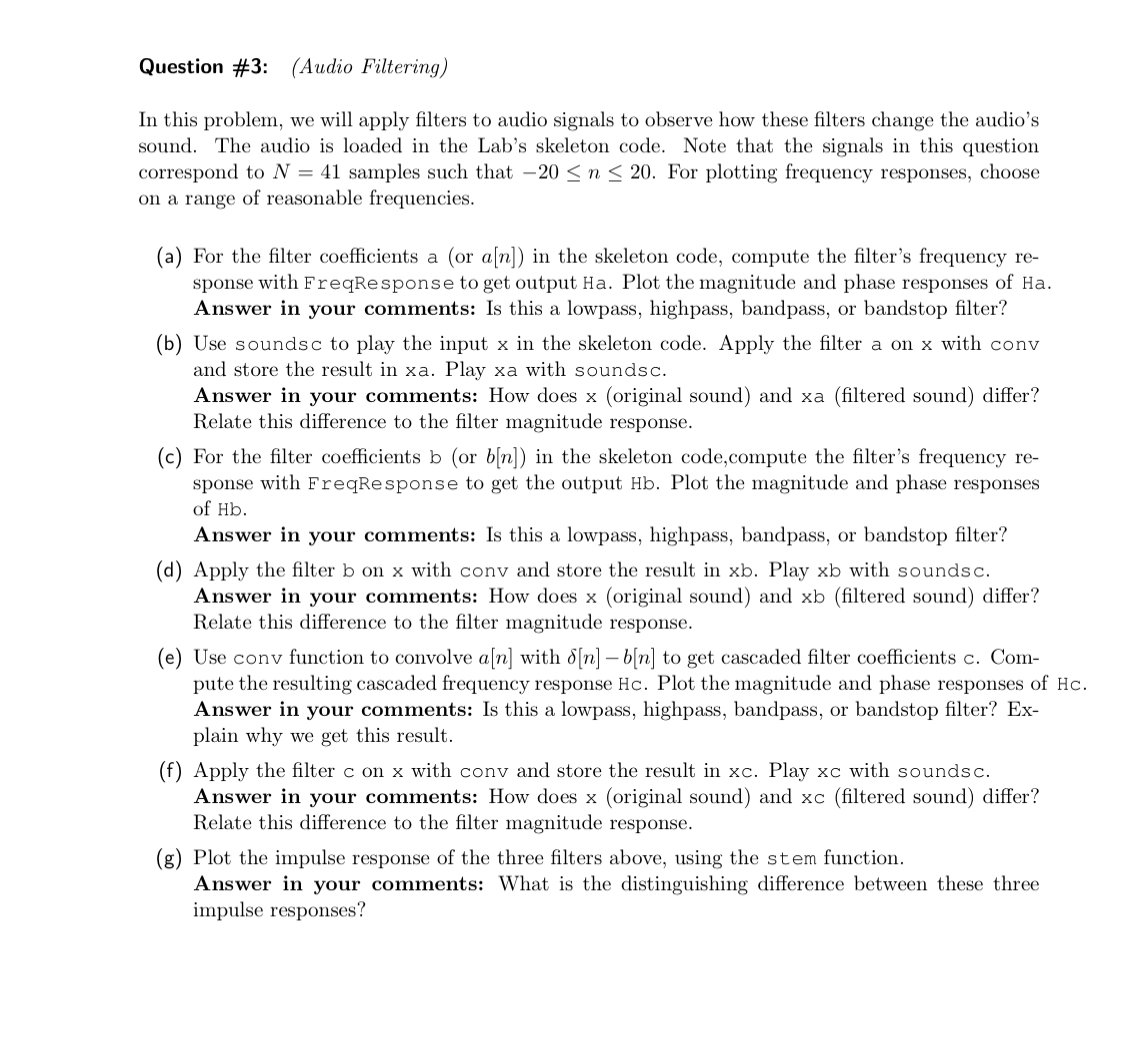
In this problem, we will apply filters to audio signals to observe how these filters change the audio's sound. The audio is loaded in the Lab's skeleton code. Note that the signals in this question correspond to samples such that For plotting frequency responses, choose on a range of reasonable frequencies.
a For the filter coefficients a or in the skeleton code, compute the filter's frequency response with FreqResponse to get output Plot the magnitude and phase responses of Answer in your comments: Is this a lowpass, highpass, bandpass, or bandstop filter?
b Use soundsc to play the input in the skeleton code. Apply the filter a on with conv and store the result in xa Play xa with soundsc.
Answer in your comments: How does original sound and xa filtered sound differ? Relate this difference to the filter magnitude response.
c For the filter coefficients or in the skeleton code,compute the filter's frequency response with FreqResponse to get the output Plot the magnitude and phase responses of
Answer in your comments: Is this a lowpass, highpass, bandpass, or bandstop filter?
d Apply the filter on with conv and store the result in Play with soundsc.
Answer in your comments: How does original sound and filtered sound differ? Relate this difference to the filter magnitude response.
e Use conv function to convolve with to get cascaded filter coefficients c Compute the resulting cascaded frequency response Plot the magnitude and phase responses of Answer in your comments: Is this a lowpass, highpass, bandpass, or bandstop filter? Explain why we get this result.
f Apply the filter on with conv and store the result in Play with soundsc. Answer in your comments: How does original sound and filtered sound differ? Relate this difference to the filter magnitude response.
g Plot the impulse response of the three filters above, using the stem function. Answer in your comments: What is the distinguishing difference between these three impulse responses?
NEED HELP WRITING CODE
Step by Step Solution
There are 3 Steps involved in it
1 Expert Approved Answer
Step: 1 Unlock

Question Has Been Solved by an Expert!
Get step-by-step solutions from verified subject matter experts
Step: 2 Unlock
Step: 3 Unlock
 Study Help