







Question: Question 3 - B+ Trees We've seen how B+ Trees can be used to build indices for efficient access to data. In this question, we'll
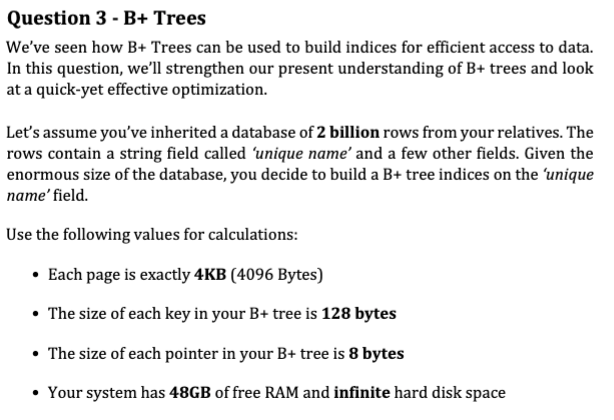
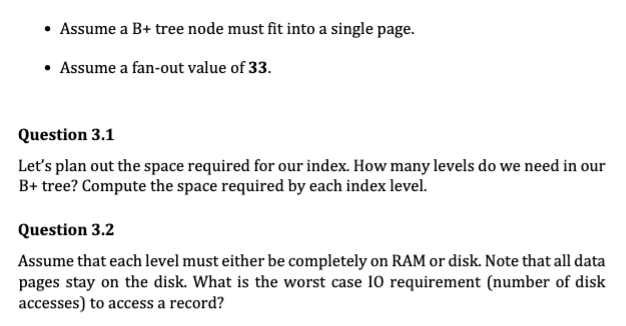
Question 3 - B+ Trees We've seen how B+ Trees can be used to build indices for efficient access to data. In this question, we'll strengthen our present understanding of B+ trees and look at a quick-yet effective optimization. Let's assume you've inherited a database of 2 billion rows from your relatives. The rows contain a string field called 'unique name' and a few other fields. Given the enormous size of the database, you decide to build a B+ tree indices on the 'unique name' field. Use the following values for calculations: - Each page is exactly 4KB (4096 Bytes) - The size of each key in your B+ tree is 128 bytes - The size of each pointer in your B+ tree is 8 bytes - Your system has 48GB of free RAM and infinite hard disk space - Assume a B+ tree node must fit into a single page. - Assume a fan-out value of 33. Question 3.1 Let's plan out the space required for our index. How many levels do we need in our B+ tree? Compute the space required by each index level. Question 3.2 Assume that each level must either be completely on RAM or disk. Note that all data pages stay on the disk. What is the worst case IO requirement (number of disk accesses) to access a record
Step by Step Solution
There are 3 Steps involved in it

Get step-by-step solutions from verified subject matter experts
 Study Help