







Question: Question 3. [Benjamin et al.. Chapter 3 Labour Supply and Public Policy). Income-maintenance policy: wage subsidies and tax credits The US. Earned Income Tax Credit
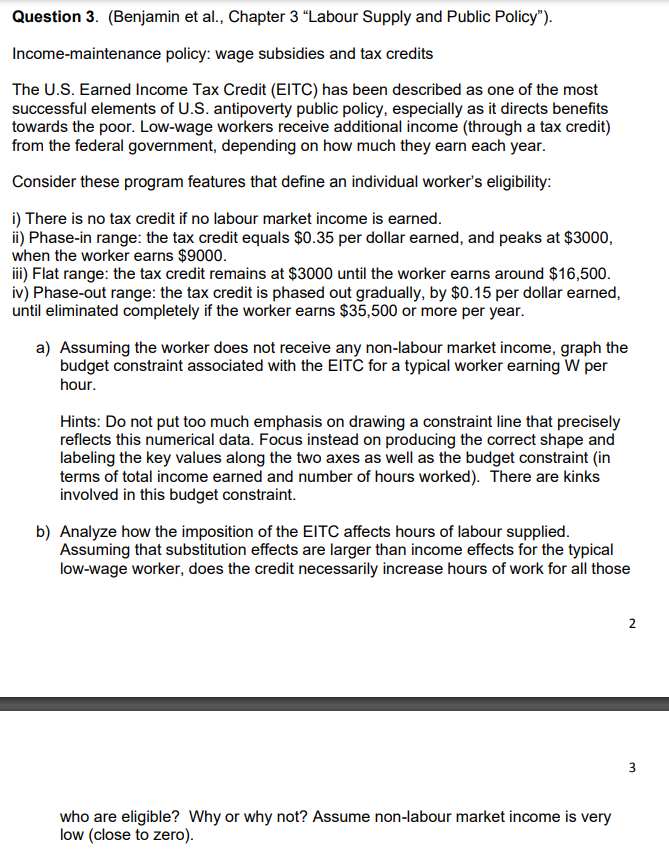

Question 3. [Benjamin et al.. Chapter 3 \"Labour Supply and Public Policy\"). Income-maintenance policy: wage subsidies and tax credits The US. Earned Income Tax Credit {EITC} has been described as one of the most successful elements of LLB. antipoverty public policy. especially as it directs benets towards the poor. Low-wage workers receive additional income {through a tax credit) from lhe federal government, depending on how much they earn each year. Consider these program features that dene an individual worker's eligibility: i] There is no tax credit if no labour market income is earned. ii) Phase-in range: the tax credit equals $0.35 per dollar earned. and peaks at $3000. when the worker earns $9000. iii] Flat range: the tax credit remains at $3000 until the worker earns around $16,500. iv] Phase-out range: the tax credit is phased out gradually. by $0.15 per dollar earned. until eliminated completely if the worker earns $35,500 or more per year. a} Assuming the worker does not receive any hon-labour market income, graph the budget constraint associated with the EITC for a typical worker earning W per houn Hints: Do not put too much emphasis on drawing a constraint line that precisely reects this numerical data. Focus instead on producing the correct shape and labeling the key values along the two axes as well as the budget constraint {in terms of total income earned and number of hours worked}. There are kinks involved in this budget constraint. b} Analyze how the imposition of the EITC affects hours of labour supplied. Assuming that substitution effects are larger than income effects for the typical low-wage worker, does the credit necessarily increase hours of work for all those who are eligible? Why or why not? Assume non-labour market income is very low {close to zero]. c) Analyze the impact of the EITC on an individual's labour force participation decision, assuming that the individual was not working in the absence of the EITC. Assume non-labour market income is very low (close to zero)
Step by Step Solution
There are 3 Steps involved in it

Get step-by-step solutions from verified subject matter experts
 Study Help