







Question: Question 3 Consider the damped spring-mass mechanical system given as: dt2d2x+0.15dtdx+x=0x(0)=10dtdx(0)=0 (a) Perform the first five iterations to determine the position x(t) for t in
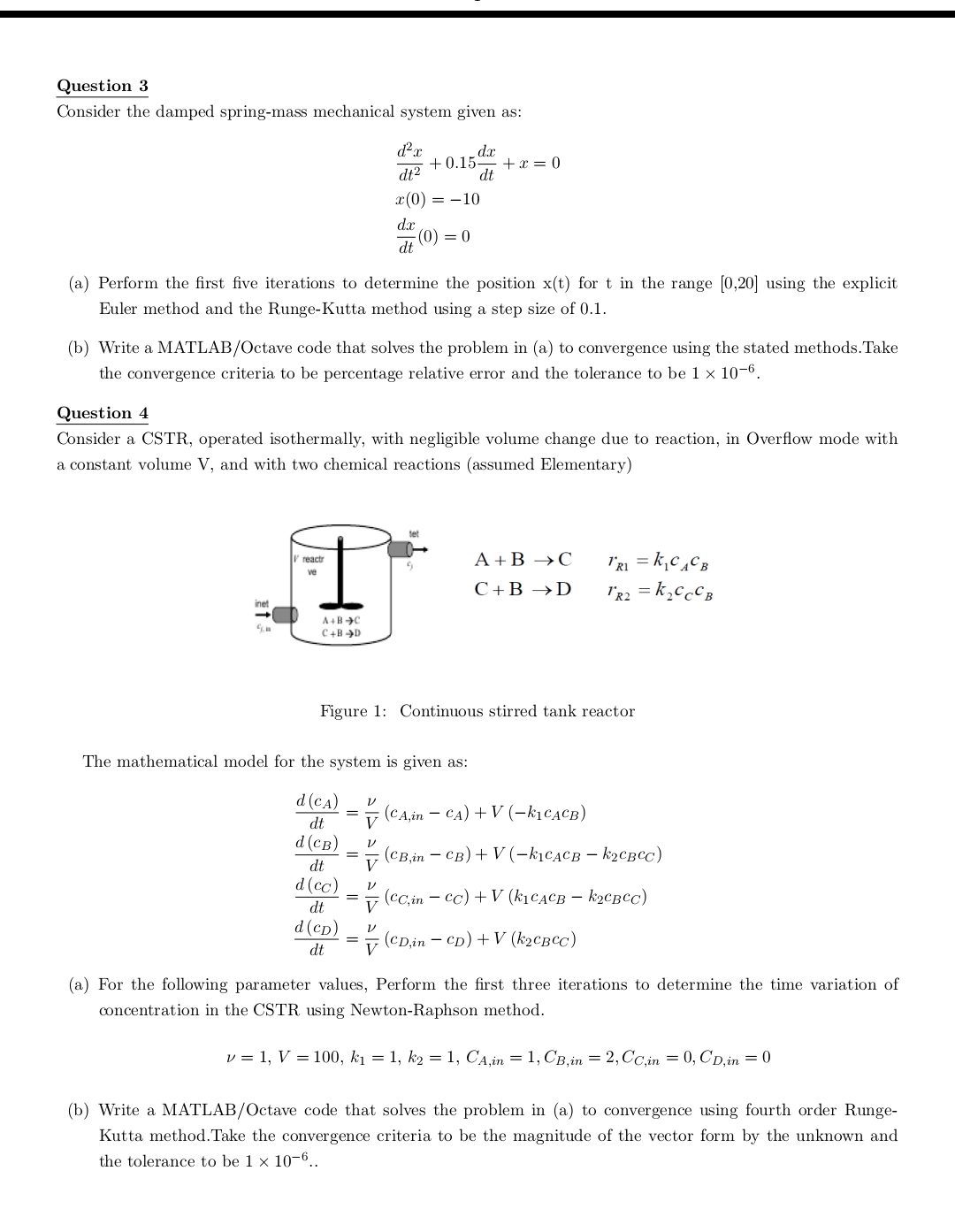
Question 3 Consider the damped spring-mass mechanical system given as: dt2d2x+0.15dtdx+x=0x(0)=10dtdx(0)=0 (a) Perform the first five iterations to determine the position x(t) for t in the range [0,20] using the explicit Euler method and the Runge-Kutta method using a step size of 0.1 . (b) Write a MATLAB/Octave code that solves the problem in (a) to convergence using the stated methods.Take the convergence criteria to be percentage relative error and the tolerance to be 1106. Question 4 Consider a CSTR, operated isothermally, with negligible volume change due to reaction, in Overflow mode with a constant volume V, and with two chemical reactions (assumed Elementary) A+BCC+BDrR1=k1cAcBrR2=k2cCcB Figure 1: Continuous stirred tank reactor The mathematical model for the system is given as: dtd(cA)dtd(cB)dtd(cC)dtd(cD)=V(cA,incA)+V(k1cAcB)=V(cB,incB)+V(k1cAcBk2cBcC)=V(cC,incC)+V(k1cAcBk2cBcC)=V(cD,incD)+V(k2cBcC) (a) For the following parameter values, Perform the first three iterations to determine the time variation of concentration in the CSTR using Newton-Raphson method. =1,V=100,k1=1,k2=1,CA,in=1,CB,in=2,CC,in=0,CD,in=0 (b) Write a MATLAB/Octave code that solves the problem in (a) to convergence using fourth order RungeKutta method.Take the convergence criteria to be the magnitude of the vector form by the unknown and the tolerance to be 1106
Step by Step Solution
There are 3 Steps involved in it

Get step-by-step solutions from verified subject matter experts
 Study Help