





Question: Question 3- Did Amazon make a mistake spending all that capital to buy a physical-store retailer- Whole Foods? This is the headline on Forbes on
Question 3- Did Amazon make a mistake spending
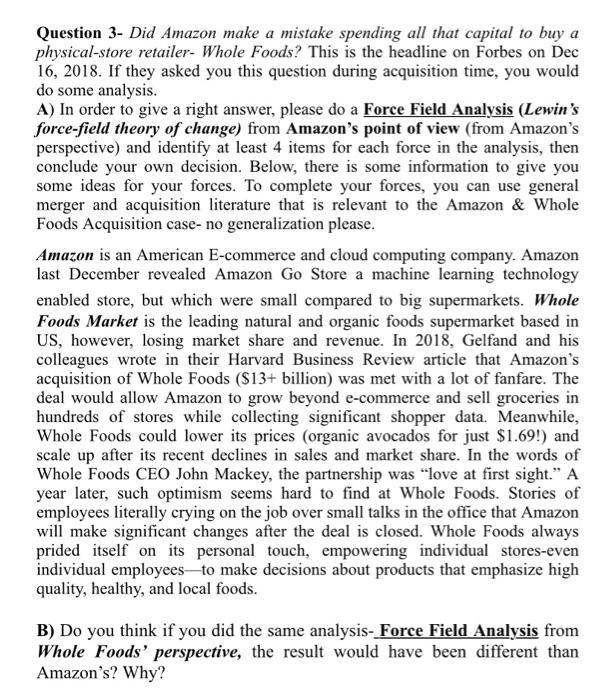
Question 3- Did Amazon make a mistake spending all that capital to buy a physical-store retailer- Whole Foods? This is the headline on Forbes on Dec 16, 2018. If they asked you this question during acquisition time, you would do some analysis. A) In order to give a right answer, please do a Force Field Analysis (Lewin's force-field theory of change) from Amazon's point of view (from Amazon's perspective) and identify at least 4 items for each force in the analysis, then conclude your own decision. Below, there is some information to give you some ideas for your forces. To complete your forces, you can use general merger and acquisition literature that is relevant to the Amazon & Whole Foods Acquisition case- no generalization please. Amazon is an American E-commerce and cloud computing company. Amazon last December revealed Amazon Go Store a machine learning technology enabled store, but which were small compared to big supermarkets. Whole Foods Market is the leading natural and organic foods supermarket based in US, however, losing market share and revenue. In 2018, Gelfand and his colleagues wrote in their Harvard Business Review article that Amazon's acquisition of Whole Foods ($13+ billion) was met with a lot of fanfare. The deal would allow Amazon to grow beyond e-commerce and sell groceries in hundreds of stores while collecting significant shopper data. Meanwhile, Whole Foods could lower its prices (organic avocados for just $1.69!) and scale up after its recent declines in sales and market share. In the words of Whole Foods CEO John Mackey, the partnership was love at first sight. A year later, such optimism seems hard to find at Whole Foods. Stories of employees literally crying on the job over small talks in the office that Amazon will make significant changes after the deal is closed. Whole Foods always prided itself on its personal touch, empowering individual stores-even individual employees to make decisions about products that emphasize high quality, healthy, and local foods. B) Do you think if you did the same analysis- Force Field Analysis from Whole Foods' perspective, the result would have been different than Amazon's? Why

Step by Step Solution

There are 3 Steps involved in it

1 Expert Approved Answer
Step: 1 Unlock blur-text-image

Question Has Been Solved by an Expert!

Get step-by-step solutions from verified subject matter experts

Step: 2 Unlock
Step: 3 Unlock

Students Have Also Explored These Related General Management Questions!