







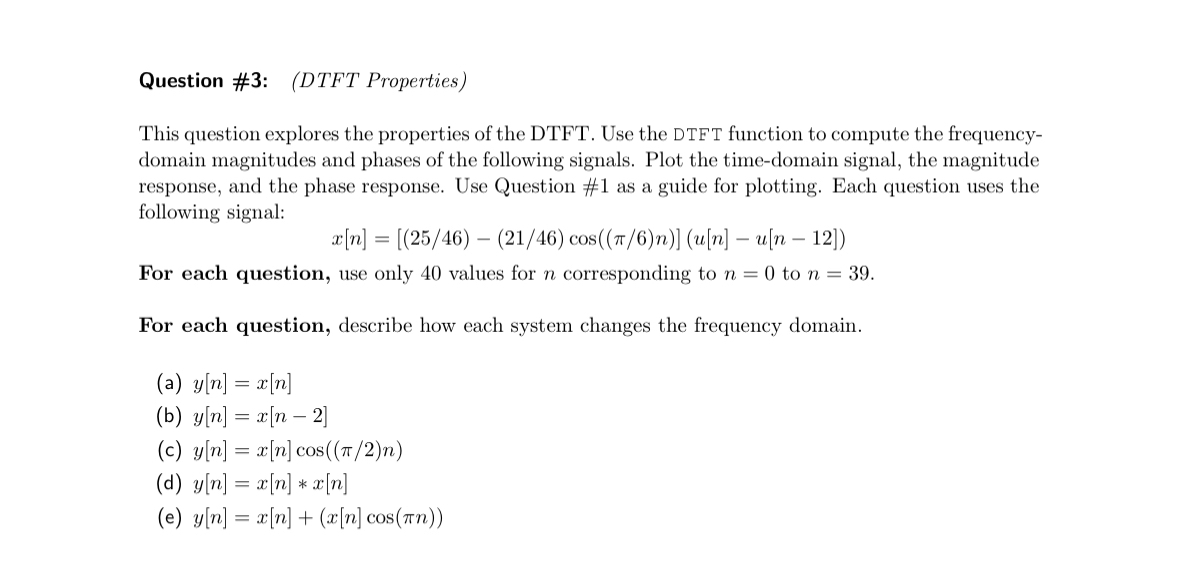
Question: Question # 3 : ( DTFT Properties ) This question explores the properties of the DTFT . Use the DTFT function to compute the frequencydomain
Question #: DTFT Properties
This question explores the properties of the DTFT Use the DTFT function to compute the frequencydomain magnitudes and phases of the following signals. Plot the timedomain signal, the magnitude response, and the phase response. Use Question # as a guide for plotting. Each question uses the following signal:
For each question, use only values for corresponding to to
For each question, describe how each system changes the frequency domain.
a
b
c
d
e
NEED HELP WITH THE CODE
Step by Step Solution
There are 3 Steps involved in it
1 Expert Approved Answer
Step: 1 Unlock

Question Has Been Solved by an Expert!
Get step-by-step solutions from verified subject matter experts
Step: 2 Unlock
Step: 3 Unlock
 Study Help