



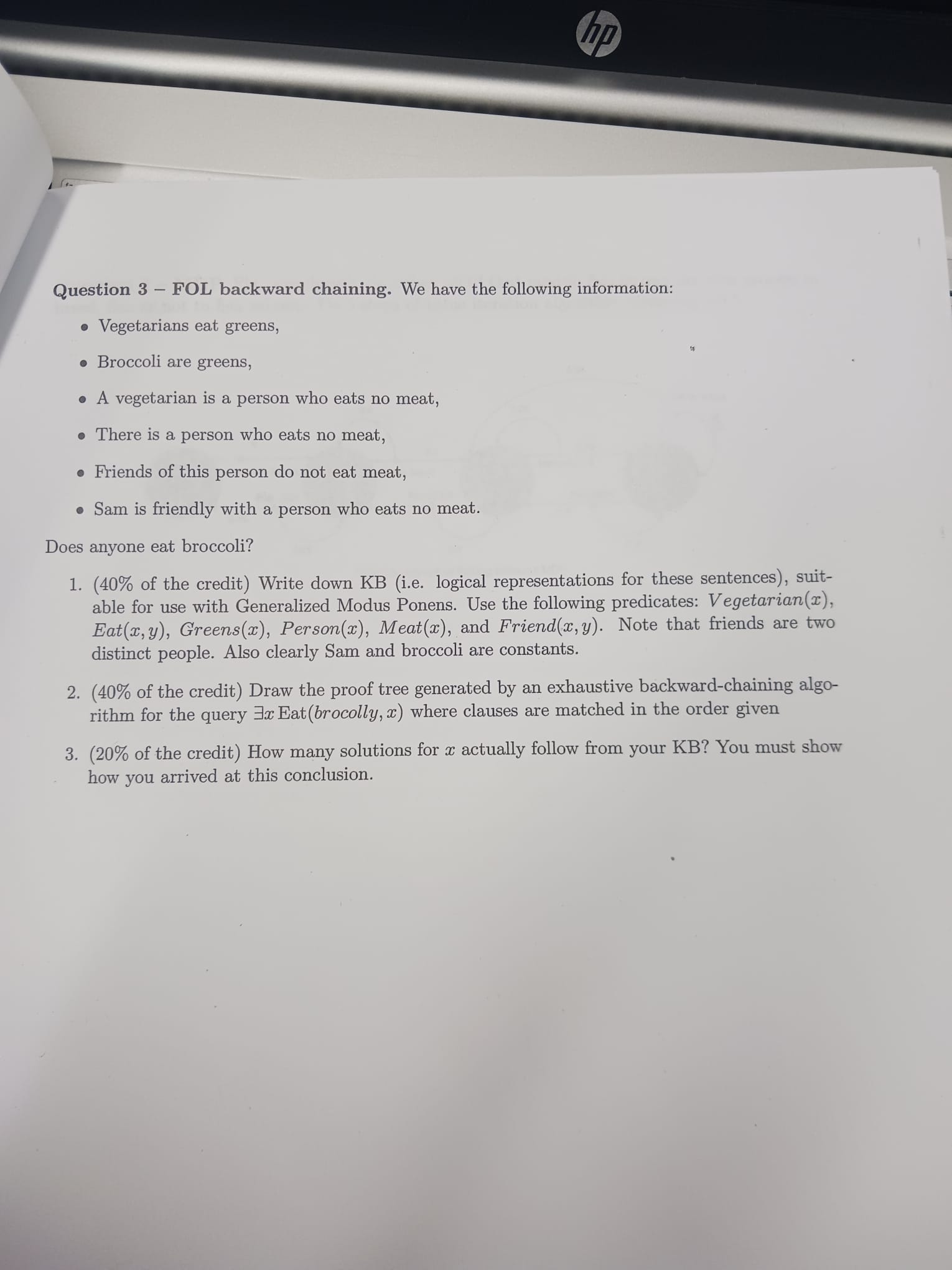
Question: Question 3 - FOL backward chaining. We have the following information: - Vegetarians eat greens, - Broccoli are greens, - A vegetarian is a person
Question FOL backward chaining. We have the following information:
Vegetarians eat greens,
Broccoli are greens,
A vegetarian is a person who eats no meat,
There is a person who eats no meat,
Friends of this person do not eat meat,
Sam is friendly with a person who eats no meat.
Does anyone eat broccoli?
of the credit Write down KB ie logical representations for these sentences suitable for use with Generalized Modus Ponens. Use the following predicates: Vegetarian xoperatornameEatx yoperatornameGreensxoperatornamePersonxoperatornameMeatx and Friend x y Note that friends are two distinct people. Also clearly Sam and broccoli are constants.
of the credit Draw the proof tree generated by an exhaustive backwardchaining algorithm for the query exists x operatornameEatbrocolly x where clauses are matched in the order given
of the credit How many solutions for x actually follow from your KB You must show how you arrived at this conclusion.
Step by Step Solution
There are 3 Steps involved in it
1 Expert Approved Answer
Step: 1 Unlock

Question Has Been Solved by an Expert!
Get step-by-step solutions from verified subject matter experts
Step: 2 Unlock
Step: 3 Unlock