







Question: Question 3. Given the following training samples from two classes: Class 1: $(1,1)^{t},(2,2)^{t},(2,0)^{t}$ Class 2: $(0,0)^{t},(1,0)^{t),(0,1)^{t}$ (1) Are the two classes linearly separable? (2) Use
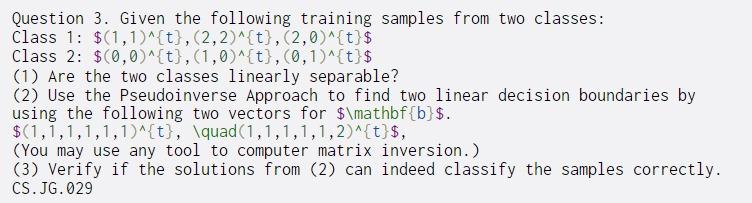
Question 3. Given the following training samples from two classes: Class 1: $(1,1)^{t},(2,2)^{t},(2,0)^{t}$ Class 2: $(0,0)^{t},(1,0)^{t),(0,1)^{t}$ (1) Are the two classes linearly separable? (2) Use the Pseudoinverse Approach to find two linear decision boundaries by using the following two vectors for $\mathbf {b}$. $(1,1,1,1,1,1)^{t}, \quad(1,1,1,1,1,2)^{t} $, (You may use any tool to computer matrix inversion.) (3) Verify if the solutions from (2) can indeed classify the samples correctly. CS.JG.029
Step by Step Solution
There are 3 Steps involved in it
1 Expert Approved Answer
Step: 1 Unlock

Question Has Been Solved by an Expert!
Get step-by-step solutions from verified subject matter experts
Step: 2 Unlock
Step: 3 Unlock
 Study Help