


Question: Question 3 is the Seniority System Fair! Traditionally, union contracts have called for pay and promotion systems that reward employees with higher pay and advancement
Question 3 is the Seniority System Fair!
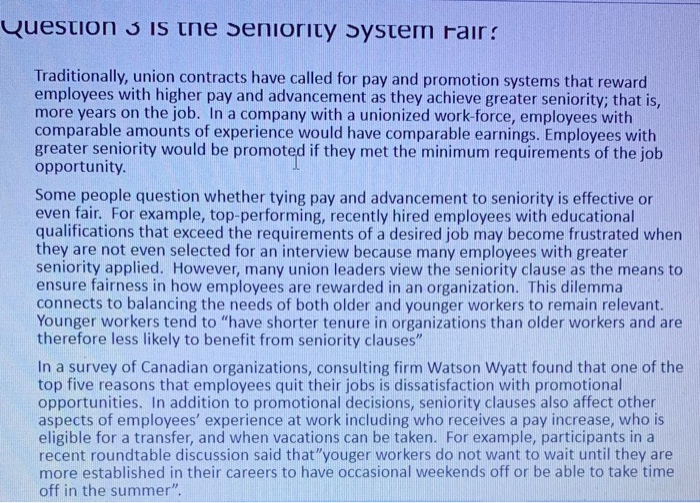
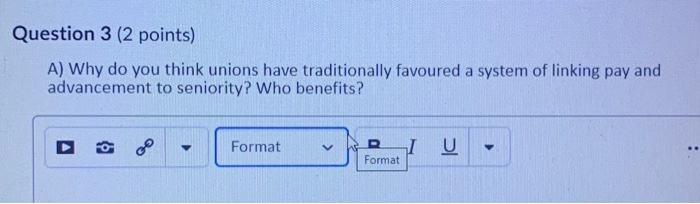
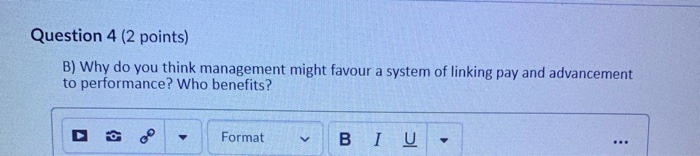
Question 3 is the Seniority System Fair! Traditionally, union contracts have called for pay and promotion systems that reward employees with higher pay and advancement as they achieve greater seniority; that is, more years on the job. In a company with a unionized work-force, employees with comparable amounts of experience would have comparable earnings. Employees with greater seniority would be promoted if they met the minimum requirements of the job opportunity. Some people question whether tying pay and advancement to seniority is effective or even fair. For example, top-performing, recently hired employees with educational qualifications that exceed the requirements of a desired job may become frustrated when they are not even selected for an interview because many employees with greater seniority applied. However, many union leaders view the seniority clause as the means to ensure fairness in how employees are rewarded in an organization. This dilemma connects to balancing the needs of both older and younger workers to remain relevant. Younger workers tend to "have shorter tenure in organizations than older workers and are therefore less likely to benefit from seniority clauses" In a survey of Canadian organizations, consulting firm Watson Wyatt found that one of the top five reasons that employees quit their jobs is dissatisfaction with promotional opportunities. In addition to promotional decisions, seniority clauses also affect other aspects of employees' experience at work including who receives a pay increase, who is eligible for a transfer, and when vacations can be taken. For example, participants in a recent roundtable discussion said that "youger workers do not want to wait until they are more established in their careers to have occasional weekends off or be able to take time off in the summer". Question 3 (2 points) A) Why do you think unions have traditionally favoured a system of linking pay and advancement to seniority? Who benefits? Format I U Format Question 4 (2 points) B) Why do you think management might favour a system of linking pay and advancement to performance? Who benefits? Format V Question 5 (3 points) What employee rights and expectations does seniority-based pay, promotion, and scheduling system fulfill? What standards for ethical behaviour does it meet? Question 6 (3 points) What employee rights does a performance-based pay and promotion, and scheduling system fulfill? What standards for ethical behaviour does it meet? A Format B I U
Step by Step Solution

There are 3 Steps involved in it

1 Expert Approved Answer
Step: 1 Unlock blur-text-image

Question Has Been Solved by an Expert!

Get step-by-step solutions from verified subject matter experts

Step: 2 Unlock
Step: 3 Unlock

Students Have Also Explored These Related General Management Questions!