







Question: Question 3. Let C() be the statement r has a cat, let D(2) be the statement has a dog and let F(2) be the
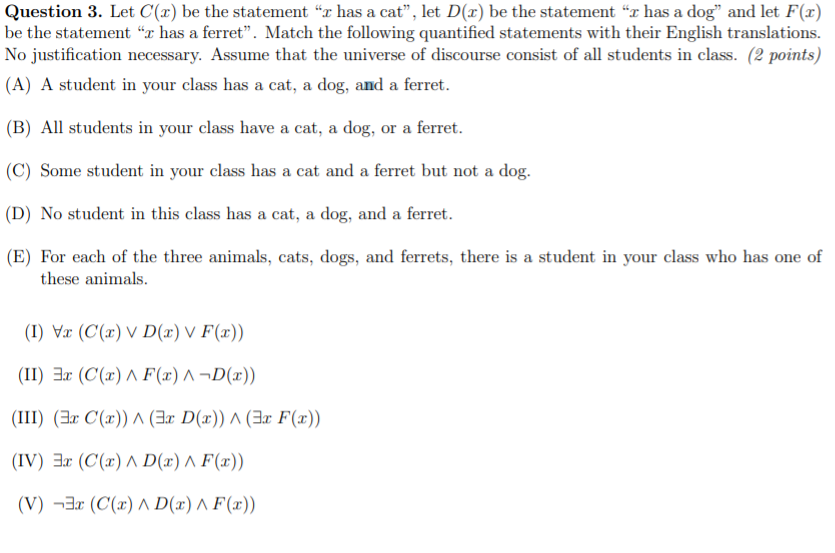
Question 3. Let C() be the statement "r has a cat", let D(2) be the statement " has a dog" and let F(2) be the statement "r has a ferret". Match the following quantified statements with their English translations. No justification necessary. Assume that the universe of discourse consist of all students in class. (2 points) (A) A student in your class has a cat, a dog, and a ferret. (B) All students in your class have a cat, a dog, or a ferret. (C) Some student in your class has a cat and a ferret but not a dog. (D) No student in this class has a cat, a dog, and a ferret. (E) For each of the three animals, cats, dogs, and ferrets, there is a student in your class who has one of these animals. (1) Vx (C(x) V D(2) V F(x)) (II) 3x (C(2) A F() 4-D(x)) (III) (Ex C(2)) A (3:D(x)) ^ (Ex F(x)) (IV) 3x (C(2) A D(2) A F(x)) (V) -3x (C(x) ^ D(2) A F(x))
Step by Step Solution
There are 3 Steps involved in it

Get step-by-step solutions from verified subject matter experts
 Study Help