







Question: Question 3 (Marks: 60) Read the following linked article. Find and summarize three source of your own that compliments the article. Each summary must illustrate
Question 3 (Marks: 60) Read the following linked article. Find and summarize three source of your own that compliments the article. Each summary must illustrate how it is linked to the article of Maynard. The summary of each article must not exceed half a page. Prepare and attach a PowerPoint presentation of not more than 10 slides on the topic. The last slide must contain your references in APA format.
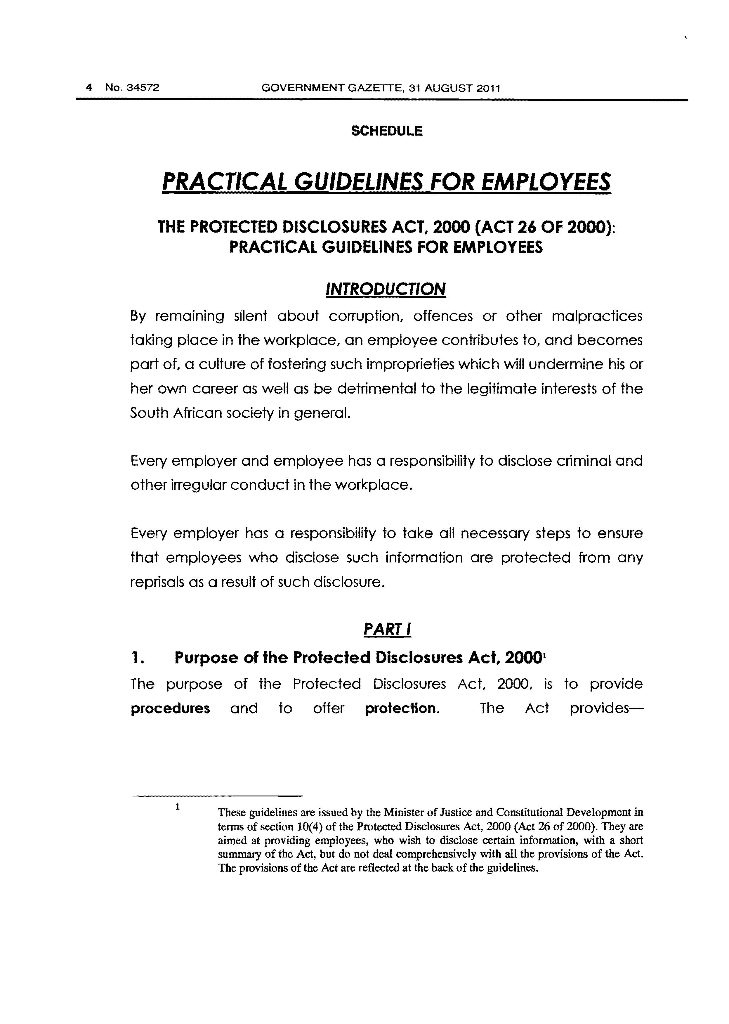
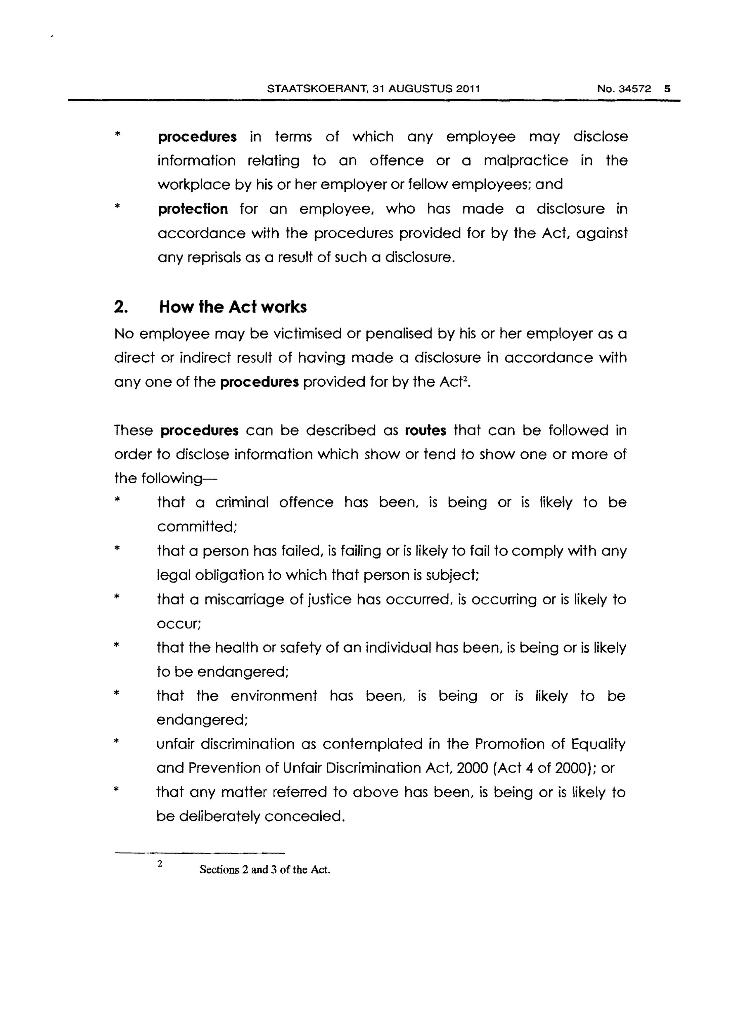
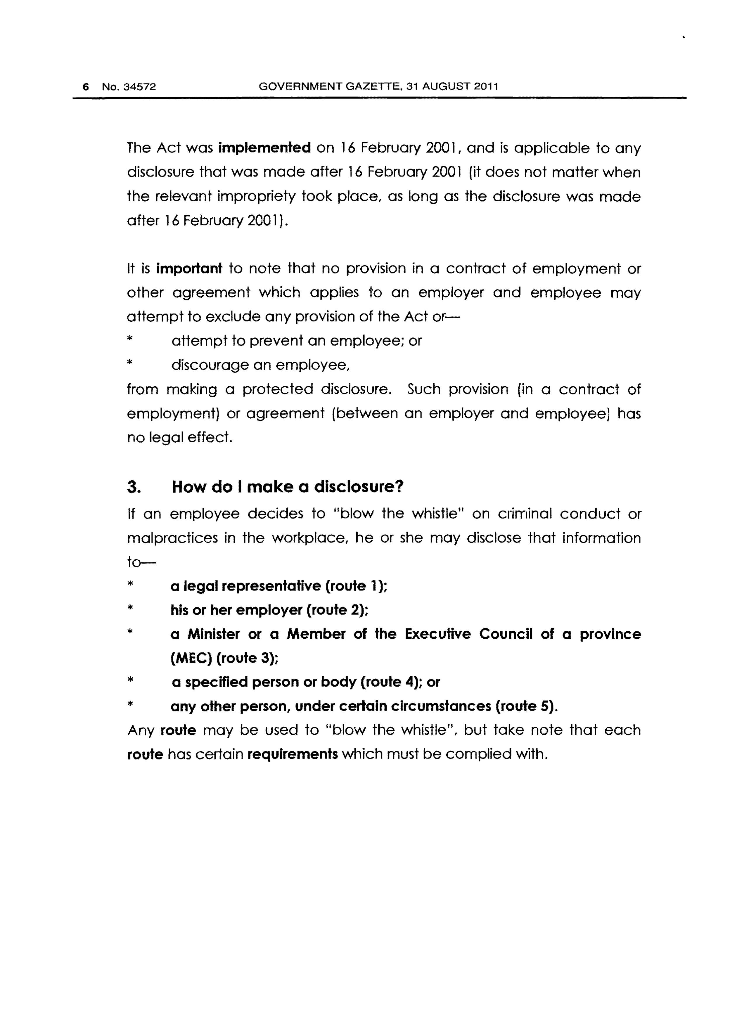
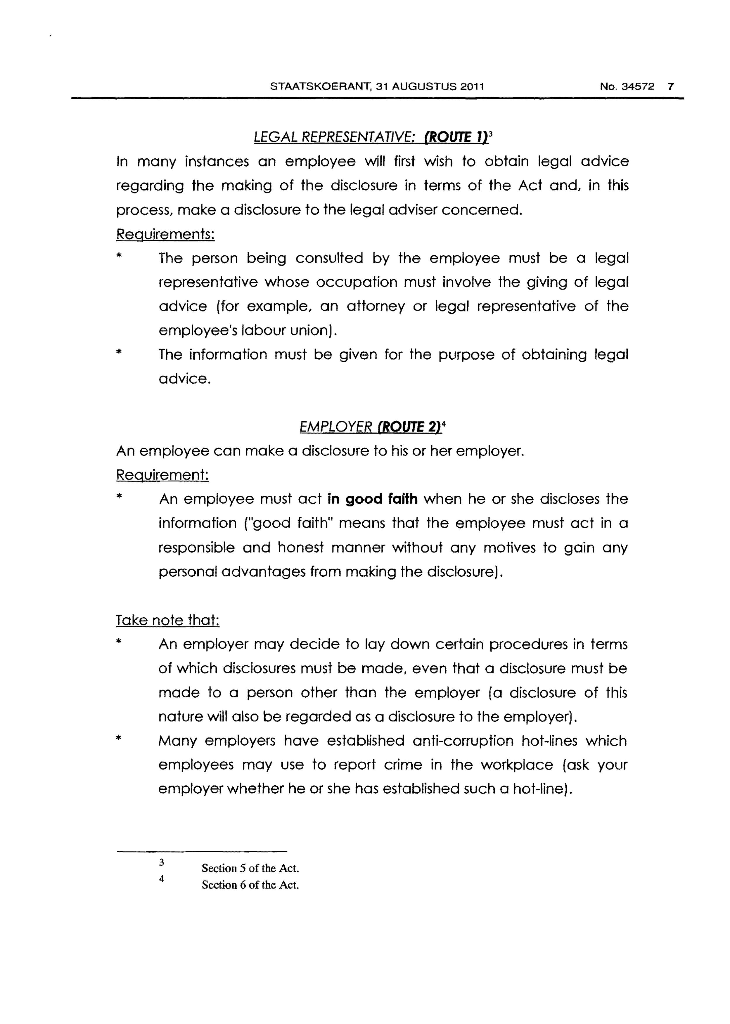
4 No, 34572 GOVERNMENT GAZETTE, 31 AUGUST 2011 SCHEDULE PRACTICAL GUIDELINES FOR EMPLOYEES THE PROTECTED DISCLOSURES ACT, 2000 (ACT 26 OF 2000): PRACTICAL GUIDELINES FOR EMPLOYEES INTRODUCTION By remaining silent about corruption, offences or other malpractices taking place in the workplace, an employee contributes to, and becomes part of, a culture of fostering such improprieties which will undermine his or her own career as well as be detrimental to the legitimate interests of the South African society in general. Every employer and employee has a responsibility to disclose criminal and other inegular conduct in the workplace. Every employer has a responsibility to take all necessary steps to ensure that employees who disclose such information are protected from any reprisals as a result of such disclosure. PARTI 1. Purpose of the Protected Disclosures Act, 2000 The purpose of the Protected Disclosures Act, 2000. is to provide procedures and fo oifer protection. The provides- Act 1 These guidelines are issued by the Minister of Justice and Constitutional Development in terms of section 10(4) of the Protected Disclosures Act, 2000 (Act 26 of 2000). They are aimed at providing employees, who wish to disclose certain information, with a short summary of the Act, but do not deal comprehensivcly with all the provisions of the Act. The provisions of the Act are reflected at the back of the guidelines. STAATSKOERANT, 31 AUGUSTUS 2011 No. 34572 5 procedures in terms of which any employee may disclose information relating to an offence or a malpractice in the workplace by his or her employer or fellow employees; and protection for an employee, who has made a disclosure in accordance with the procedures provided for by the Act, against any reprisals as a result of such a disclosure. 2. How the Act works No employee may be victimised or penalised by his or her employer as a direct or indirect result of having made a disclosure in accordance with any one of the procedures provided for by the Act. These procedures can be described as routes that can be followed in order to disclose information which show or tend to show one or more of the following that a criminal offence has been, is being or is likely to be committed; that a person has failed, is failing or is likely to fail to comply with any legal obligation to which that person is subject; that a miscarriage of justice has occurred, is occurring or is likely to occur that the health or safety of an individual has been, is being or is likely to be endangered: that the environment has been, is being or is likely to be endangered; unfair discrimination as contemplated in the Promotion of Equality and Prevention of Unfair Discrimination Act, 2000 (Act 4 of 2000); or that any matter referred to above has been, is being or is likely to be deliberately concealed. 2 Sections 2 and 3 of the Act. 6 No. 34572 GOVERNMENT GAZETTE, 31 AUGUST 2011 The Act was implemented on 16 February 2001, and is applicable to any disclosure that was made after 16 February 2001 (it does not matter when the relevant impropriety took place, as long as the disclosure was made after 16 February 2001). It is important to note that no provision in a contract of employment or other agreement which applies to an employer and employee may attempt to exclude any provision of the Actor attempt to prevent an employee; or discourage an employee, from making a protected disclosure. Such provision (in a contract of employment) or agreement (between an employer and employee has no legal effect. * 3. How do I make a disclosure? if an employee decides to "blow the whistle" on criminal conduct or malpractices in the workplace, he or she may disclose that information to- a legal representative (route 1); his or her employer (route 2); a Minister or a Member of the Executive Council of a province (MEC) (route 3); specified person or body (route 4); or any other person, under certain circumstances (route 5). Any route may be used to "blow the whistle", but take note that each route has certain requirements which must be complied with. STAATSKOERANT, 31 AUGUSTUS 2011 No. 34572 7 LEGAL REPRESENTATIVE: (ROUTE 1) In many instances an employee will first wish to obtain legal advice regarding the making of the disclosure in terms of the Act and, in this process, make a disclosure to the legal adviser concerned. Requirements: The person being consulted by the employee must be a legal representative whose occupation must involve the giving of legal advice (for example, an attorney or legal representative of the employee's labour union). The information must be given for the purpose of obtaining legal advice. EMPLOYER (ROUTE 2) An employee can make a disclosure to his or her employer. Requirement: An employee must act in good faith when he or she discloses the information ("good faith" means that the employee must act in a responsible and honest manner without any motives to gain any personal advantages from making the disclosure). Take note that: An employer may decide to lay down certain procedures in terms of which disclosures must be made, even that a disclosure must be made to a person other than the employer (a disclosure of this nature will also be regarded as a disclosure to the employer). Many employers have established anti-corruption hot-lines which employees may use to report crime in the workplace (ask your employer whether he or she has established such a hot-line). Section 5 of the Act. Section 6 of the Act. 8 No. 34572 GOVERNMENT GAZETTE, 31 AUGUST 2011 MINISTER OR MEC OF A PROVINCE: (ROUTE 3) An employee can make a disclosure to a Minister or an MEC of a province. Requirements: The employee must act in good faith when he or she discloses the information. This procedure only applies if the employee's employer is- an individual appointed by the relevant Minister or MEC in terms of legislation; or a body (eg a board or other institution) appointed by the relevant Minister or MEC in terms of legislation; or an organ of state falling within the area of responsibility of the relevant Minister or MEC. An organ of state is any state department or administration in the national or provincial sphere of government or any municipality in the local sphere of government or any other functionary (official) or institution exercising a power or performing a duty in terms of the Constitution or a provincial constitution or exercising a public power or performing a public function in terms of any other legislation. SPECIFIED PERSON OR BODY: (ROUTE 4 An employee can, at this stage make a disclosure to the Public Protector or Auditor-General. The Public Protector is a high level independent official who receives complaints against government agencies or officials and investigates improper prejudice suffered by a complainant for example as a result of abuse of power. Maladministration, dishonesty or improper dealings with regard to public money. 6 Section 7 of the Act. Section 8 of the Act. STAATSKOERANT, 31 AUGUSTUS 2011 No. 34572 9 improper enrichment and receipt of improper advantages can also be investigated. (For contact details see Part III.) The Auditor-General who is also a high level independent official must audit and report on the accounts, financial statements and financial management of all national and provincial state departments and administrations, all municipalities and any other institution or accounting entity required by national or provincial legislation to be audited by the Auditor-General. (For contact details see Part III.) Requirements: The disclosure must be made in good faith. The employee must reasonably believe that the impropriety which he or she wants to disclose, relates to matters that in the ordinary course are dealt with by the Public Protector or Auditor-General; and that the information and allegations contained in the disclosure are substantially true. GENERAL DISCLOSURE: (ROUTE 5) An employee can even make a disclosure to any person, for example, a member of the press (people working for radio and television stations or newspapers), a police official of the South African Police Service or a person working for an organisation which keeps watch over the public or the private sector. Requirements: The employee must act in good faith. The employee must reasonably believe that the information is substantially true. Section 9 of the Act
Step by Step Solution
There are 3 Steps involved in it
1 Expert Approved Answer
Step: 1 Unlock

Question Has Been Solved by an Expert!
Get step-by-step solutions from verified subject matter experts
Step: 2 Unlock
Step: 3 Unlock
 Study Help