







Question: question 3 need help 2. Suppose Pxy is a distribution on X x {0,1}. Recall our definition of the likelihood function (2) = P[Y =
question 3 need help
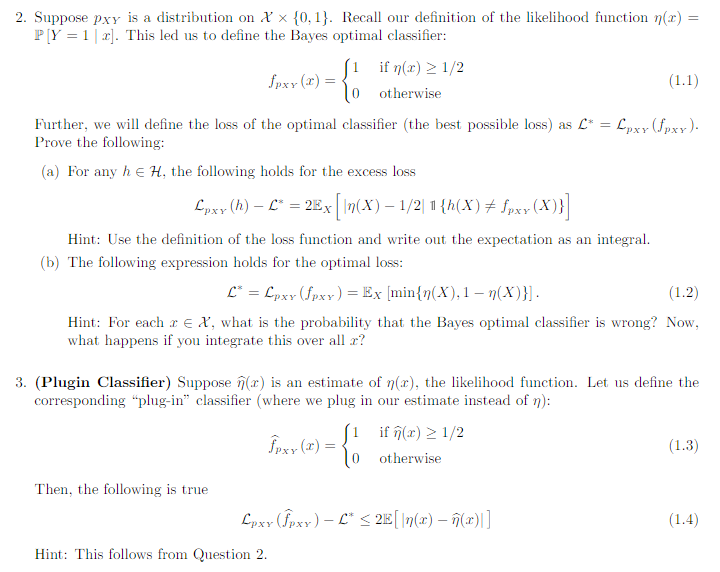
2. Suppose Pxy is a distribution on X x {0,1}. Recall our definition of the likelihood function (2) = P[Y = 1 x]. This led us to define the Bayes optimal classifier: i if n(x) > 1/2 fpxy (x) = (1.1) otherwise Further, we will define the loss of the optimal classifier (the best possible loss) as 2* = Lpxx pxy). Prove the following: (a) For any h H, the following holds for the excess loss Lyxx (h) L* = 28 x [ln(X) 1/21{h(x) + fpx? (x)}] Hint: Use the definition of the loss function and write out the expectation as an integral. (b) The following expression holds for the optimal loss: L* = Lpxx (fpxy) = Ex [min{n(X),1 - n(X)}]. (1.2) Hint: For each r e X', what is the probability that the Bayes optimal classifier is wrong? Now, what happens if you integrate this over all x? 3. (Plugin Classifier) Suppose (0) is an estimate of n(2), the likelihood function. Let us define the corresponding "plug-in classifier (where we plug in our estimate instead of n): fi if n(x) 1/2 fpxy (1) = (1.3) otherwise { Then, the following is true Lpxr fpxy) - 4* 1/2 fpxy (x) = (1.1) otherwise Further, we will define the loss of the optimal classifier (the best possible loss) as 2* = Lpxx pxy). Prove the following: (a) For any h H, the following holds for the excess loss Lyxx (h) L* = 28 x [ln(X) 1/21{h(x) + fpx? (x)}] Hint: Use the definition of the loss function and write out the expectation as an integral. (b) The following expression holds for the optimal loss: L* = Lpxx (fpxy) = Ex [min{n(X),1 - n(X)}]. (1.2) Hint: For each r e X', what is the probability that the Bayes optimal classifier is wrong? Now, what happens if you integrate this over all x? 3. (Plugin Classifier) Suppose (0) is an estimate of n(2), the likelihood function. Let us define the corresponding "plug-in classifier (where we plug in our estimate instead of n): fi if n(x) 1/2 fpxy (1) = (1.3) otherwise { Then, the following is true Lpxr fpxy) - 4*
Step by Step Solution
There are 3 Steps involved in it

Get step-by-step solutions from verified subject matter experts
 Study Help