







Question: Question 3 (PART A) Table 2 shows some data related to crime in different areas of England. When answering the questions that follow, assume that
Question 3 (PART A)
Table 2 shows some data related to crime in different areas of England. When answering the questions that follow, assume that the rates of offences in each area in the year ending June 2020 are valid indicators of the current annual risks of these offences.
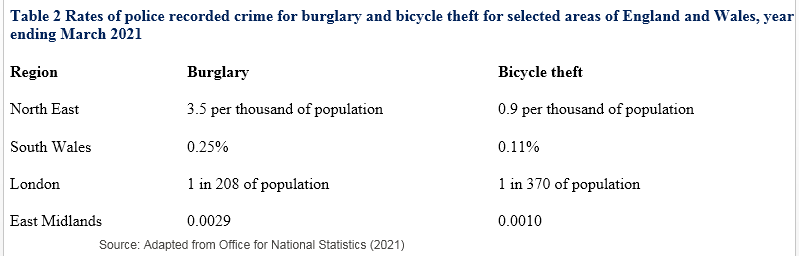
3.1 Transform the figures in Table 2 into one comparable measure of risk by expressing each probability as a decimal, rounded to four decimal places. (3 marks)
3.2 If crimes categorised as burglary and bicycle theft are independent events, what is the chance (expressed in percentage) of being a victim of both crimes next year in the East Midlands? (3 marks)
3.3 Give two reasons why a particular person in South Wales may in fact be at a higher risk of burglary than the probability shown in the table. (4 marks)
3.4 Briefly explain in your own words the meaning of moral hazard. Give two ways in which insurers may try to reduce the possibility of moral hazard. (5 marks)
Word limit for above questions: 800 words
Table 2 Rates of police recorded crime for burglary and bicycle theft for selected areas of England and Wales, year ending March 2021 Region North East South Wales London East Midlands Burglary 3.5 per thousand of population 0.25% 1 in 208 of population 0.0029 Source: Adapted from Office for National Statistics (2021) Bicycle theft 0.9 per thousand of population 0.11% 1 in 370 of population 0.0010 Table 2 Rates of police recorded crime for burglary and bicycle theft for selected areas of England and Wales, year ending March 2021 Region North East South Wales London East Midlands Burglary 3.5 per thousand of population 0.25% 1 in 208 of population 0.0029 Source: Adapted from Office for National Statistics (2021) Bicycle theft 0.9 per thousand of population 0.11% 1 in 370 of population 0.0010
Step by Step Solution
There are 3 Steps involved in it

Get step-by-step solutions from verified subject matter experts
 Study Help