







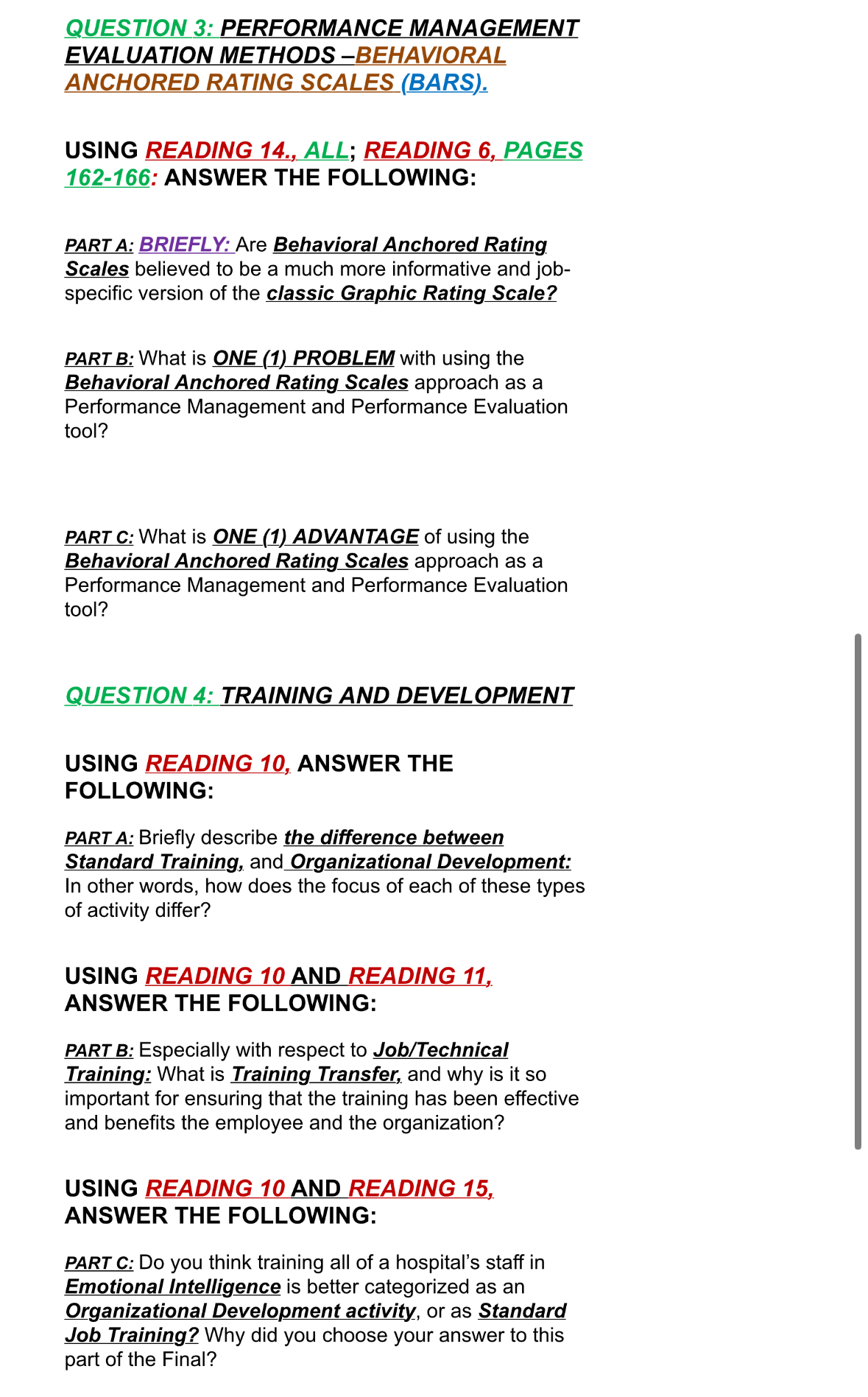
Question: QUESTION 3 : PERFORMANCE MANAGEMENT EVALUATION METHODS - BEHAVIORAL ANCHORED RATING SCALES ( BARS ) . USING READING 1 4 . , ALL; READING 6
QUESTION : PERFORMANCE MANAGEMENT
EVALUATION METHODS BEHAVIORAL
ANCHORED RATING SCALES BARS
USING READING ALL; READING PAGES
: ANSWER THE FOLLOWING:
PART A: BRIEFLY: Are Behavioral Anchored Rating
Scales believed to be a much more informative and job
specific version of the classic Graphic Rating Scale?
PART B: What is ONE PROBLEM with using the
Behavioral Anchored Rating Scales approach as a
Performance Management and Performance Evaluation
tool?
PART C: What is ONE ADVANTAGE of using the
Behavioral Anchored Rating Scales approach as a
Performance Management and Performance Evaluation
tool?
QUESTION : TRAINING AND DEVELOPMENT
USING READING ANSWER THE
FOLLOWING:
PART A: Briefly describe the difference between
Standard Training, and Organizational Development:
In other words, how does the focus of each of these types
of activity differ?
USING READING AND READING
ANSWER THE FOLLOWING:
PART B: Especially with respect to JobTechnical
Training: What is Training Transfer, and why is it so
important for ensuring that the training has been effective
and benefits the employee and the organization?
USING READING AND READING
ANSWER THE FOLLOWING:
PART C: Do you think training all of a hospital's staff in
Emotional Intelligence is better categorized as an
Organizational Development activity, or as Standard
Job Training? Why did you choose your answer to this
part of the Final?
Step by Step Solution
There are 3 Steps involved in it
1 Expert Approved Answer
Step: 1 Unlock

Question Has Been Solved by an Expert!
Get step-by-step solutions from verified subject matter experts
Step: 2 Unlock
Step: 3 Unlock
 Study Help