







Question: Question 3: Projects with Different Time Length (25 points) A town's recreation department is trying to decide how to use a plot of land. lICIIne
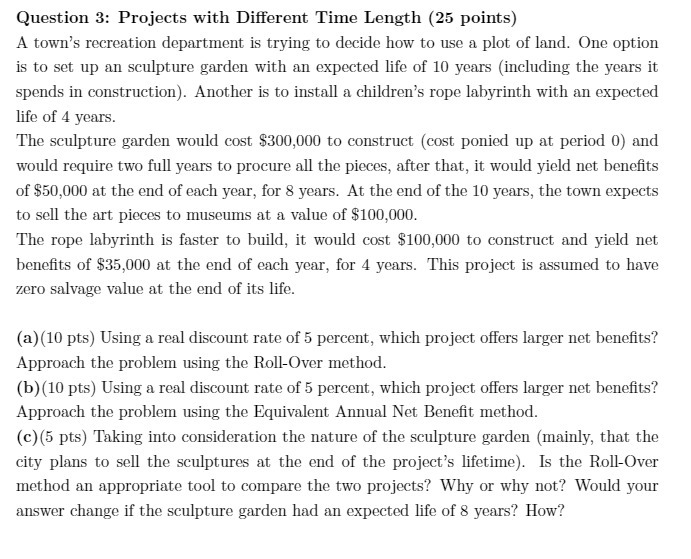
Question 3: Projects with Different Time Length (25 points) A town's recreation department is trying to decide how to use a plot of land. lICIIne option is to set up an sculpture garden with an expected life of ll] years [including the years it spends in construction}. Another is to install a children's rope labyrinth with an expected life of 4 yeais. The sculpture garden would cost $300,000 to construct {cost ponied up at period 1]) and would require two full years to procure all the pieces, after that, it would yield net benets of $5, at the end of each year, for 3 years. At the end of the ll] years, the town expects to sell the art pieces to museums at a value of $1,. The rope labyrinth is faster to build, it would cost $l, to construct and yield net benets of $354100 at the end of each year, for 4 years. This project is assumed to haye zero salvage value at the end of its life. {a)[1 pts] Using a real discount rate of 5 percent, which project o'ers larger net benets? Approach the problem using the RollDyer method. {b]{1 pts] Using a real discount rate of 5 percent, which project o'ers larger net benets? Approach the problem using the Equivalent Annual Net Benet method. {C}{5 pts} Taking into consideration the nature of the sculpture garden (mainly, that the city plans to sell the sculptures at the end of the project's lifetime). Is the RollOver method an appropriate tool to compare the two projects? Why or why not? Would your answer change if the sculpture garden had an expected life of 3 years? How
Step by Step Solution
There are 3 Steps involved in it

Get step-by-step solutions from verified subject matter experts
 Study Help