







Question: Question 3 Question-3 (VaR-1): This question is intended to help you understand how to estimate Value-at-Risk (VaR) and Conditional Value-at-Risk (CVaR). In parts (a) through
Question 3
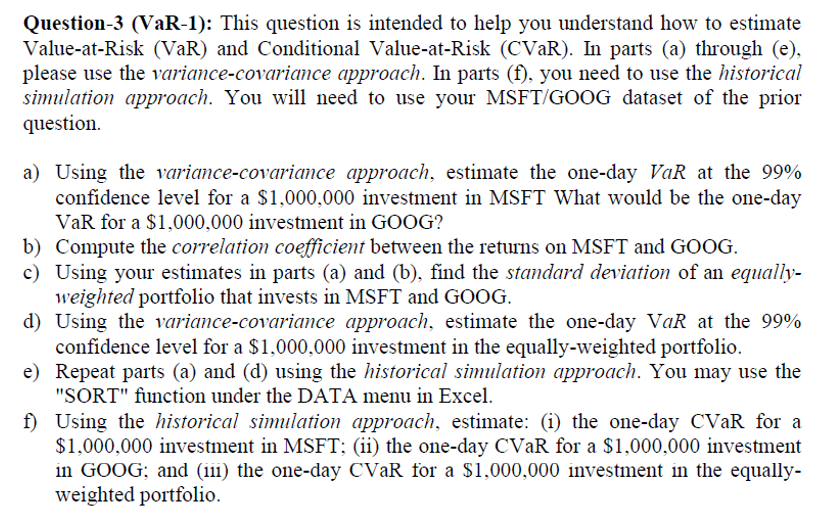
Question-3 (VaR-1): This question is intended to help you understand how to estimate Value-at-Risk (VaR) and Conditional Value-at-Risk (CVaR). In parts (a) through (e), please use the variance-covariance approach. In parts (f), you need to use the historical simulation approach. You will need to use your MSFT/GOOG dataset of the prior question. a) Using the variance-covariance approach, estimate the one-day VaR at the 99% confidence level for a $1,000,000 investment in MSFT What would be the one-day VaR for a $1,000,000 investment in GOOG? b) Compute the correlation coefficient between the returns on MSFT and GOOG. c) Using your estimates in parts (a) and (b), find the standard deviation of an equally- weighted portfolio that invests in MSFT and GOOG. d) Using the variance-covariance approach, estimate the one-day VaR at the 99% confidence level for a $1,000,000 investment in the equally-weighted portfolio. e) Repeat parts (a) and (d) using the historical simulation approach. You may use the "SORT" function under the DATA menu in Excel. f) Using the historical simulation approach, estimate: (i) the one-day CVaR for a $1,000,000 investment in MSFT; (ii) the one-day CVaR for a $1,000,000 investment in GOOG; and (iii) the one-day CVaR for a $1,000,000 investment in the equally- weighted portfolio
Step by Step Solution
There are 3 Steps involved in it

Get step-by-step solutions from verified subject matter experts
 Study Help