Question: Question 3. Read the above article Why Manufacturing Matters given on pg. 17, and answer the following questions. (40 points) (i) What evidence exists to
Question 3. Read the above article Why Manufacturing Matters given on pg. 17, and answer the following questions. (40 points) (i) What evidence exists to support the argument that manufacturing promotes economic growth?
Explain how manufacturing contributes to the economic development of Kuwait? (20 points) (ii) What policies can governments adopt to promote the growth of manufacturing? (20 points)
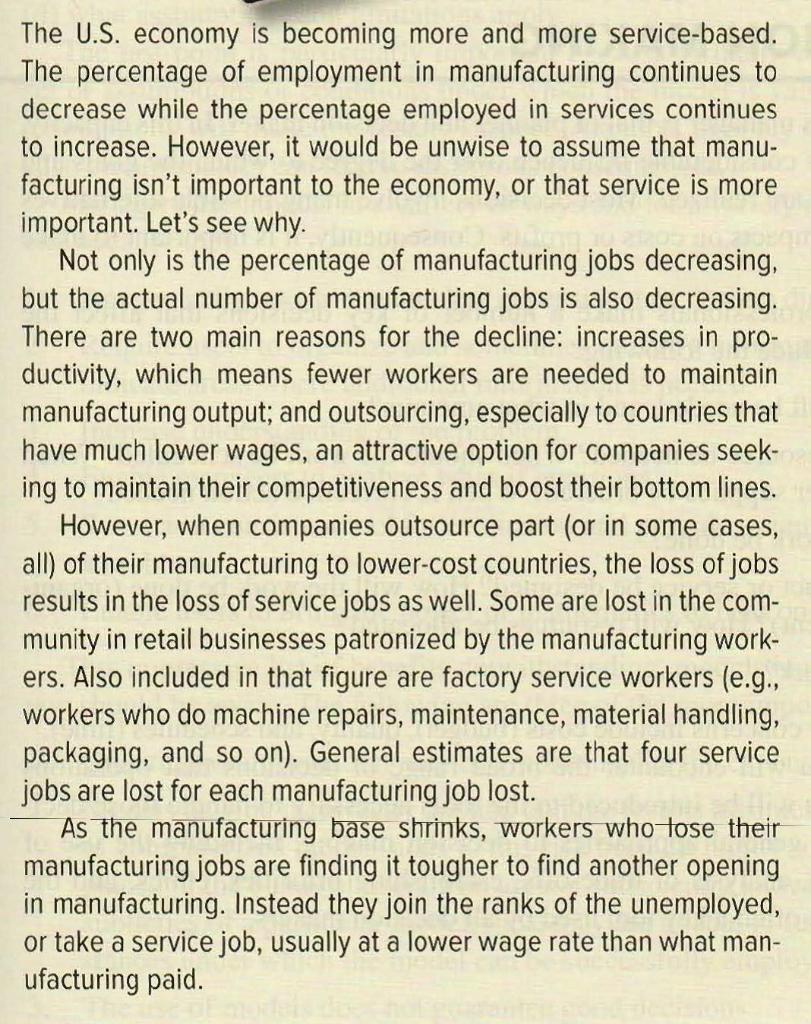
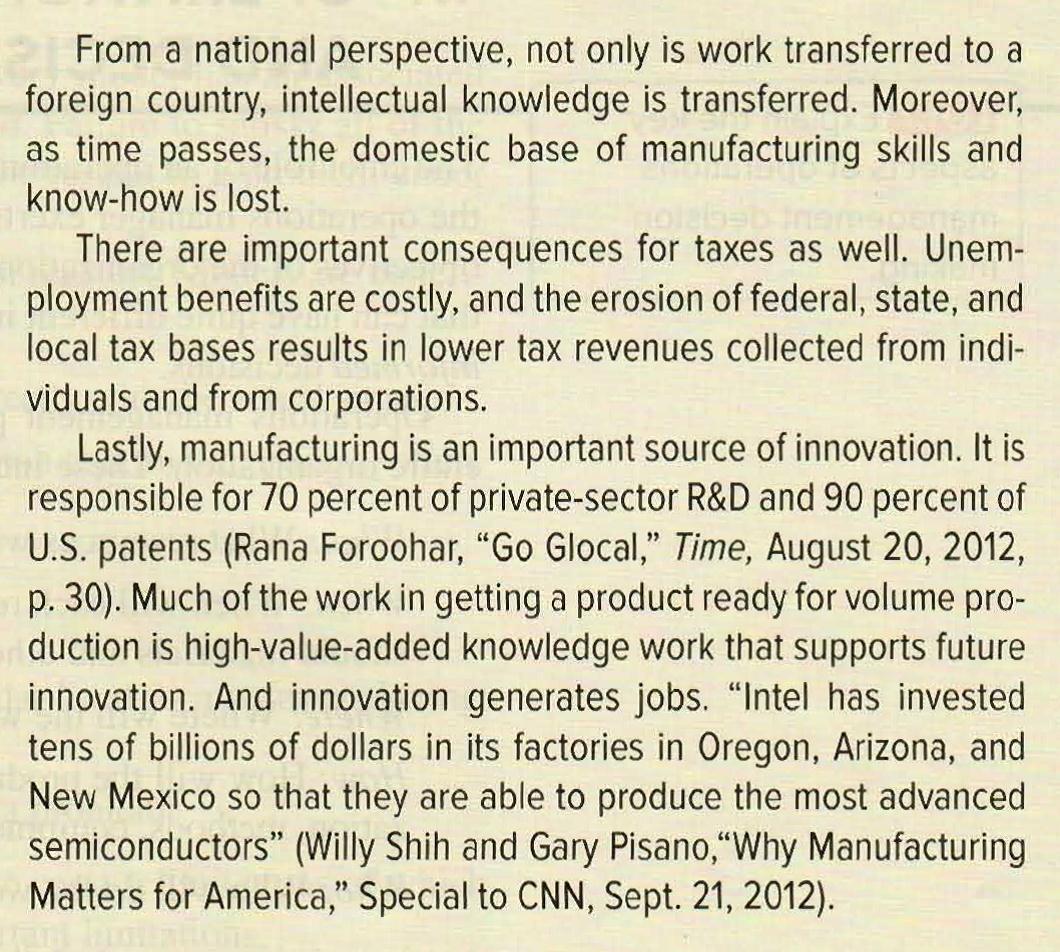
The U.S. economy is becoming more and more service-based. The percentage of employment in manufacturing continues to decrease while the percentage employed in services continues to increase. However, it would be unwise to assume that manu- facturing isn't important to the economy, or that service is more important. Let's see why. Not only is the percentage of manufacturing jobs decreasing, but the actual number of manufacturing jobs is also decreasing. There are two main reasons for the decline: increases in pro- ductivity, which means fewer workers are needed to maintain manufacturing output; and outsourcing, especially to countries that have much lower wages, an attractive option for companies seek- ing to maintain their competitiveness and boost their bottom lines. However, when companies outsource part (or in some cases, all) of their manufacturing to lower-cost countries, the loss of jobs results in the loss of service jobs as well. Some are lost in the com- munity in retail businesses patronized by the manufacturing work- ers. Also included in that figure are factory service workers (e.g., workers who do machine repairs, maintenance, material handling, packaging, and so on). General estimates are that four service jobs are lost for each manufacturing job lost. As the manufacturing base shrinks, workers who lose their manufacturing jobs are finding it tougher to find another opening in manufacturing. Instead they join the ranks of the unemployed, or take a service job, usually at a lower wage rate than what man- ufacturing paid. From a national perspective, not only is work transferred to a foreign country, intellectual knowledge is transferred. Moreover, as time passes, the domestic base of manufacturing skills and know-how is lost. There are important consequences for taxes as well. Unem- ployment benefits are costly, and the erosion of federal, state, and local tax bases results in lower tax revenues collected from indi- viduals and from corporations. Vid Lastly, manufacturing is an important source of innovation. It is responsible for 70 percent of private-sector R&D and 90 percent of U.S. patents (Rana Foroohar, "Go Glocal," Time, August 20, 2012, p. 30). Much of the work in getting a product ready for volume pro- duction is high-value-added knowledge work that supports future innovation. And innovation generates jobs. "Intel has invested tens of billions of dollars in its factories in Oregon, Arizona, and New Mexico so that they are able to produce the most advanced semiconductors" (Willy Shih and Gary Pisano, "Why Manufacturing Matters for America," Special to CNN, Sept. 21, 2012)









 Study Help