





Question: Question 3. You are working for an aggressive private equity fund. You want to evaluate a possible acquisition of CovidVac plc, which specialises in producing
Question 3.
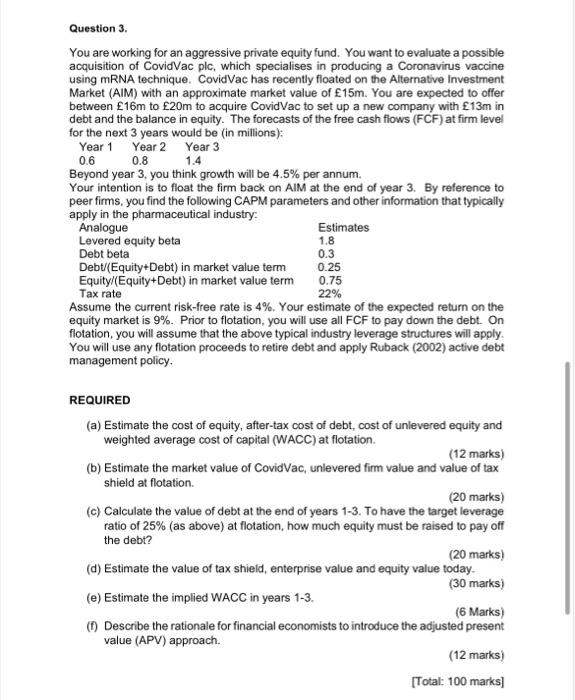
You are working for an aggressive private equity fund. You want to evaluate a possible acquisition of CovidVac plc, which specialises in producing a Coronavirus vaccine using mRNA technique. CovidVac has recently floated on the Alternative Investment Market (AIM) with an approximate market value of 15m. You are expected to offer between 16m to 20m to acquire CovidVac to set up a new company with 13m in debt and the balance in equity. The forecasts of the free cash flows (FCF) at firm level for the next 3 years would be (in millions):
Year 1 Year 2 Year 3
0.6 0.8 1.4
Beyond year 3, you think growth will be 4.5% per annum.
Your intention is to float the firm back on AIM at the end of year 3. By reference to peer firms, you find the following CAPM parameters and other information that typically apply in the pharmaceutical industry:
Analogue Estimates Levered equity beta 1.8
Debt beta 0.3 Debt/(Equity+Debt) in market value term 0.25 Equity/(Equity+Debt) in market value term 0.75
Tax rate 22%
Assume the current risk-free rate is 4%. Your estimate of the expected return on the equity market is 9%. Prior to flotation, you will use all FCF to pay down the debt. On flotation, you will assume that the above typical industry leverage structures will apply. You will use any flotation proceeds to retire debt and apply Ruback (2002) active debt management policy.
REQUIRED
(a) Estimate the cost of equity, after-tax cost of debt, cost of unlevered equity and weighted average cost of capital (WACC) at flotation.
(12 marks)
(b) Estimate the market value of CovidVac, unlevered firm value and value of tax
shield at flotation.
(20 marks)
(c) Calculate the value of debt at the end of years 1-3. To have the target leverage ratio of 25% (as above) at flotation, how much equity must be raised to pay off
the debt?
(20 marks)
(d) Estimate the value of tax shield, enterprise value and equity value today.
(30 marks)
(e) Estimate the implied WACC in years 1-3.
(6 Marks)
(f) Describetherationaleforfinancialeconomiststointroducetheadjustedpresent
BEFM016
Turn over
value (APV) approach.
4
(12 marks)
 Question 3. You are working for an aggressive private equity fund.

Question 3. You are working for an aggressive private equity fund. You want to evaluate a possible acquisition of CovidVac plc, which specialises in producing a Coronavirus vaccine using mRNA technique. CovidVac has recently floated on the Alternative Investment Market (AlM) with an approximate market value of 15m. You are expected to offer between 16m to 20m to acquire CovidVac to set up a new company with 13m in debt and the balance in equity. The forecasts of the free cash flows (FCF) at firm level for the next 3 years would be (in millions): Year10.6Year20.8Year31.4 Beyond year 3 , you think growth will be 4.5% per annum. Your intention is to float the firm back on AlM at the end of year 3 . By reference to peer firms, you find the following CAPM parameters and other information that typically apply in the pharmaceutical industry: Assume the current risk-free rate is 4%. Your estimate of the expected return on the equity market is 9%. Prior to flotation, you will use all FCF to pay down the debt. On flotation, you will assume that the above typical industry leverage structures will apply. You will use any flotation proceeds to retire debt and apply Ruback (2002) active debt management policy. REQUIRED (a) Estimate the cost of equity, after-tax cost of debt, cost of unlevered equity and weighted average cost of capital (WACC) at flotation. (12 marks) (b) Estimate the market value of CovidVac, unlevered firm value and value of tax shield at flotation. (20 marks) (c) Calculate the value of debt at the end of years 1-3. To have the target leverage ratio of 25% (as above) at flotation, how much equity must be raised to pay off the debt? (20 marks) (d) Estimate the value of tax shield, enterprise value and equity value today. ( 30 marks) (e) Estimate the implied WACC in years 13. (6 Marks) (f) Describe the rationale for financial economists to introduce the adjusted present value (APV) approach. (12 marks) [Total: 100 marks]

Step by Step Solution

There are 3 Steps involved in it

1 Expert Approved Answer
Step: 1 Unlock blur-text-image
Question Has Been Solved by an Expert!

Get step-by-step solutions from verified subject matter experts

Step: 2 Unlock
Step: 3 Unlock

Students Have Also Explored These Related Finance Questions!