Question: Question 30 (4 points) Table 7.5 A company makes four products that have the following characteristics: Product A sells for $50 but needs $10 of
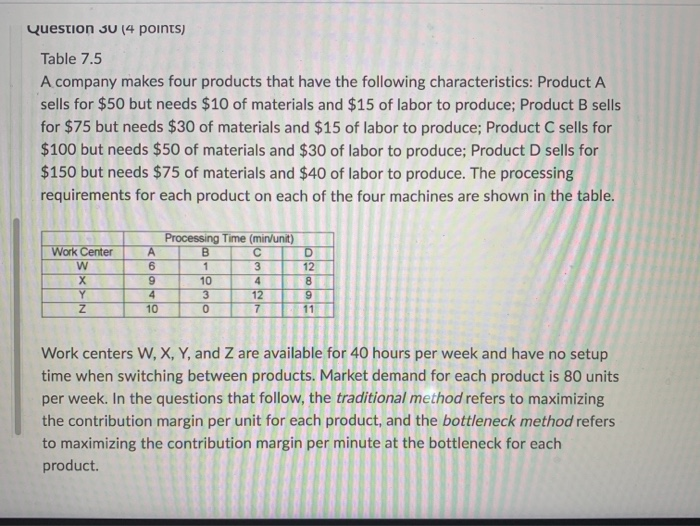
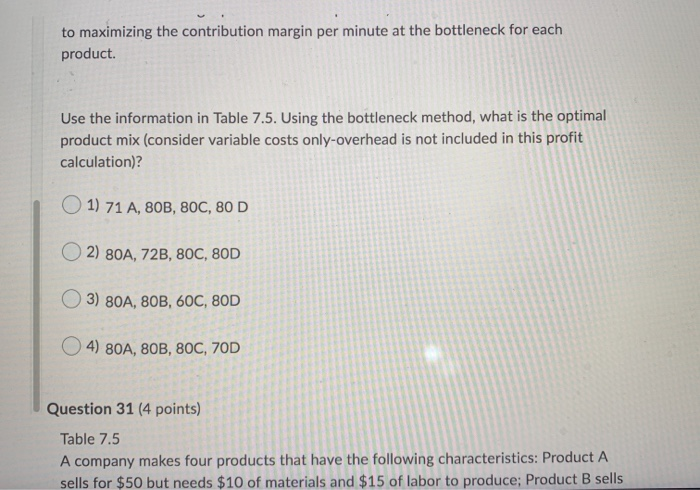
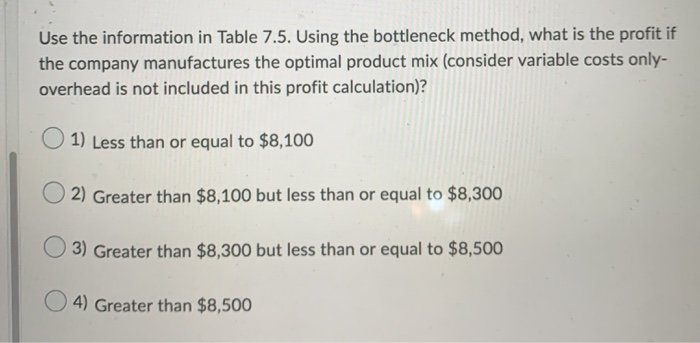
Question 30 (4 points) Table 7.5 A company makes four products that have the following characteristics: Product A sells for $50 but needs $10 of materials and $15 of labor to produce; Product B sells for $75 but needs $30 of materials and $15 of labor to produce; Product C sells for $100 but needs $50 of materials and $30 of labor to produce; Product D sells for $150 but needs $75 of materials and $40 of labor to produce. The processing requirements for each product on each of the four machines are shown in the table. Work Center C W A Processing Time (mir/unit) B 0 10 129 Y z L 10 Work centers W, X, Y, and Z are available for 40 hours per week and have no setup time when switching between products. Market demand for each product is 80 units per week. In the questions that follow, the traditional method refers to maximizing the contribution margin per unit for each product, and the bottleneck method refers to maximizing the contribution margin per minute at the bottleneck for each product. to maximizing the contribution margin per minute at the bottleneck for each product Use the information in Table 7.5. Using the bottleneck method, what is the optimal product mix (consider variable costs only-overhead is not included in this profit calculation)? 1) 71 A, 80B, 80C, 80 D 2) 80A, 72B, 80C, BOD 3) 80A, 80B, 60C, 80D 4) 80A, 80B, BOC, 70D Question 31 (4 points) Table 7.5 A company makes four products that have the following characteristics: Product A sells for $50 but needs $10 of materials and $15 of labor to produce; Product B sells Use the information in Table 7.5. Using the bottleneck method, what is the profit if the company manufactures the optimal product mix (consider variable costs only- overhead is not included in this profit calculation)? 1) Less than or equal to $8,100 O2) Greater than $8,100 but less than or equal to $8,300 0 3) Greater than $8,300 but less than or equal to $8,500 4) Greater than $8,500









 Study Help