







Question: Question 3&4 Exercise 3. Let U : R1 , R be a utility function, i.e., U (c1,C2) E R represents the utility level associated with
Question 3&4
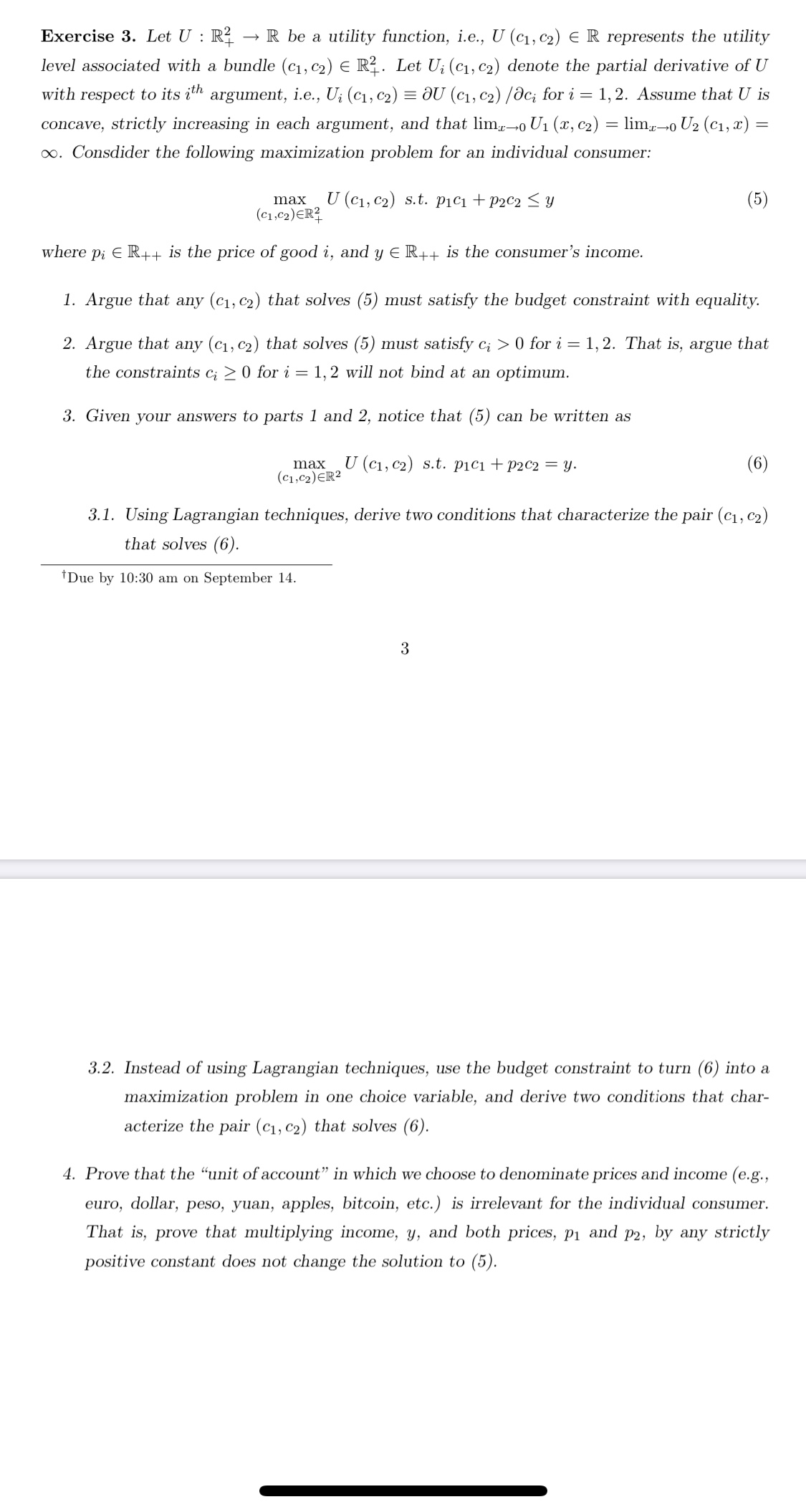
Exercise 3. Let U : R1 , R be a utility function, i.e., U (c1,C2) E R represents the utility level associated with a bundle (c1, 62) E 133,. Let Ug- (1,62) denote the partial derivative of U with respect to its it!\" argument, i.e., U1: (61,62) E 8U (61,62) [36,; fort = 1, 2. Assume that U is concave, strictly increasing in each argument, and that ling,0 U1 (3:, oz) : \"mm.0 U2 (c1, cc) : 00. Consdider the following maximization problem for an individual consumer: max U(C1,C2l S-t- P161 +P2C2 S y (5) (1,C2)R: where 10:: E R++ is the price of good i, and y E R++ is the consumer's income. 1. Argue that any (cth) that solves (5) must satisfy the budget constraint with equality. 2. Argue that any (c1,c2) that solves (5) must satisfy c,: > 0 for i = 1, 2. That is, argue that the constraints c1; 2 0 for i = 1, 2 will not bind at an optimum. 3. Given your answers to parts 1 and 2, notice that ( 5) can be written as max U(C1,Cg) S.t. p161+P262 = y. (6) (1,62)ER2 3.1. Using Lagrangian techniques, derive two conditions that characterize the pair (cl, C2) that solves (6). tDue by 10:30 am on September 14. 3.2. Instead of using Lagrangian techniques, use the budget constraint to turn (6) into a maximization problem in one choice variable, and derive two conditions that char acterize the pair {c1,c2) that solves (6) 4. Prove that the \"unit ofaccount\" in which we choose to denominate prices and income (e.g., euro, dollar, peso, yuan, apples, bitcoin, etc.) is irrelevant for the individual consumer. That is, prove that multiplying income, y, and both prices, p1 and p2, by any strictly positive constant does not change the solution to
Step by Step Solution
There are 3 Steps involved in it

Get step-by-step solutions from verified subject matter experts
 Study Help