







Question: Question #3-6 Marks If P(c) is a polynomial and c is a constant for which P(c) 0, then c is called a zero of P(r)
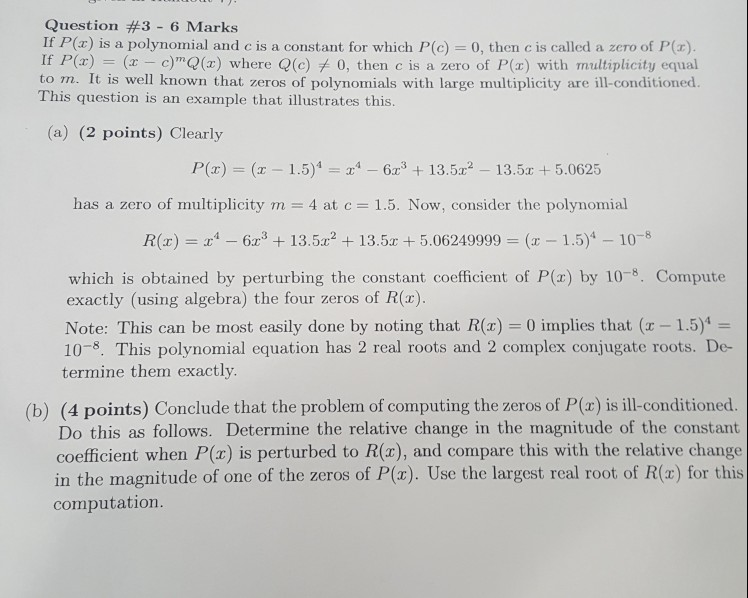
Question #3-6 Marks If P(c) is a polynomial and c is a constant for which P(c) 0, then c is called a zero of P(r) If P(a) - ( c)Q(z) where Q(c) 0, then c is a zero of P(r) with multiplicity equal This question is an example that illustrates this. (a) (2 points) Clearly P(x) ( 1.5)4 63 13.52 13.5x 5.0625 has a zero of multiplicity m 4 at c 1.5. Now, consider the polynomial R(r)613.513.5. 5.06249999 ( 1.5)4 -108 which is obtained by perturbing the constant coefficient of P(x) by 10-8. Compute exactly (using algebra) the four zeros of R() Note: This can be most easily done by noting that R(z) 0 implies that (r-1.5)" 10-8. This polynomial equation has 2 real roots and 2 complex conjugate roots. De- termine them exactly (b) (4 points) Conclude that the problem of computing the zeros of P(x) is ill-conditioned Do this as follows. Determine the relative change in the magnitude of the constant coefficient when P(x) is perturbed to R(x), and compare this with the relative change in the magnitude of one of the zeros of P(x). Use the largest real root of R(x) for this computation
Step by Step Solution
There are 3 Steps involved in it

Get step-by-step solutions from verified subject matter experts
 Study Help