







Question: Question 38 (5 points) Bonus Question: Which one is INCORRECT? a) A statistical test conducted to determine whether to reject or not reject a hypothesized
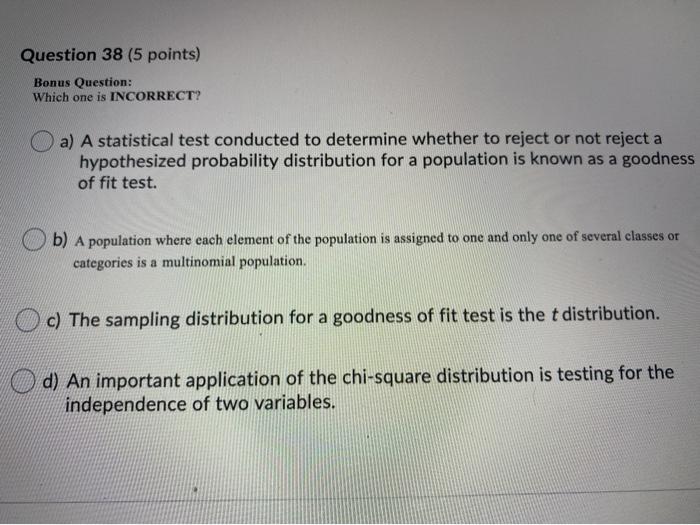
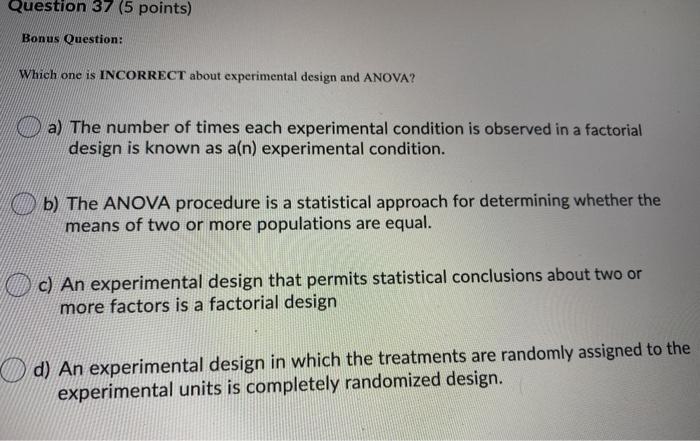
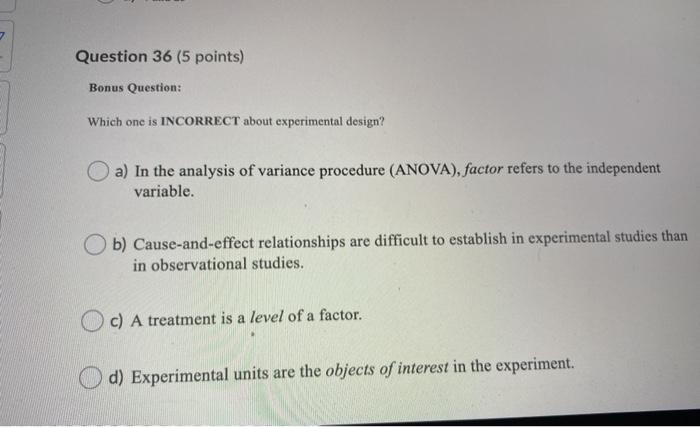
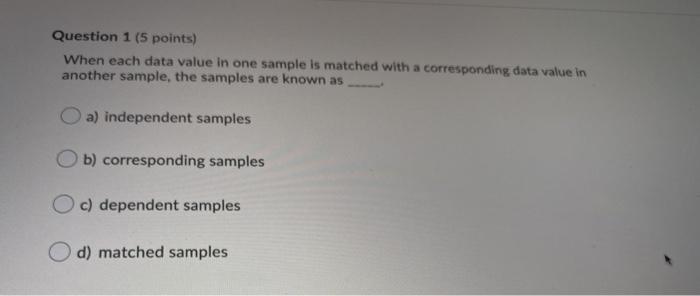
Question 38 (5 points) Bonus Question: Which one is INCORRECT? a) A statistical test conducted to determine whether to reject or not reject a hypothesized probability distribution for a population is known as a goodness of fit test. b) A population where each element of the population is assigned to one and only one of several classes or categories is a multinomial population c) The sampling distribution for a goodness of fit test is the t distribution. d) An important application of the chi-square distribution is testing for the independence of two variables. Question 37 (5 points) Bonus Question: Which one is INCORRECT about experimental design and ANOVA? a) The number of times each experimental condition is observed in a factorial design is known as a(n) experimental condition. b) The ANOVA procedure is a statistical approach for determining whether the means of two or more populations are equal. c) An experimental design that permits statistical conclusions about two or more factors is a factorial design d) An experimental design in which the treatments are randomly assigned to the experimental units is completely randomized design. Question 36 (5 points) Bonus Question: Which one is INCORRECT about experimental design? a) In the analysis of variance procedure (ANOVA), factor refers to the independent variable. Ob) Cause-and-effect relationships are difficult to establish in experimental studies than in observational studies. c) A treatment is a level of a factor. d) Experimental units are the objects of interest in the experiment. Question 1 (5 points) When each data value in one sample is matched with a corresponding data value in another sample, the samples are known as a) independent samples Ob) corresponding samples c) dependent samples Od) matched samples
Step by Step Solution
There are 3 Steps involved in it

Get step-by-step solutions from verified subject matter experts
 Study Help