







Question: Question 4: 15 marks a) Consider a hypothetical DWT Decomposition Level information given below for an image of size 1024x1024 pixels. Answer the following questions:
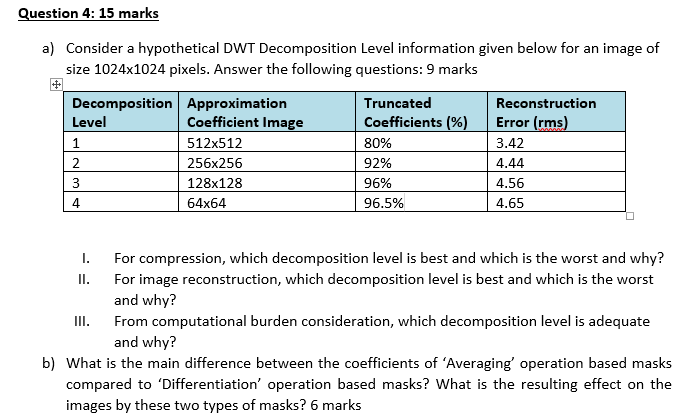
Question 4: 15 marks a) Consider a hypothetical DWT Decomposition Level information given below for an image of size 1024x1024 pixels. Answer the following questions: 9 marks + Decomposition Approximation Level Coefficient Image 1 512x512 2 256x256 3 128x128 4 64x64 Truncated Coefficients (%) 80% 92% 96% 96.5% Reconstruction Error (rms) 3.42 4.44 4.56 4.65 1. For compression, which decomposition level is best and which is the worst and why? II. For image reconstruction, which decomposition level is best and which is the worst and why? III. From computational burden consideration, which decomposition level is adequate and why? b) What is the main difference between the coefficients of 'Averaging' operation based masks compared to 'Differentiation' operation based masks? What is the resulting effect on the images by these two types of masks? 6 marks Question 4: 15 marks a) Consider a hypothetical DWT Decomposition Level information given below for an image of size 1024x1024 pixels. Answer the following questions: 9 marks + Decomposition Approximation Level Coefficient Image 1 512x512 2 256x256 3 128x128 4 64x64 Truncated Coefficients (%) 80% 92% 96% 96.5% Reconstruction Error (rms) 3.42 4.44 4.56 4.65 1. For compression, which decomposition level is best and which is the worst and why? II. For image reconstruction, which decomposition level is best and which is the worst and why? III. From computational burden consideration, which decomposition level is adequate and why? b) What is the main difference between the coefficients of 'Averaging' operation based masks compared to 'Differentiation' operation based masks? What is the resulting effect on the images by these two types of masks? 6 marks
Step by Step Solution
There are 3 Steps involved in it

Get step-by-step solutions from verified subject matter experts
 Study Help