





Question: Question 4 15 points Save Answer a) Mention two cases wherein two consecutive iteration of the simplex method would yield the same objective function value.
Question 4 15 points Save Answer a) Mention two

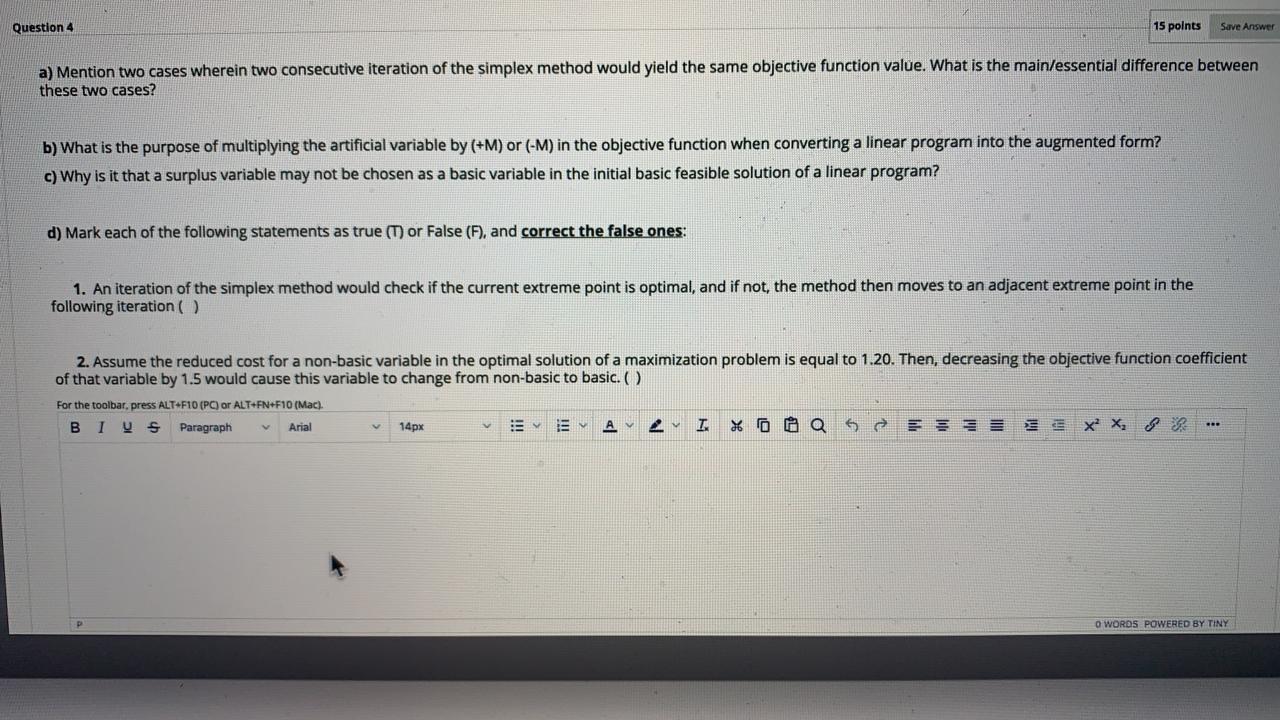
Question 4 15 points Save Answer a) Mention two cases wherein two consecutive iteration of the simplex method would yield the same objective function value. What is the main/essential difference between these two cases? b) What is the purpose of multiplying the artificial variable by (+M) or (-M) in the objective function when converting a linear program into the augmented form? c) Why is it that a surplus variable may not be chosen as a basic variable in the initial basic feasible solution of a linear program? d) Mark each of the following statements as true (1) or False (F), and correct the false ones: 1. An iteration of the simplex method would check if the current extreme point is optimal, and if not, the method then moves to an adjacent extreme point in the following iteration () 2. Assume the reduced cost for a non-basic variable in the optimal solution of a maximization problem is equal to 1.20. Then, decreasing the objective function coefficient of that variable by 1.5 would cause this variable to change from non-basic to basic. () For the toolbar, press ALT+F10 (PC) or ALT+FN+F10 (Mac). B 1 Paragraph Arial 14px T. GQ x x O WORDS POWERED BY TINY

Step by Step Solution

There are 3 Steps involved in it

1 Expert Approved Answer
Step: 1 Unlock blur-text-image

Question Has Been Solved by an Expert!

Get step-by-step solutions from verified subject matter experts

Step: 2 Unlock
Step: 3 Unlock

Students Have Also Explored These Related General Management Questions!