







Question: Question 4 (2 points) Suppose that we have a population in which out of every ten U.S. households, three have no dogs, 4 have 1
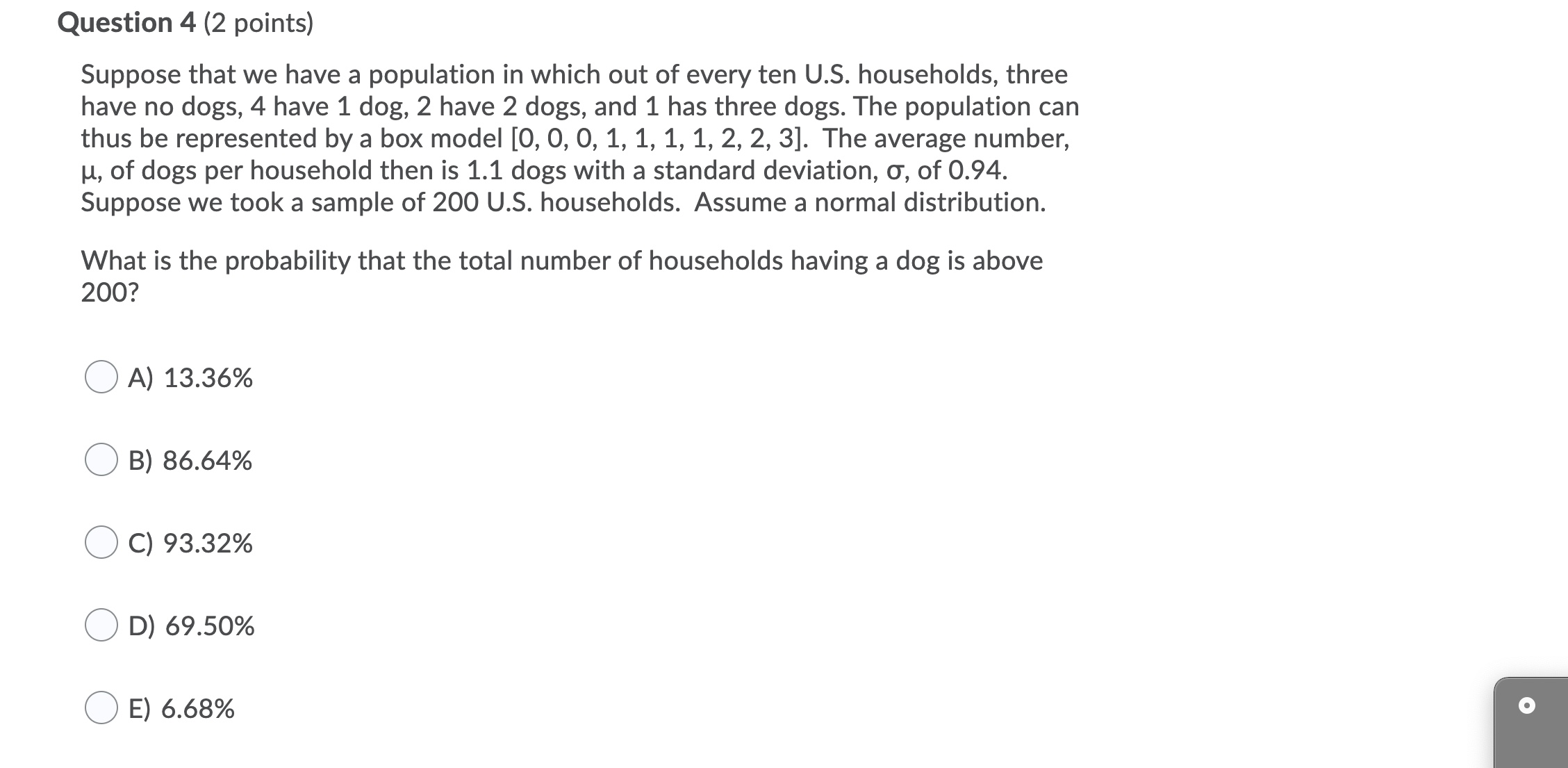
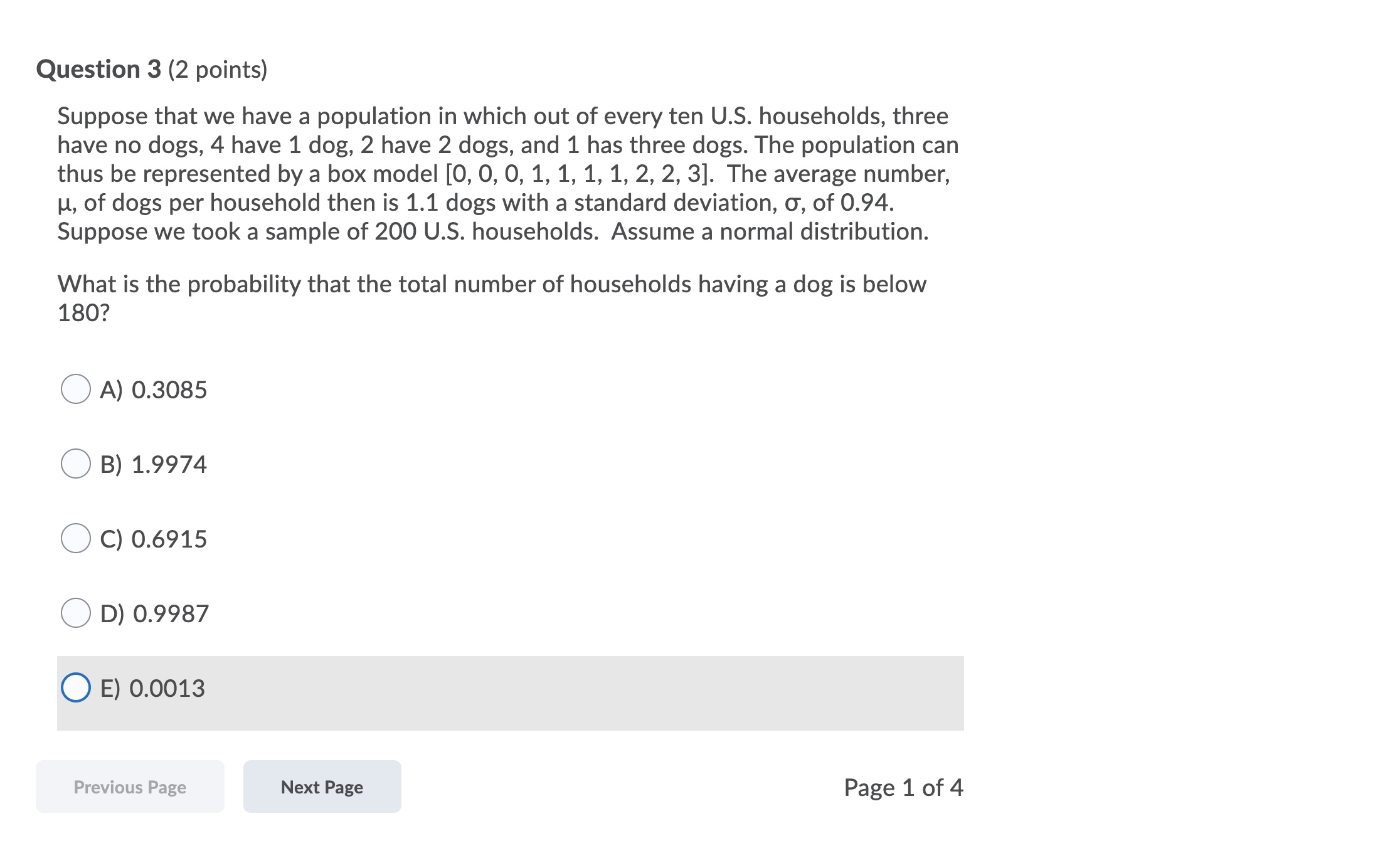
Question 4 (2 points) Suppose that we have a population in which out of every ten U.S. households, three have no dogs, 4 have 1 dog, 2 have 2 dogs, and 1 has three dogs. The population can thus be represented by a box model [0, 0,0, 1, 1, 1, 1, 2, 2,3]. The average number, )1, of dogs per household then is 1.1 dogs with a standard deviation, 0', of 0.94. Suppose we took a sample of 200 US. households. Assume a normal distribution. What is the probability that the total number of households having a dog is above 200? Q A) 13.36% 0 B) 86.64% 0 C) 93.32% 0 D) 69.50% 0 E) 6.68% Question 3 (2 points) Suppose that we have a population in which out of every ten US. households, three have no dogs, 4 have 1 dog, 2 have 2 dogs, and 1 has three dogs. The population can thus be represented by a box model [0, 0,0, 1, 1, 1, 1, 2, 2, 3]. The average number, 1.1, of dogs per household then is 1.1 dogs with a standard deviation, 0', of 0.94. Suppose we took a sample of 200 US. households. Assume a normal distribution. What is the probability that the total number of households having a dog is below 180? Q A) 0.3035 0 B) 1.9974 0 C) 0.6915 0 D) 0.9987 0 E) 0.0013 Previous Page Next Page Page 1 0f 4
Step by Step Solution
There are 3 Steps involved in it

Get step-by-step solutions from verified subject matter experts
 Study Help