







Question: Question 4: 30 pts An X-ray diffraction experiment was performed with a copper specimen. The illuminaion was achieved with X-rays of Cu-Ka radiation. The
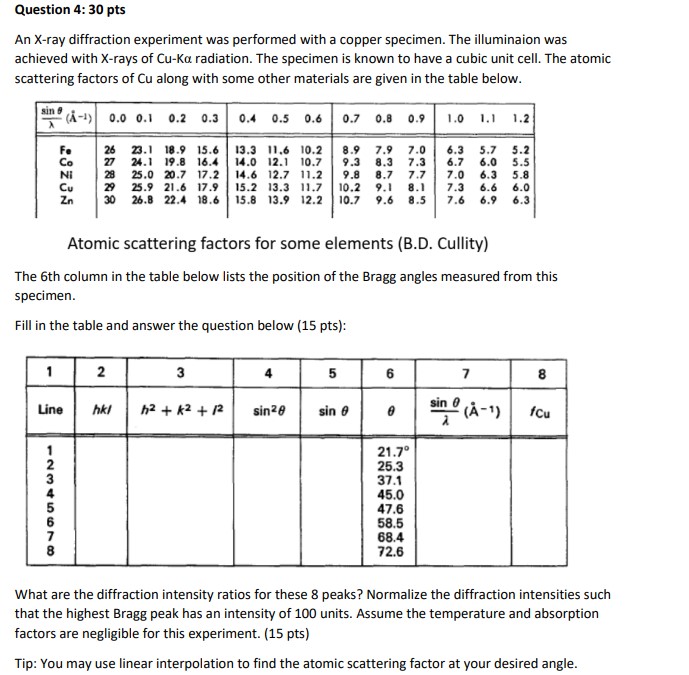
Question 4: 30 pts An X-ray diffraction experiment was performed with a copper specimen. The illuminaion was achieved with X-rays of Cu-Ka radiation. The specimen is known to have a cubic unit cell. The atomic scattering factors of Cu along with some other materials are given in the table below. sin (A) 0.0 0.1 0.2 0.3 0.4 0.5 0.6 0.7 0.8 0.9 1.0 1.1 1.2 Fe 26 23.1 18.9 15.6 13.3 11.6 10.2 8.9 7.9 7.0 6.3 5.7 5.2 Co 27 24.1 19.8 16.4 Ni 28 25.0 20.7 17.2 Cu 29 Zn 30 10.7 11.2 25.9 21.6 17.9 15.2 13.3 11.7 26.8 22.4 18.6 15.8 13.9 12.2 14.0 12.1 9.3 8.3 7.3 6.7 6.0 5.5 14.6 12.7 9.8 8.7 7.7 7.0 6.3 5.8 10.2 9.1 8.1 7.3 6.6 6.0 10.7 9.6 8.5 7.6 6.9 6.3 Atomic scattering factors for some elements (B.D. Cullity) The 6th column in the table below lists the position of the Bragg angles measured from this specimen. Fill in the table and answer the question below (15 pts): 1 2 3 4 5 6 7 8 Line hkl h + k + 12 sin20 sin 0 sin (A-1) fcu 12345678 8 21.7 25.3 37.1 45.0 47.6 58.5 68.4 72.6 What are the diffraction intensity ratios for these 8 peaks? Normalize the diffraction intensities such that the highest Bragg peak has an intensity of 100 units. Assume the temperature and absorption factors are negligible for this experiment. (15 pts) Tip: You may use linear interpolation to find the atomic scattering factor at your desired angle.
Step by Step Solution
There are 3 Steps involved in it

Get step-by-step solutions from verified subject matter experts
 Study Help