







Question: Question 4: (3+8) a) There are few documents stuck for printing in a printing queue. The person responsible for printing performs certain random operations to
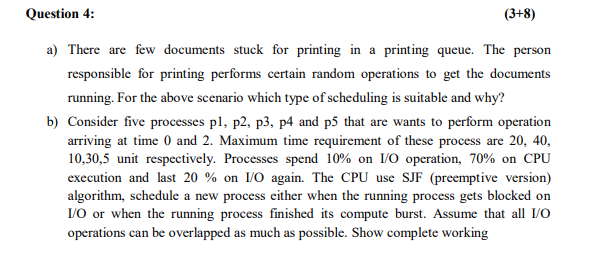
Question 4: (3+8) a) There are few documents stuck for printing in a printing queue. The person responsible for printing performs certain random operations to get the documents running. For the above scenario which type of scheduling is suitable and why? b) Consider five processes pl, p2, p3, p4 and p5 that are wants to perform operation arriving at time 0 and 2. Maximum time requirement of these process are 20, 40, 10,30,5 unit respectively. Processes spend 10% on 1/0 operation, 70% on CPU execution and last 20 % on 1/0 again. The CPU use SJF (preemptive version) algorithm, schedule a new process either when the running process gets blocked on 1/0 or when the running process finished its compute burst. Assume that all I/O operations can be overlapped as much as possible. Show complete working Question 4: (3+8) a) There are few documents stuck for printing in a printing queue. The person responsible for printing performs certain random operations to get the documents running. For the above scenario which type of scheduling is suitable and why? b) Consider five processes pl, p2, p3, p4 and p5 that are wants to perform operation arriving at time 0 and 2. Maximum time requirement of these process are 20, 40, 10,30,5 unit respectively. Processes spend 10% on 1/0 operation, 70% on CPU execution and last 20 % on 1/0 again. The CPU use SJF (preemptive version) algorithm, schedule a new process either when the running process gets blocked on 1/0 or when the running process finished its compute burst. Assume that all I/O operations can be overlapped as much as possible. Show complete working
Step by Step Solution
There are 3 Steps involved in it

Get step-by-step solutions from verified subject matter experts
 Study Help