







Question: Question 4 (4 +18 + 12 = 34) A 400 mg dose of a drug was given to a patient as an IV bolus. Blood
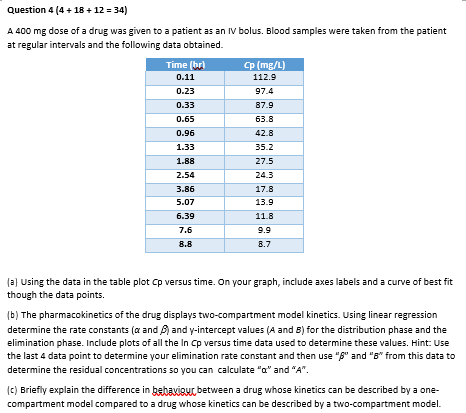
Question 4 (4 +18 + 12 = 34) A 400 mg dose of a drug was given to a patient as an IV bolus. Blood samples were taken from the patient at regular intervals and the following data obtained. Time (bri Cp (mg/L) 0.11 112.9 0.23 97.4 0.33 87.9 0.65 63.8 0.96 42.8 1.33 35.2 1.88 27.5 2.54 24.3 3.86 17.8 5.07 13.9 6.39 11.8 7.6 9.9 8.8 8.7 (a] Using the data in the table plot Cp versus time. On your graph, include axes labels and a curve of best fit though the data points. (b) The pharmacokinetics of the drug displays two-compartment model kinetics. Using linear regression determine the rate constants (a and B) and y-intercept values (A and B) for the distribution phase and the elimination phase. Include plots of all the In Cp versus time data used to determine these values. Hint: Use the last 4 data point to determine your elimination rate constant and then use "9" and "5" from this data to determine the residual concentrations so you can calculate "a" and "A". 1) Briefly explain the difference in bebaxisur between a drug whose kinetics can be described by a one- compartment model compared to a drug whose kinetics can be described by a two-compartment model. Question 4 (4 +18 + 12 = 34) A 400 mg dose of a drug was given to a patient as an IV bolus. Blood samples were taken from the patient at regular intervals and the following data obtained. Time (bri Cp (mg/L) 0.11 112.9 0.23 97.4 0.33 87.9 0.65 63.8 0.96 42.8 1.33 35.2 1.88 27.5 2.54 24.3 3.86 17.8 5.07 13.9 6.39 11.8 7.6 9.9 8.8 8.7 (a] Using the data in the table plot Cp versus time. On your graph, include axes labels and a curve of best fit though the data points. (b) The pharmacokinetics of the drug displays two-compartment model kinetics. Using linear regression determine the rate constants (a and B) and y-intercept values (A and B) for the distribution phase and the elimination phase. Include plots of all the In Cp versus time data used to determine these values. Hint: Use the last 4 data point to determine your elimination rate constant and then use "9" and "5" from this data to determine the residual concentrations so you can calculate "a" and "A". 1) Briefly explain the difference in bebaxisur between a drug whose kinetics can be described by a one- compartment model compared to a drug whose kinetics can be described by a two-compartment model
Step by Step Solution
There are 3 Steps involved in it

Get step-by-step solutions from verified subject matter experts
 Study Help