







Question: Question 4 (8 points): a) (2 points) As a newly minted (developed) NK cell, you exit to the periphery bearing some spiffy new duds (surface
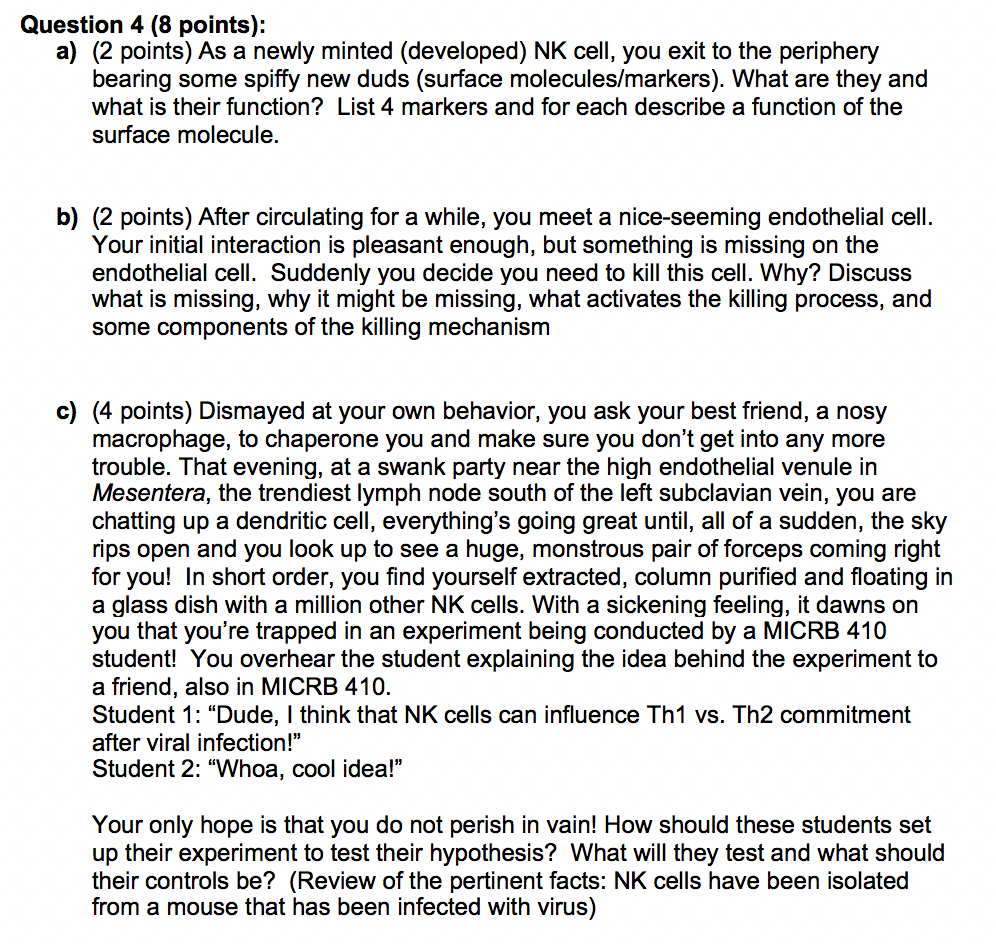
Question 4 (8 points): a) (2 points) As a newly minted (developed) NK cell, you exit to the periphery bearing some spiffy new duds (surface molecules/markers). What are they and what is their function? List 4 markers and for each describe a function of the surface molecule b) (2 points) After circulating for a while, you meet a nice-seeming endothelial cell Your initial interaction is pleasant enough, but something is missing on the endothelial cell. Suddenly you decide you need to kill this cell. Why? Discuss what is missing, why it might be missing, what activates the killing process, and some components of the killing mechanism c) (4 points) Dismayed at your own behavior, you ask your best friend, a nosy macrophage, to chaperone you and make sure you don't get into any more trouble. Ihat evening, at a swank party near the high endothelial venule in Mesentera, the trendiest lymph node south of the left subclavian vein, you are chatting up a dendritic cell, everything's going great until, all of a sudden, the sky rips open and you look up to see a huge, monstrous pair of forceps coming right for you! In short order, you find yourself extracted, column purified and floating in a glass dish with a million other NK cells. With a sickening feeling, it dawns on you that you're trapped in an experiment being conducted by a MICRB 410 student! You overhear the student explaining the idea behind the experiment to a friend, also in MICRB 410 Student 1: "Dude, I think that NK cells can influence Th1 vs. Th2 commitment after viral infection! Student 2: "Whoa, cool idea!" Your only hope is that you do not perish in vain! How should these students set up their experiment to test their hypothesis? What will they test and what should their controls be? (Review of the pertinent facts: NK cells have been isolated from a mouse that has been infected with virus) Question 4 (8 points): a) (2 points) As a newly minted (developed) NK cell, you exit to the periphery bearing some spiffy new duds (surface molecules/markers). What are they and what is their function? List 4 markers and for each describe a function of the surface molecule b) (2 points) After circulating for a while, you meet a nice-seeming endothelial cell Your initial interaction is pleasant enough, but something is missing on the endothelial cell. Suddenly you decide you need to kill this cell. Why? Discuss what is missing, why it might be missing, what activates the killing process, and some components of the killing mechanism c) (4 points) Dismayed at your own behavior, you ask your best friend, a nosy macrophage, to chaperone you and make sure you don't get into any more trouble. Ihat evening, at a swank party near the high endothelial venule in Mesentera, the trendiest lymph node south of the left subclavian vein, you are chatting up a dendritic cell, everything's going great until, all of a sudden, the sky rips open and you look up to see a huge, monstrous pair of forceps coming right for you! In short order, you find yourself extracted, column purified and floating in a glass dish with a million other NK cells. With a sickening feeling, it dawns on you that you're trapped in an experiment being conducted by a MICRB 410 student! You overhear the student explaining the idea behind the experiment to a friend, also in MICRB 410 Student 1: "Dude, I think that NK cells can influence Th1 vs. Th2 commitment after viral infection! Student 2: "Whoa, cool idea!" Your only hope is that you do not perish in vain! How should these students set up their experiment to test their hypothesis? What will they test and what should their controls be? (Review of the pertinent facts: NK cells have been isolated from a mouse that has been infected with virus)
Step by Step Solution
There are 3 Steps involved in it

Get step-by-step solutions from verified subject matter experts
 Study Help