







Question: Question 4. Consider an inverse demand function as P=aQ (where a>0,P and Q represent market price and total quantity respectively). There are three firms: firm
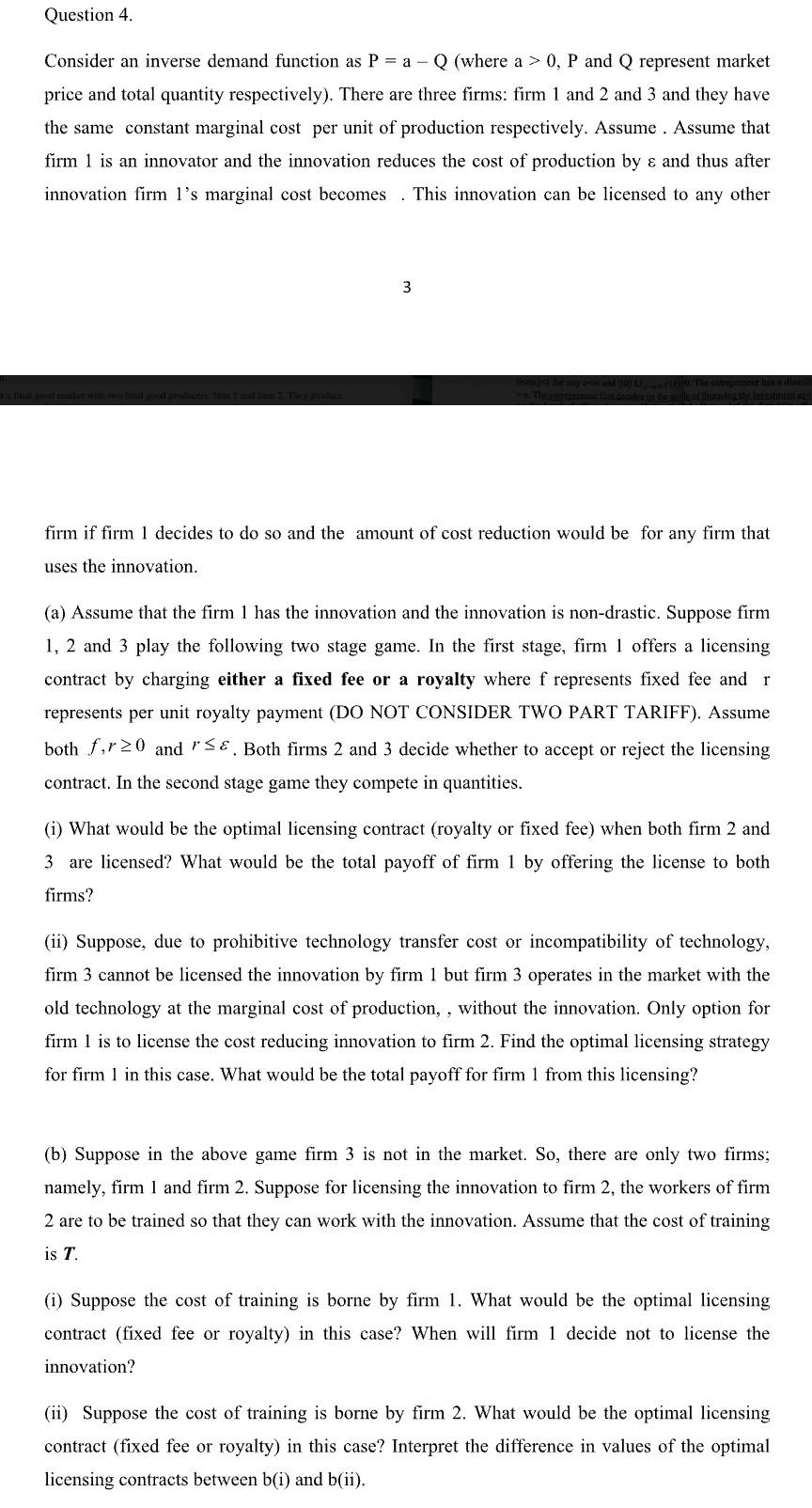
Question 4. Consider an inverse demand function as P=aQ (where a>0,P and Q represent market price and total quantity respectively). There are three firms: firm 1 and 2 and 3 and they have the same constant marginal cost per unit of production respectively. Assume. Assume that firm 1 is an innovator and the innovation reduces the cost of production by and thus after innovation firm l's marginal cost becomes. This innovation can be licensed to any other 3 firm if firm 1 decides to do so and the amount of cost reduction would be for any firm that uses the innovation. (a) Assume that the firm 1 has the innovation and the innovation is non-drastic. Suppose firm 1,2 and 3 play the following two stage game. In the first stage, firm 1 offers a licensing contract by charging either a fixed fee or a royalty where f represents fixed fee and r represents per unit royalty payment (DO NOT CONSIDER TWO PART TARIFF). Assume both f,r0 and r. Both firms 2 and 3 decide whether to accept or reject the licensing contract. In the second stage game they compete in quantities. (i) What would be the optimal licensing contract (royalty or fixed fee) when both firm 2 and 3 are licensed? What would be the total payoff of firm 1 by offering the license to both firms? (ii) Suppose, due to prohibitive technology transfer cost or incompatibility of technology, firm 3 cannot be licensed the innovation by firm 1 but firm 3 operates in the market with the old technology at the marginal cost of production, , without the innovation. Only option for firm 1 is to license the cost reducing innovation to firm 2. Find the optimal licensing strategy for firm 1 in this case. What would be the total payoff for firm 1 from this licensing? (b) Suppose in the above game firm 3 is not in the market. So, there are only two firms; namely, firm 1 and firm 2. Suppose for licensing the innovation to firm 2, the workers of firm 2 are to be trained so that they can work with the innovation. Assume that the cost of training is T. (i) Suppose the cost of training is borne by firm 1. What would be the optimal licensing contract (fixed fee or royalty) in this case? When will firm 1 decide not to license the innovation? (ii) Suppose the cost of training is borne by firm 2. What would be the optimal licensing contract (fixed fee or royalty) in this case? Interpret the difference in values of the optimal licensing contracts between b(i) and b (ii)
Step by Step Solution
There are 3 Steps involved in it

Get step-by-step solutions from verified subject matter experts
 Study Help