



Question: Question 4 Consider the sketch below and answer the following questions. Hint: start by determining the resultant of the two forces with known magnitude and
Question
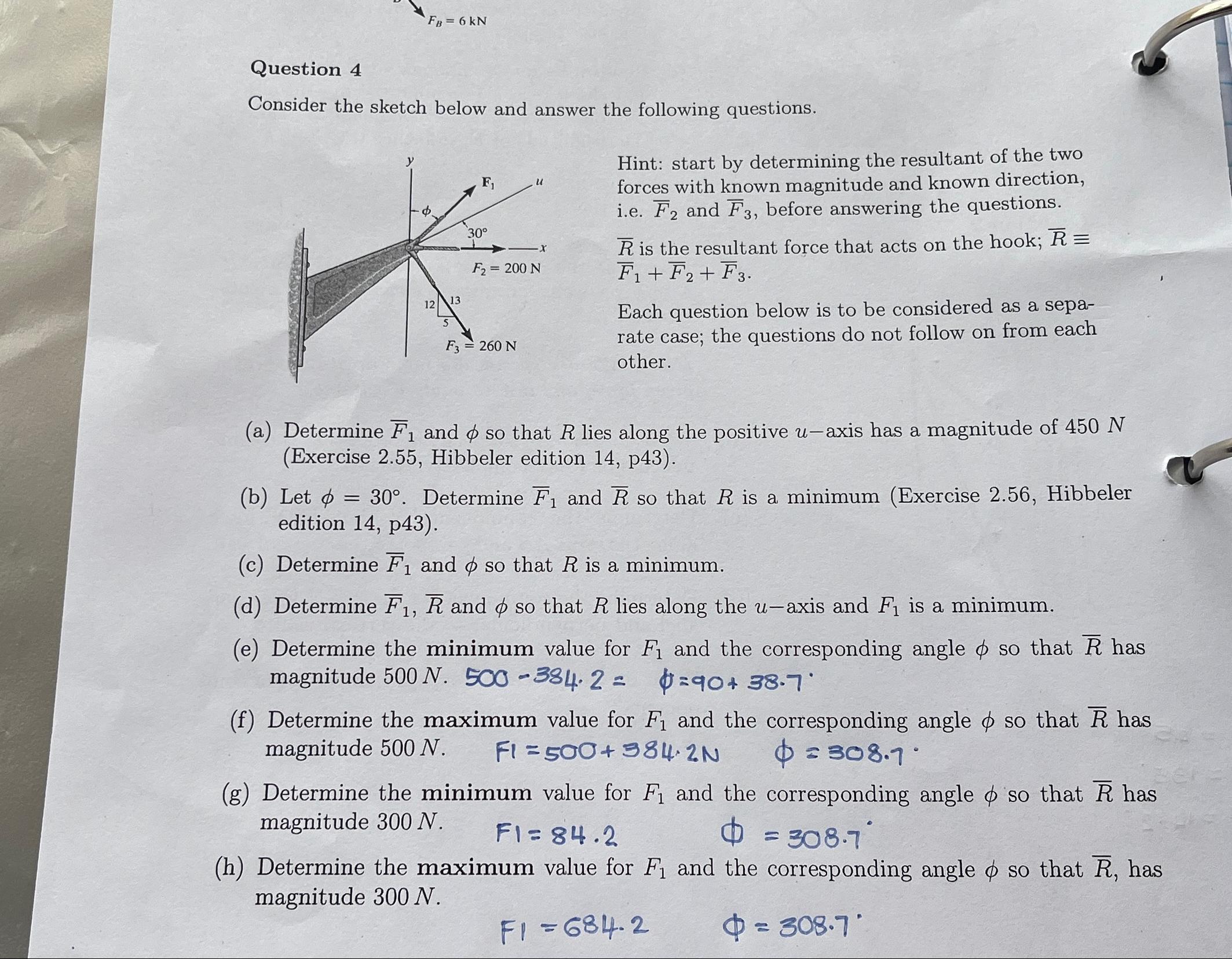
Consider the sketch below and answer the following questions.
Hint: start by determining the resultant of the two forces with known magnitude and known direction, ie and before answering the questions.
is the resultant force that acts on the hook;
Each question below is to be considered as a separate case; the questions do not follow on from each other.
a Determine and so that lies along the positive axis has a magnitude of Exercise Hibbeler edition p
b Let Determine and so that is a minimum Exercise Hibbeler edition p
c Determine and so that is a minimum.
d Determine and so that lies along the axis and is a minimum.
e Determine the minimum value for and the corresponding angle so that has magnitude
f Determine the maximum value for and the corresponding angle so that has magnitude
g Determine the minimum value for and the corresponding angle so that has magnitude
h Determine the maximum value for and the corresponding angle so that has magnitude
Step by Step Solution
There are 3 Steps involved in it
1 Expert Approved Answer
Step: 1 Unlock

Question Has Been Solved by an Expert!
Get step-by-step solutions from verified subject matter experts
Step: 2 Unlock
Step: 3 Unlock