







Question: Question 4: Differences in competition (10 points) Below you find a table with estimation results from a paper by Niederle and Vesterlund (2007, Do women
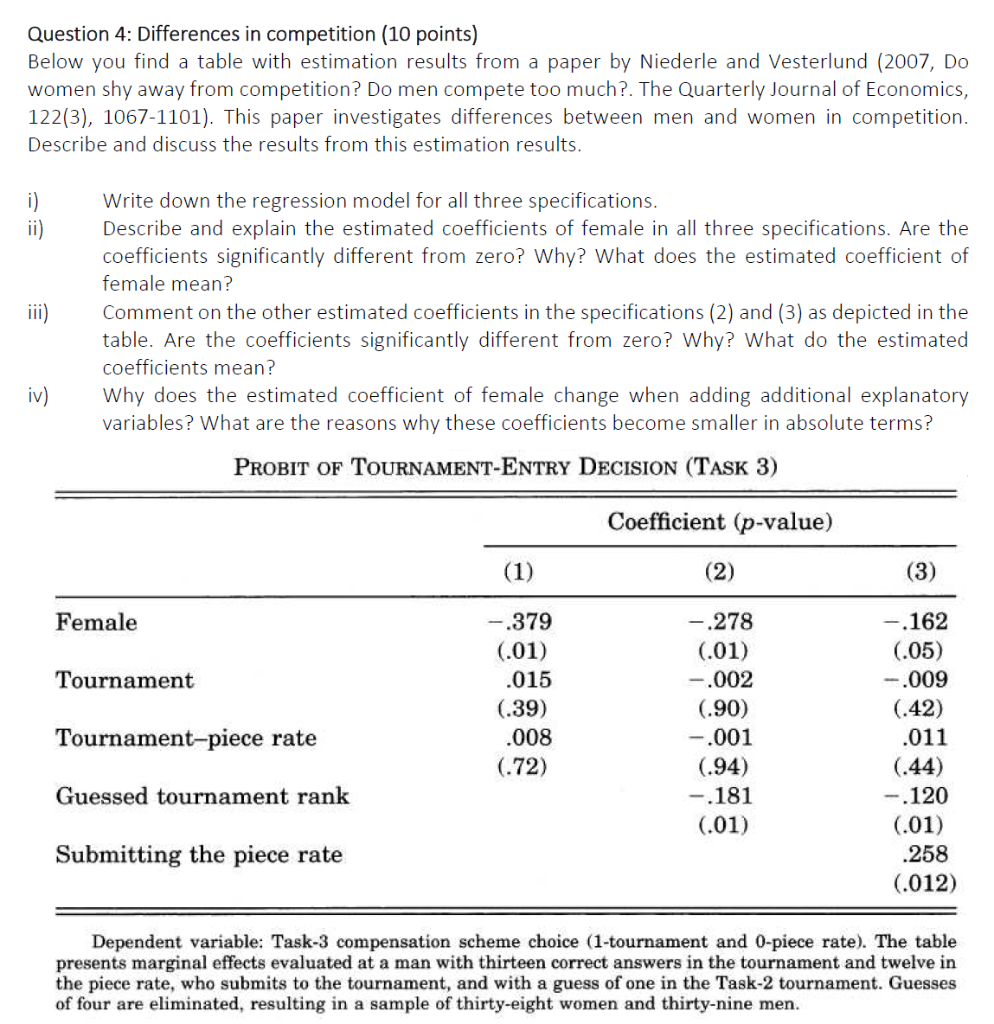
Question 4: Differences in competition (10 points) Below you find a table with estimation results from a paper by Niederle and Vesterlund (2007, Do women shy away from competition? Do men compete too much? The Quarterly Journal of Economics, 122(3), 1067-1101). This paper investigates differences between men and women in competition. Describe and discuss the results from this estimation results. i) ii) Write down the regression model for all three specifications. Describe and explain the estimated coefficients of female in all three specifications. Are the coefficients significantly different from zero? Why? What does the estimated coefficient of female mean? Comment on the other estimated coefficients in the specifications (2) and (3) as depicted in the table. Are the coefficients significantly different from zero? Why? What do the estimated coefficients mean? Why does the estimated coefficient of female change when adding additional explanatory variables? What are the reasons why these coefficients become smaller in absolute terms? iv) PROBIT OF TOURNAMENT-ENTRY DECISION (TASK 3) Coefficient (p-value) (1) (2) (3) Female Tournament -.379 (.01) .015 (.39) .008 (.72) -.278 (.01) -.002 (.90) -.001 (.94) -.181 (.01) Tournament-piece rate -.162 (.05) -.009 (42) .011 (.44) -.120 (.01) .258 (.012) Guessed tournament rank Submitting the piece rate Dependent variable: Task-3 compensation scheme choice (1-tournament and 0-piece rate). The table presents marginal effects evaluated at a man with thirteen correct answers in the tournament and twelve in the piece rate, who submits to the tournament, and with a guess of one in the Task-2 tournament. Guesses of four are eliminated, resulting in a sample of thirty-eight women and thirty-nine men. Question 4: Differences in competition (10 points) Below you find a table with estimation results from a paper by Niederle and Vesterlund (2007, Do women shy away from competition? Do men compete too much? The Quarterly Journal of Economics, 122(3), 1067-1101). This paper investigates differences between men and women in competition. Describe and discuss the results from this estimation results. i) ii) Write down the regression model for all three specifications. Describe and explain the estimated coefficients of female in all three specifications. Are the coefficients significantly different from zero? Why? What does the estimated coefficient of female mean? Comment on the other estimated coefficients in the specifications (2) and (3) as depicted in the table. Are the coefficients significantly different from zero? Why? What do the estimated coefficients mean? Why does the estimated coefficient of female change when adding additional explanatory variables? What are the reasons why these coefficients become smaller in absolute terms? iv) PROBIT OF TOURNAMENT-ENTRY DECISION (TASK 3) Coefficient (p-value) (1) (2) (3) Female Tournament -.379 (.01) .015 (.39) .008 (.72) -.278 (.01) -.002 (.90) -.001 (.94) -.181 (.01) Tournament-piece rate -.162 (.05) -.009 (42) .011 (.44) -.120 (.01) .258 (.012) Guessed tournament rank Submitting the piece rate Dependent variable: Task-3 compensation scheme choice (1-tournament and 0-piece rate). The table presents marginal effects evaluated at a man with thirteen correct answers in the tournament and twelve in the piece rate, who submits to the tournament, and with a guess of one in the Task-2 tournament. Guesses of four are eliminated, resulting in a sample of thirty-eight women and thirty-nine men
Step by Step Solution
There are 3 Steps involved in it

Get step-by-step solutions from verified subject matter experts
 Study Help