







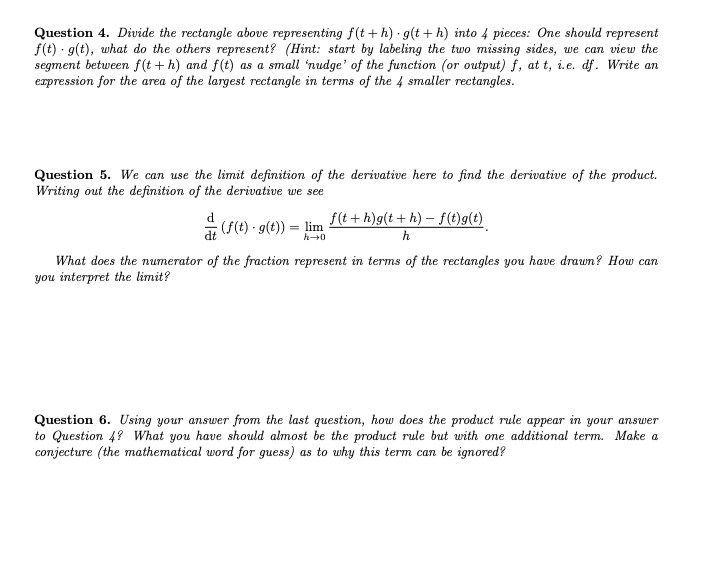
Question: Question 4 . Divide the rectangle above representing f ( t + h ) * g ( t + h ) into 4 pieces: One
Question Divide the rectangle above representing into pieces: One should represent
and a small 'nudge' the function output Write
expression for the area the largest rectangle terms the smaller rectangles.
Question can use the definition the derivative here find the derivative the product.
Writing out the definition the derivative see
What does the numerator the fraction represent terms the rectangles you have drawn? How can
you interpret the
Question Using your answer from the last question, how does the product rule appear your answer
Question What you have should almost the product rule but with one additional term. Make
conjecture mathematical word for guess why this term can ignored?
Step by Step Solution
There are 3 Steps involved in it
1 Expert Approved Answer
Step: 1 Unlock

Question Has Been Solved by an Expert!
Get step-by-step solutions from verified subject matter experts
Step: 2 Unlock
Step: 3 Unlock
 Study Help