







Question: Question 4 Indicate whether the following statements are TRUE (T) or FALSE (F). No points will be deducted for the first wrong answer. 1. Lower
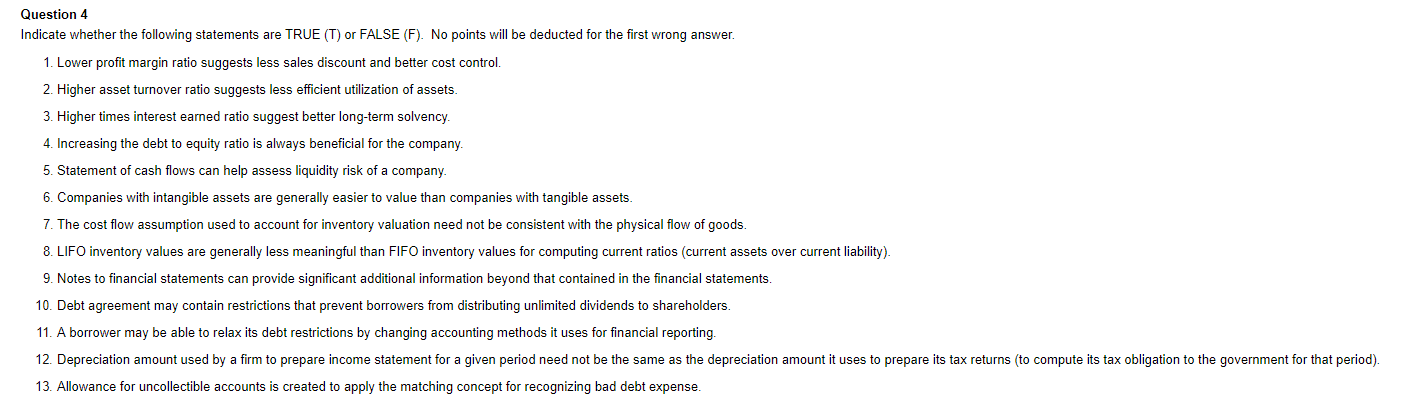
Question 4 Indicate whether the following statements are TRUE (T) or FALSE (F). No points will be deducted for the first wrong answer. 1. Lower profit margin ratio suggests less sales discount and better cost control. 2. Higher asset turnover ratio suggests less efficient utilization of assets. 3. Higher times interest earned ratio suggest better long-term solvency. 4. Increasing the debt to equity ratio is always beneficial for the company. 5. Statement of cash flows can help assess liquidity risk of a company 6. Companies with intangible assets are generally easier to value than companies with tangible assets. 7. The cost flow assumption used to account for inventory valuation need not be consistent with the physical flow of goods. 8. LIFO inventory values are generally less meaningful than FIFO inventory values for computing current ratios (current assets over current liability). 9. Notes to financial statements can provide significant additional information beyond that contained in the financial statements. 10. Debt agreement may contain restrictions that prevent borrowers from distributing unlimited dividends to shareholders. 11. A borrower may be able to relax its debt restrictions by changing accounting methods it uses for financial reporting. 12. Depreciation amount used by a firm to prepare income statement for a given period need not be the same as the depreciation amount it uses to prepare its tax returns to compute its tax obligation to the government for that period). 13. Allowance for uncollectible accounts is created to apply the matching concept for recognizing bad debt expense. Question 4 Indicate whether the following statements are TRUE (T) or FALSE (F). No points will be deducted for the first wrong answer. 1. Lower profit margin ratio suggests less sales discount and better cost control. 2. Higher asset turnover ratio suggests less efficient utilization of assets. 3. Higher times interest earned ratio suggest better long-term solvency. 4. Increasing the debt to equity ratio is always beneficial for the company. 5. Statement of cash flows can help assess liquidity risk of a company 6. Companies with intangible assets are generally easier to value than companies with tangible assets. 7. The cost flow assumption used to account for inventory valuation need not be consistent with the physical flow of goods. 8. LIFO inventory values are generally less meaningful than FIFO inventory values for computing current ratios (current assets over current liability). 9. Notes to financial statements can provide significant additional information beyond that contained in the financial statements. 10. Debt agreement may contain restrictions that prevent borrowers from distributing unlimited dividends to shareholders. 11. A borrower may be able to relax its debt restrictions by changing accounting methods it uses for financial reporting. 12. Depreciation amount used by a firm to prepare income statement for a given period need not be the same as the depreciation amount it uses to prepare its tax returns to compute its tax obligation to the government for that period). 13. Allowance for uncollectible accounts is created to apply the matching concept for recognizing bad debt expense
Step by Step Solution
There are 3 Steps involved in it

Get step-by-step solutions from verified subject matter experts
 Study Help