







Question: Question 4 is a two part question. Please answer both parts. Thank you! 4. Consider a gambler who at each play of the game has
Question 4 is a two part question. Please answer both parts. Thank you!
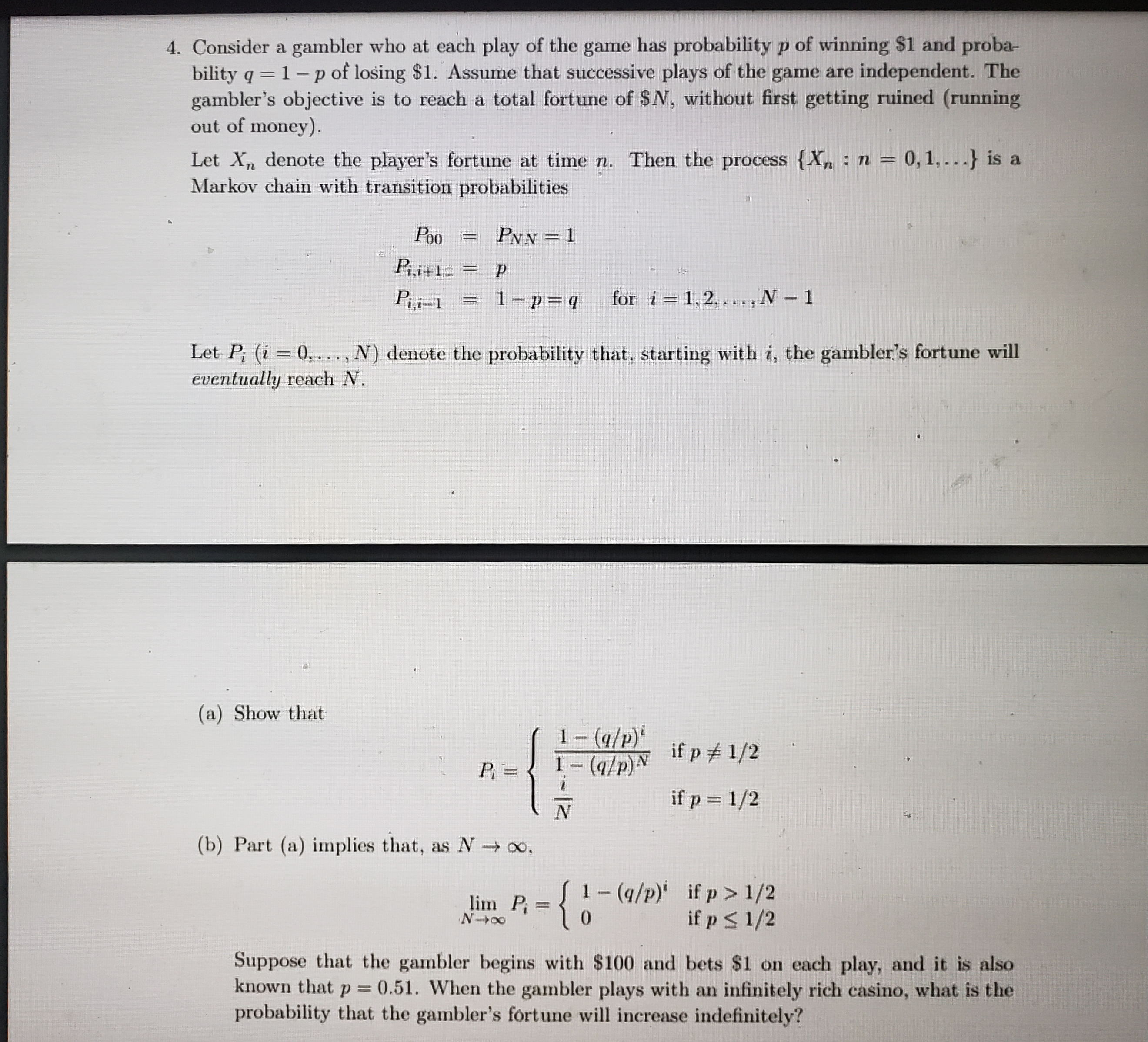
4. Consider a gambler who at each play of the game has probability p of winning $1 and proba- bility q = 1 -p of losing $1. Assume that successive plays of the game are independent. The gambler's objective is to reach a total fortune of $N, without first getting ruined (running out of money). Let Xn denote the player's fortune at time n. Then the process {X, : n = 0, 1, ...} is a Markov chain with transition probabilities Poo = PNN = 1 Puitle = P Pi,i-1 = 1-p=q for i = 1, 2, ..., N - 1 Let P, (i = 0. . .., N) denote the probability that, starting with i, the gambler's fortune will eventually reach N. (a) Show that 1 - (q/p)' if p # 1/2 PI= 1 - (q/p)N N if p = 1/2 (b) Part (a) implies that, as N - co. lim P. = 1 -(9/p)' ifp > 1/2 if p S 1/2 Suppose that the gambler begins with $100 and bets $1 on each play, and it is also known that p = 0.51. When the gambler plays with an infinitely rich casino, what is the probability that the gambler's fortune will increase indefinitely
Step by Step Solution
There are 3 Steps involved in it

Get step-by-step solutions from verified subject matter experts
 Study Help