







Question: Question 4 ( k - means, 4 0 / 1 0 0 ) Using the same terminology adopted in our course, we shall refer to
Question kmeans, Using the same terminology adopted in our course, we shall
refer to the kmeans" algorithm as the algorithm that initializes the centroids randomly,
followed by a "refinement phase" where the clusters are improved further. We shall refer to
kmeans as the algorithm that only selects the centroids, so as to provide some
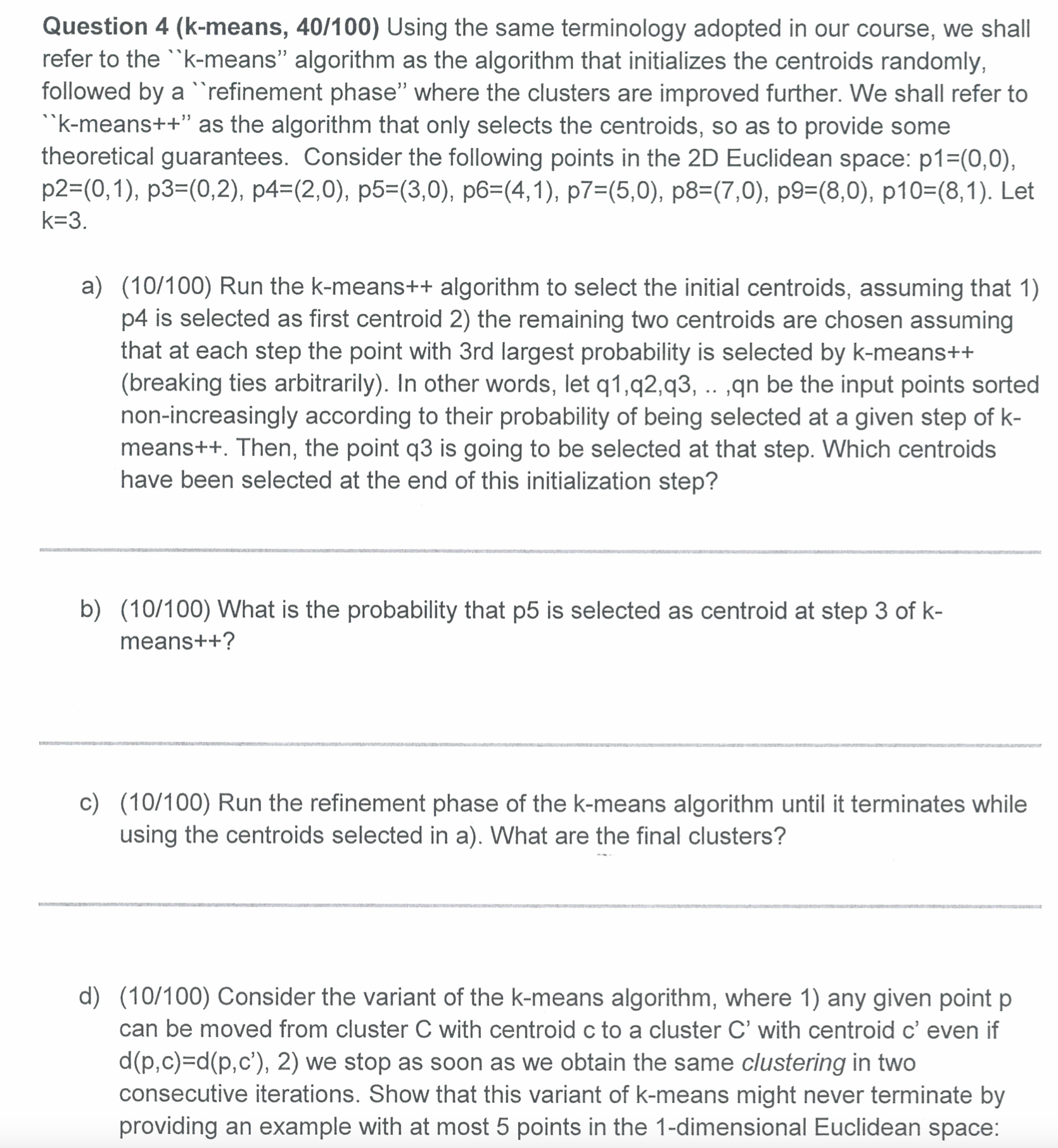
theoretical guarantees. Consider the following points in the Euclidean space:
Let
a Run the kmeans algorithm to select the initial centroids, assuming that
p is selected as first centroid the remaining two centroids are chosen assuming
that at each step the point with rd largest probability is selected by kmeans
breaking ties arbitrarily In other words, let be the input points sorted
nonincreasingly according to their probability of being selected at a given step of
means Then, the point q is going to be selected at that step. Which centroids
have been selected at the end of this initialization step?
b What is the probability that p is selected as centroid at step of
means
c Run the refinement phase of the kmeans algorithm until it terminates while
using the centroids selected in a What are the final clusters?
d Consider the variant of the kmeans algorithm, where any given point
can be moved from cluster with centroid to a cluster with centroid c even if
: we stop as soon as we obtain the same clustering in two
consecutive iterations. Show that this variant of kmeans might never terminate by
providing an example with at most points in the dimensional Euclidean space:Question kmeans, Using the same terminology adopted in our course, we shall
refer to the kmeans" algorithm as the algorithm that initializes the centroids randomly,
followed by a "refinement phase" where the clusters are improved further. We shall refer to
kmeans as the algorithm that only selects the centroids, so as to provide some
theoretical guarantees. Consider the following points in the Euclidean space:
Let
a Run the kmeans algorithm to select the initial centroids, assuming that
p is selected as first centroid the remaining two centroids are chosen assuming
that at each step the point with rd largest probability is selected by kmeans
breaking ties arbitrarily In other words, let be the input points sorted
nonincreasingly according to their probability of being selected at a given step of
means Then, the point q is going to be selected at that step. Which centroids
have been selected at the end of this initialization step?
b What is the probability that p is selected as centroid at step of
means
c Run the refinement phase of the kmeans algorithm until it terminates while
using the centroids selected in a What are the final clusters?
d Consider the variant of the kmeans algorithm, where any given point
can be moved from cluster with centroid to a cluster with centroid c even if
: we stop as soon as we obtain the same clustering in two
consecutive iterations. Show that this variant of kmeans might never terminate by
providing an example with at most points in the dimensional Euclidean space:
Step by Step Solution
There are 3 Steps involved in it
1 Expert Approved Answer
Step: 1 Unlock

Question Has Been Solved by an Expert!
Get step-by-step solutions from verified subject matter experts
Step: 2 Unlock
Step: 3 Unlock
 Study Help