







Question: Question 4. LE Suppose that an infinitely lived agent faces the following functions in each period: Utility function: Income (or, output): After-tax income allocation: (c)
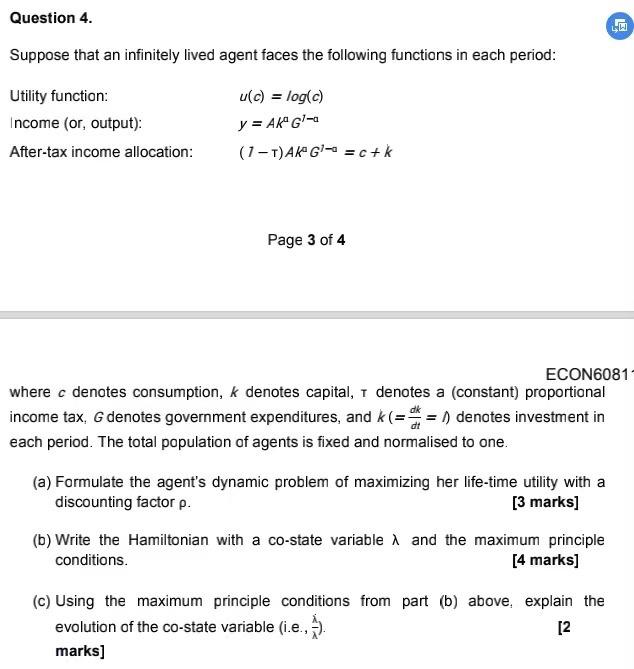
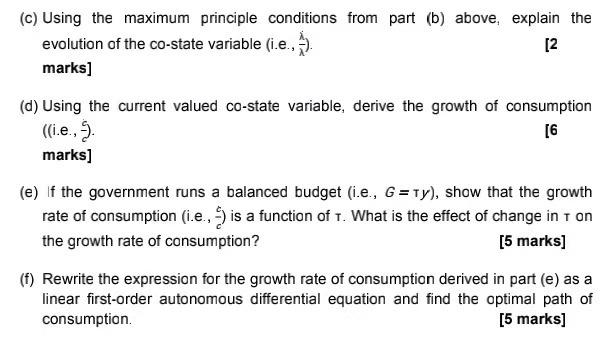
Question 4. LE Suppose that an infinitely lived agent faces the following functions in each period: Utility function: Income (or, output): After-tax income allocation: (c) = log(c) y = AG- (1-T)AK G-4 = c+k Page 3 of 4 ECON6081 where c denotes consumption, k denotes capital, 1 denotes a constant) proportional income tax, G denotes government expenditures, and k (= = 1) denotes investment in each period. The total population of agents is fixed and normalised to one. (a) Formulate the agent's dynamic problem of maximizing her life-time utility with a discounting factor p. [3 marks] (b) Write the Hamiltonian with a co-state variableand the maximum principle conditions. [4 marks] (c) Using the maximum principle conditions from part (b) above, explain the evolution of the co-state variable (i.e., ) [2 marks] (c) Using the maximum principle conditions from part (b) above, explain the evolution of the co-state variable (...) [2 marks] (d) Using the current valued co-state variable, derive the growth of consumption ((i.e., 9. [6 marks] (e) if the government runs a balanced budget (i.e., G =Ty), show that the growth rate of consumption (i.e., S) is a function of 1. What is the effect of change in ton the growth rate of consumption? [5 marks] (1) Rewrite the expression for the growth rate of consumption derived in part (e) as a linear first-order autonomous differential equation and find the optimal path of consumption [5 marks] Question 4. LE Suppose that an infinitely lived agent faces the following functions in each period: Utility function: Income (or, output): After-tax income allocation: (c) = log(c) y = AG- (1-T)AK G-4 = c+k Page 3 of 4 ECON6081 where c denotes consumption, k denotes capital, 1 denotes a constant) proportional income tax, G denotes government expenditures, and k (= = 1) denotes investment in each period. The total population of agents is fixed and normalised to one. (a) Formulate the agent's dynamic problem of maximizing her life-time utility with a discounting factor p. [3 marks] (b) Write the Hamiltonian with a co-state variableand the maximum principle conditions. [4 marks] (c) Using the maximum principle conditions from part (b) above, explain the evolution of the co-state variable (i.e., ) [2 marks] (c) Using the maximum principle conditions from part (b) above, explain the evolution of the co-state variable (...) [2 marks] (d) Using the current valued co-state variable, derive the growth of consumption ((i.e., 9. [6 marks] (e) if the government runs a balanced budget (i.e., G =Ty), show that the growth rate of consumption (i.e., S) is a function of 1. What is the effect of change in ton the growth rate of consumption? [5 marks] (1) Rewrite the expression for the growth rate of consumption derived in part (e) as a linear first-order autonomous differential equation and find the optimal path of consumption [5 marks]
Step by Step Solution
There are 3 Steps involved in it

Get step-by-step solutions from verified subject matter experts
 Study Help